
Introduction
You’ve probably heard both terms — yoga and yoga therapy. At first, they sound like the same thing. But they’re not. Here we help you to understand the difference between yoga and yoga therapy
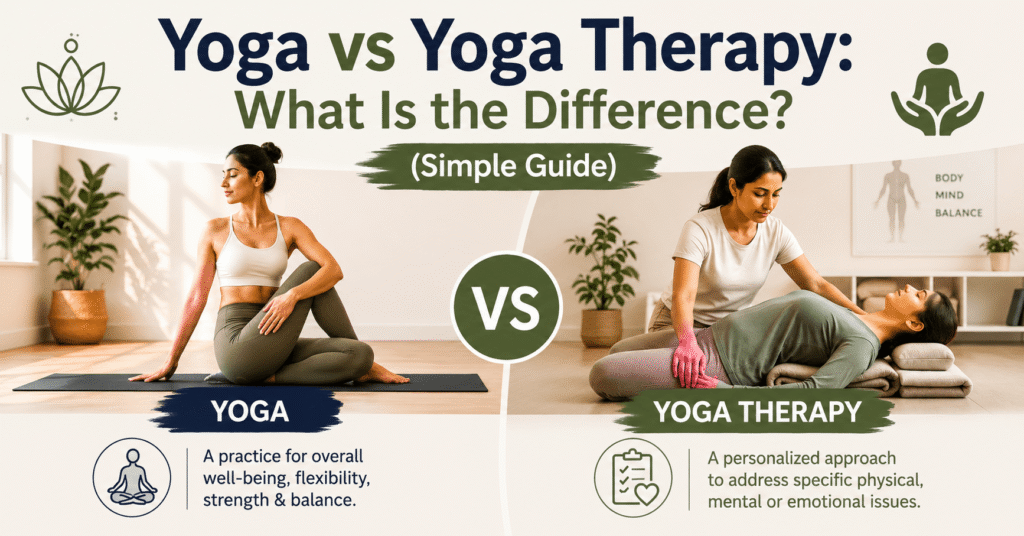
One is a group practice you do to stay fit and feel good. The other is a personalised healing process designed for your specific health condition.
If you’ve ever wondered, “Is yoga enough for my back pain?” or “Do I need a yoga therapist instead of a yoga teacher?” — this article is for you.
Let’s break it down clearly.
What Is Yoga?
Yoga is a mind-body practice that originated in India over 5,000 years ago. It combines physical postures (asanas), breathing exercises (pranayama), and meditation to support overall physical and mental health.
Today, yoga is practised by millions of people around the world — in studios, parks, homes, and online.
What happens in a yoga class?
- A trained yoga teacher leads a group of students
- Everyone follows the same sequence of poses
- Classes may focus on strength, flexibility, relaxation, or spirituality
- Common styles include Hatha, Vinyasa, Yin, Ashtanga, Restorative, and more
Who is yoga for?
Yoga is for everyone — beginners, athletes, older adults, and children. You don’t need a health condition to practice yoga. Most people do yoga to:
- Reduce stress and anxiety
- Improve flexibility and strength
- Sleep better
- Stay fit
- Feel calmer and more focused
Yoga is a general wellness practice. It’s excellent for prevention and everyday well-being.
What Is Yoga Therapy?
Yoga therapy is a specialised branch of yoga used to address specific physical, mental, or emotional health conditions. It uses the tools of yoga — postures, breathing, relaxation, and meditation — but applies them in a clinical and personalised way.
The International Association of Yoga Therapists (IAYT) defines yoga therapy as:
“The specific application of yogic tools — postures, breath work, meditation techniques, and more — to address an individual’s physical, mental, and emotional needs.”
What happens in a yoga therapy session?
- It is usually one-on-one (not a group class)
- The therapist takes a detailed health history before starting
- A personalised treatment plan is created based on your specific condition
- The plan is updated as your health improves
- Sessions may include gentle movement, breathwork, relaxation, guided meditation, and sometimes conversation
Who is yoga therapy for?
Yoga therapy is designed for people managing a health condition, such as:
- Chronic back pain or joint problems
- Anxiety, depression, or PTSD
- Diabetes or high blood pressure
- Cancer (as a complementary support)
- Autoimmune conditions
- Recovery from injury
- Long COVID symptoms
- Osteoporosis
Yoga vs Yoga Therapy: Key Differences at a Glance
| Feature | Yoga | Yoga Therapy |
|---|---|---|
| Setting | Group class | One-on-one (usually) |
| Purpose | General wellness | Treating a specific condition |
| Approach | Same for everyone | Personalised to the individual |
| Assessment | No health history taken | Detailed health history required |
| Teacher’s role | Teach yoga techniques | Apply yoga to heal or manage illness |
| Training required | 200-hour teacher training (minimum) | 800–1000+ hours of training |
| Who it’s best for | Anyone wanting to stay healthy | People with a health condition or injury |
The Main Difference: General vs Personalised
The clearest way to understand the difference is this:
- Yoga follows a one-size-fits-all approach. Everyone in the class does the same poses.
- Yoga therapy follows a tailored approach. Everything is designed specifically for your body, your condition, and your goals.
Think of it this way:
A yoga class is like going to the gym. Anyone can join and benefit from it.
Yoga therapy is like seeing a physiotherapist. The exercises are designed specifically for you — not for the whole group.
The Role of Training: Yoga Teacher vs Yoga Therapist
This is an important distinction that many people overlook.
Yoga Teacher
A yoga teacher typically completes a 200-hour teacher training course. They learn how to lead classes safely and teach different yoga styles. Their focus is on teaching techniques to a group.
Yoga Therapist
A yoga therapist has far more advanced training. According to the IAYT, a certified yoga therapist must complete a minimum of 800 recognised hours of training (many complete 1,000 hours or more). This includes:
- Understanding of anatomy, physiology, and medical terminology
- Psychological and mental health knowledge
- Real-life case studies (at least 156 hours)
- Working alongside other healthcare professionals
- A final dissertation or research project
This takes 1 year to complete.
A yoga therapist isn’t just a yoga teacher — they are a trained healthcare professional who uses yoga as a therapeutic tool.
Can Yoga Be Therapeutic Too?
Yes — and this is where people often get confused.
Yoga can absolutely be therapeutic. Many people find that regular yoga practice reduces their anxiety, eases their back pain, or helps them manage stress. That’s real and valid.
But there’s a difference between yoga being helpful and yoga therapy treating a condition.
Yoga therapy involves clinical assessment, a structured treatment plan, and ongoing evaluation of progress. It’s not just doing yoga — it’s using yoga as a form of healthcare.
Which One Is Right for You?
Here’s a simple way to decide:
Choose regular yoga if:
- You’re generally healthy
- You want to improve fitness, flexibility, or reduce everyday stress
- You enjoy group classes and community
- You’re exploring yoga for the first time
Choose yoga therapy if:
- You have a specific health condition (physical or mental)
- A doctor or healthcare provider has suggested complementary therapy
- You’ve tried group yoga but found it too intense or not right for your body
- You want a personalised, one-on-one approach to healing
You can also do both at the same time. Many people attend group yoga classes while also seeing a yoga therapist for their specific condition.
What Conditions Does Yoga Therapy Help With?
Research and clinical evidence support yoga therapy as a beneficial complementary treatment for many conditions, including:
- Chronic pain – especially back pain, neck pain, and arthritis
- Mental health – anxiety, depression, PTSD, and trauma
- Cardiovascular health – high blood pressure and heart disease recovery
- Metabolic conditions – type 2 diabetes and obesity
- Cancer support – managing side effects of treatment
- Neurological conditions – multiple sclerosis and Parkinson’s disease (as supportive care)
- Respiratory conditions – asthma and COPD
- Women’s health – hormonal imbalance, PCOS, and menopause
A Quick History: How Did Yoga Therapy Begin?
Yoga itself is thousands of years old. But yoga therapy as a formal discipline is relatively modern.
Swami Kuvalyananda, an Indian scholar, is considered one of the founders of yoga therapy. In the 1920s, he began scientifically studying how yoga affects the body and mind. His research opened the door to understanding yoga not just as a spiritual practice, but as a measurable medical tool.
Today, the Yoga Certification Board, Ministry of AYUSH (Government of INDIA) sets global standards for yoga therapy training and certification.
Frequently Asked Questions (FAQs)
Q: Is yoga therapy covered by insurance?
In some countries and regions, yoga therapy may be partially covered as a complementary treatment. Check with your insurance provider or healthcare system for details.
Q: Do I need a doctor’s referral for yoga therapy?
Not always. But if you have a serious health condition, it’s a good idea to speak with your doctor before starting yoga therapy.
Q: Can a yoga teacher also be a yoga therapist?
Yes — some yoga therapists are also qualified yoga teachers. But the roles are distinct. Being a yoga teacher does not automatically make someone a yoga therapist.
Q: How many yoga therapy sessions do I need?
This depends on your condition and goals. Some people see improvement in 4–6 sessions; others benefit from ongoing regular sessions.
Q: Is yoga therapy the same as medical yoga?
The terms are sometimes used interchangeably, though “yoga therapy” is the more widely recognised professional term used by certifying bodies like the YCB, AYUSH & IAYT.
Summary
| Yoga | Yoga Therapy | |
|---|---|---|
| Best for | General health and wellness | Specific health conditions |
| Format | Group classes | Personalised, one-on-one |
| Goal | Overall wellbeing | Healing, managing illness |
| Practitioner | Yoga teacher (200-hour training) | Yoga therapist (800–1000+ hours training) |
Both yoga and yoga therapy are valuable. Yoga keeps you healthy. Yoga therapy helps you heal.
If you’re simply looking to feel better, move more, and manage stress, a regular yoga class is a great place to start.
If you have a specific health condition and want a guided, personalised approach, a certified yoga therapist can help design a programme tailored to your needs.
Looking to explore yoga therapy? Search for a certified yoga therapy program by Yoga Shout on our website-visit now