
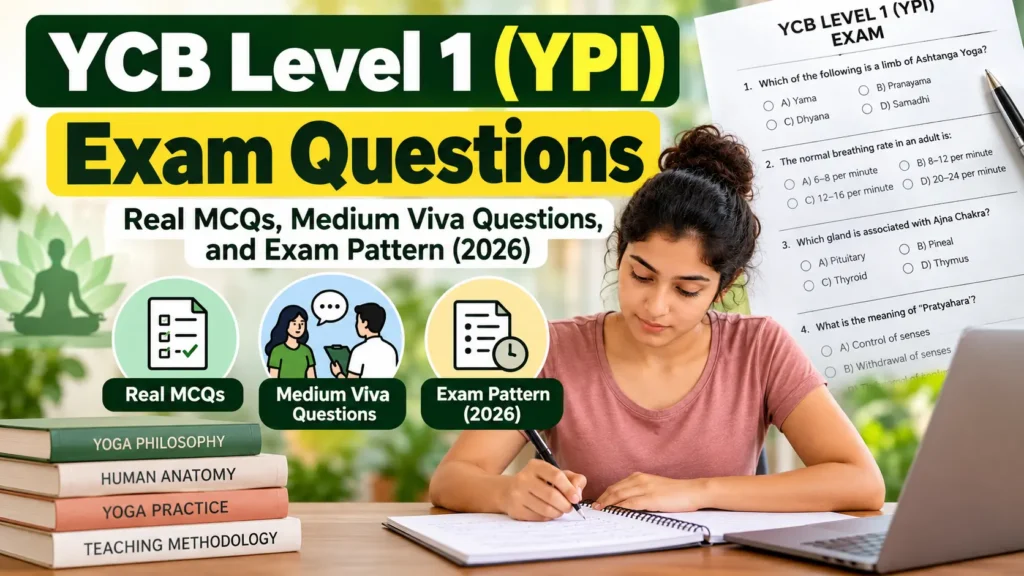
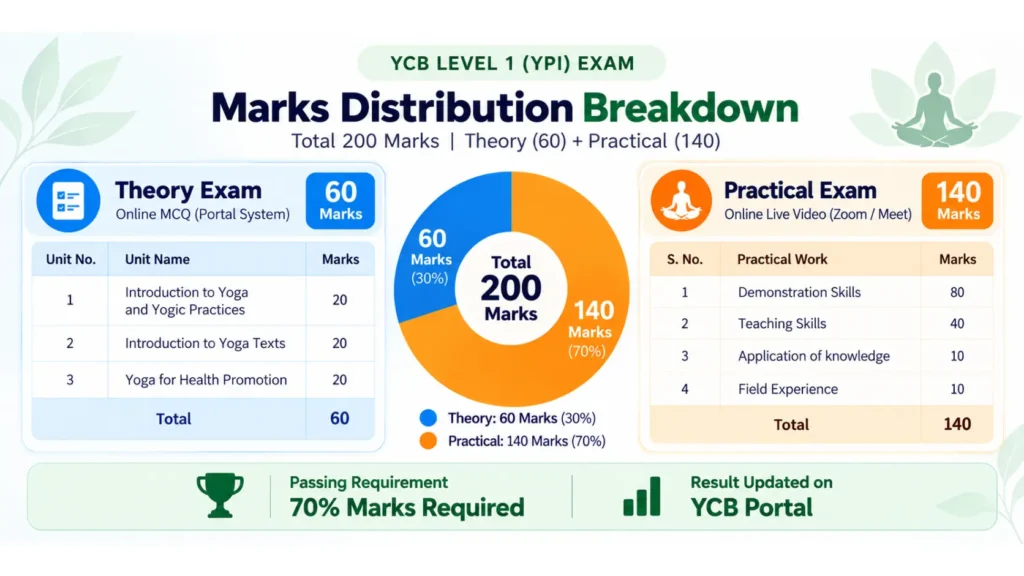
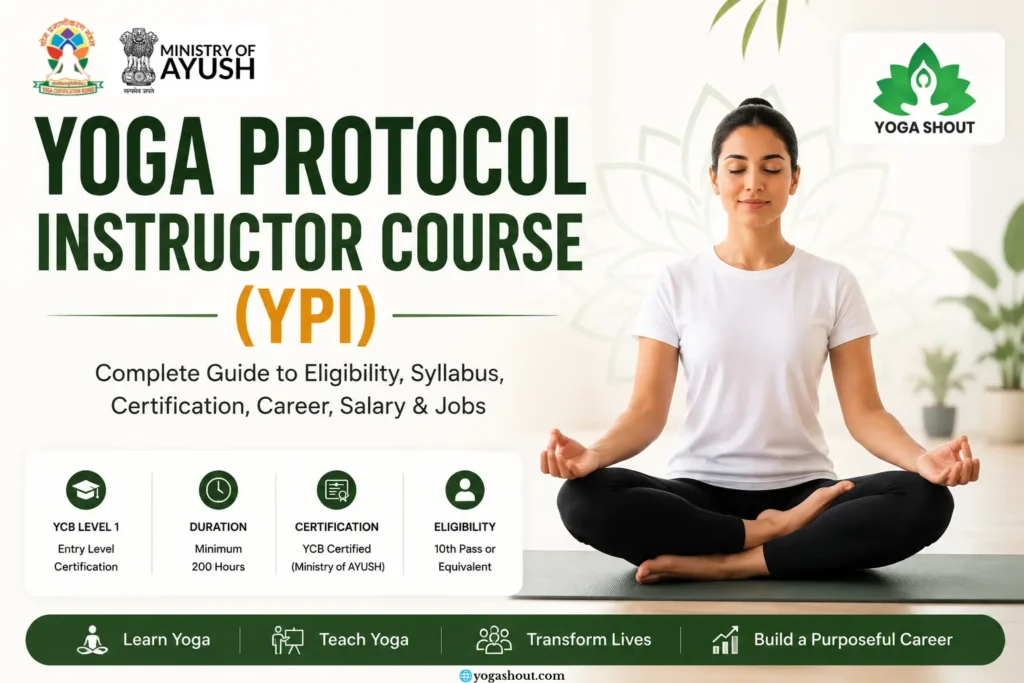
The Yoga Certification Board (YCB) Level 1 certification, officially titled Yoga Protocol Instructor (YPI), is the foundational gateway recognized by the Ministry of AYUSH for teaching standard yoga protocols. The examination carries a total of 200 marks, split between a 60-mark Theory exam and a 140-mark Practical and Viva assessment.
Understanding the exact exam delivery format, solving past multiple-choice questions (MCQs), and mastering practical viva cueing are essential steps to passing on your first attempt.
How the YCB Level 1 Examination is Conducted
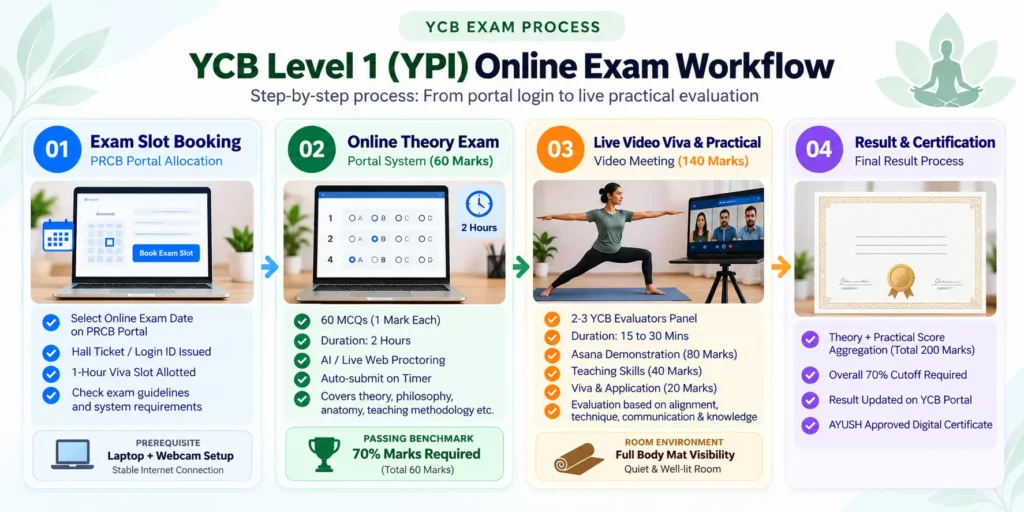
YCB examinations are organized either offline or online through approved Personnel Certification Bodies (PrCBs) or a Yoga Insitute. Today, the vast majority of candidates appear via the Online Examination Mode.
1. The Online Theory Examination
Portal-Based System: Candidates log in to a secure online exam portal provided by the examining agency or authorized institute.
Duration: The theory exam is scheduled for 2 hours.
Question Format: It consists of 60 Multiple Choice Questions (MCQs) carrying 1 mark each.
Remote Proctoring: Webcams and screen monitoring ensure compliance throughout the session.
2. The Online Practical & Viva Examination
Meeting Platform: The practical assessment takes place over video platforms such as Zoom or Google Meet.
Slot Allocation: Candidates are assigned an individual 1-hour time slot window, during which they join the waiting room and are admitted for their turn.
Examiner Panel: The evaluation is conducted by a panel of 2 to 3 YCB-approved examiners.
Test Duration (15–30 Minutes): The actual one-on-one examination lasts between 15 to 30 minutes. During this window, the examiners evaluate three distinct competencies:
- Demonstration Skills (80 Marks): Performing prescribed Asanas, Sukshma Vyayama, and Pranayama practices.
- Teaching Skills (40 Marks): Giving verbal cues, correcting alignment, and demonstrating class management.
- Viva Voice & Application (20 Marks): Answering conceptual questions on classical texts, anatomy, and precautions.
30 Solved YCB Level 1 Exam MCQ Questions
The following 30 questions have been selected from authentic YPI exam papers to highlight critical topics where candidates frequently stumble.
Classical Yoga Texts and Philosophy MCQs / शास्त्रीय योग ग्रंथ और दर्शन MCQs
Q1. According to Hatha Yoga Pradipika, what is Mitahara? / हठ योग प्रदीपिका के अनुसार मिताहार क्या है?
Correct answer / सही उत्तर: D. All of the above / उपरोक्त सभी
Mitahara represents a balanced, agreeable, and consecrated diet where half the stomach is filled with food, one quarter with water, and one quarter left free for the movement of air. / मिताहार संतुलित, अनुकूल और पवित्र आहार को दर्शाता है, जिसमें आधा पेट भोजन से, एक चौथाई जल से भरा जाता है और एक चौथाई वायु के संचरण के लिए खाली छोड़ा जाता है।
Q2. The process of internal purification is termed “GHATA-SHUDDHI” in which text? / आंतरिक शुद्धि की प्रक्रिया को “घट-शुद्धि” किस ग्रंथ में कहा गया है?
Correct answer / सही उत्तर: A. Gheranda Samhita / घेरंड संहिता
Sage Gheranda compares the human body to an unbaked clay pot (Ghata) that must be purified through Shatkarma (Ghata-Shuddhi). / महर्षि घेरंड मानव शरीर की तुलना कच्चे मिट्टी के घड़े (घट) से करते हैं, जिसे षट्कर्म द्वारा शुद्ध करना आवश्यक है (घट-शुद्धि)।
Q3. “Manah Prashamanopayah Yoga Ityabhidhiyate” is the definition of Yoga given by which text? / “मनःप्रशमनोपायः योग इत्यभिधीयते” यह योग की परिभाषा किस ग्रंथ में दी गई है?
Correct answer / सही उत्तर: B. Yoga Vashistha / योग वासिष्ठ
Yoga Vashistha defines Yoga as the practical skillful method to pacify the mind. / योग वासिष्ठ योग को मन को शांत करने की व्यावहारिक और कुशल विधि के रूप में परिभाषित करता है।
Q4. Which of the following schools is NOT classified as an Astika Darshana? / निम्नलिखित में से कौन-सा दर्शन आस्तिक दर्शन के रूप में वर्गीकृत नहीं है?
Correct answer / सही उत्तर: D. Buddhism / बौद्ध धर्म
Buddhism is a Nastika (heterodox) tradition because it does not accept the supreme authority of the Vedas. / बौद्ध धर्म नास्तिक (अवैदिक) परंपरा है, क्योंकि वह वेदों के सर्वोच्च प्रामाण्य को स्वीकार नहीं करता।
Q5. The classical treatise “Hatha Ratnavali” was authored by which master? / शास्त्रीय ग्रंथ “हठ रत्नावली” किस महापुरुष ने लिखा?
Correct answer / सही उत्तर: B. Srinivasa Yogi / श्रीनिवास योगी
Srinivasa Yogi authored Hatha Ratnavali during the 17th century, introducing 84 distinct asanas. / श्रीनिवास योगी ने 17वीं शताब्दी में हठ रत्नावली की रचना की, जिसमें 84 आसनों का वर्णन है।
Q6. “Yuktahara-Viharasya Yukta-Cestasya Karmasu…” — this famous verse is from which text? / “युक्ताहारविहारस्य युक्तचेष्टस्य कर्मसु…” यह प्रसिद्ध श्लोक किस ग्रंथ से है?
Correct answer / सही उत्तर: B. Bhagavad Gita / भगवद्गीता
Bhagavad Gita (Chapter 6, Verse 17) emphasizes temperance in eating, recreation, and sleep to dispel suffering. / भगवद्गीता (अध्याय 6, श्लोक 17) दुःख को दूर करने के लिए आहार, विहार और निद्रा में संयम पर बल देती है।
Q7. Saptanga Yoga (Seven Limbs of Yoga) is documented in which classical text? / सप्तांग योग (योग के सात अंग) किस शास्त्रीय ग्रंथ में वर्णित है?
Correct answer / सही उत्तर: C. Gheranda Samhita / घेरंड संहिता
Gheranda Samhita structures discipline into seven limbs: Shatkarma, Asana, Mudra, Pratyahara, Pranayama, Dhyana, and Samadhi. / घेरंड संहिता साधना को सात अंगों में बाँटती है: षट्कर्म, आसन, मुद्रा, प्रत्याहार, प्राणायाम, ध्यान और समाधि।
Q8. How many Asanas are elaborately described in Swami Swatmarama’s Hatha Yoga Pradipika? / स्वामी स्वात्माराम की हठ योग प्रदीपिका में कितने आसनों का विस्तार से वर्णन है?
Correct answer / सही उत्तर: B. 15
Hatha Yoga Pradipika outlines 15 asanas, emphasizing 4 principal seated meditative poses. / हठ योग प्रदीपिका में 15 आसन बताए गए हैं, जिनमें 4 प्रमुख ध्यानात्मक बैठने के आसनों पर विशेष जोर है।
Q9. According to classical Hatha traditions, regular Pranayama practice makes the physical body what? / शास्त्रीय हठ परंपराओं के अनुसार नियमित प्राणायाम अभ्यास से शरीर कैसा हो जाता है?
Correct answer / सही उत्तर: C. Light (Laghavam) / हल्का (लाघवम्)
In Saptanga Yoga, Asana confers firmness (Dridhata), Mudra gives stability (Sthairyam), and Pranayama brings lightness (Laghavam). / सप्तांग योग में आसन से दृढ़ता, मुद्रा से स्थिरता और प्राणायाम से लघुता (हल्कापन) प्राप्त होती है।
Patanjali Yoga Sutra MCQs / पतंजलि योग सूत्र MCQs
Q10. Which Klesha refers to the innate “fear of death” according to Patanjali? / पतंजलि के अनुसार कौन-सा क्लेश जन्मजात “मृत्यु के भय” को दर्शाता है?
Correct answer / सही उत्तर: C. Abhinivesha / अभिनिवेश
Abhinivesha is the clinging to bodily life and instinctive dread of mortality found even in learned individuals. / अभिनिवेश शारीरिक जीवन से चिपके रहने और मृत्यु के सहज भय को कहते हैं, जो विद्वानों में भी पाया जाता है।
Q11. What are the primary means (Upayas) to still the fluctuations of the mind (Chitta Vrittis)? / चित्त की वृत्तियों के निरोध के प्रमुख उपाय कौन-से हैं?
Correct answer / सही उत्तर: A. Abhyasa and Vairagya / अभ्यास और वैराग्य
Patanjali Yoga Sutra 1.12 establishes: “Abhyasa-vairagyabhyam tannirodhah” (Stillness is achieved through disciplined practice and non-attachment). / पतंजलि योग सूत्र 1.12 कहता है: “अभ्यासवैराग्याभ्यां तन्निरोधः” (अनुशासित अभ्यास और अनासक्ति से चित्त की स्थिरता प्राप्त होती है)।
Q12. How does Maharshi Patanjali define Ishwara in the Yoga Sutras? / महर्षि पतंजलि योग सूत्र में ईश्वर को कैसे परिभाषित करते हैं?
Correct answer / सही उत्तर: D. Purusha Vishesha / पुरुष विशेष
Sutra 1.24 defines Ishwara as a distinct consciousness (Purusha Vishesha) untainted by afflictions, karmic actions, and fruits of action. / सूत्र 1.24 ईश्वर को क्लेश, कर्म और कर्मफल से अछूते एक विशिष्ट चेतन तत्व (पुरुष विशेष) के रूप में परिभाषित करता है।
Q13. Which Guna dominates when the mind is in the restless “Kshipta” state? / जब मन “क्षिप्त” अवस्था में बेचैन होता है, तब कौन-सा गुण प्रबल होता है?
Correct answer / सही उत्तर: B. Rajo Guna / रजो गुण
The Kshipta state is agitated, hyperactive, and driven by passion, typical of predominant Rajas. / क्षिप्त अवस्था उत्तेजित, अति-सक्रिय और आवेग से प्रेरित होती है, जो रजोगुण की प्रधानता का लक्षण है।
Q14. In Patanjali’s Chitta-Prasadana formula, what does “Mudita” mean? / पतंजलि के चित्त-प्रसादन सूत्र में “मुदिता” का क्या अर्थ है?
Correct answer / सही उत्तर: D. Joy towards virtuous deeds / पुण्य कर्मों के प्रति प्रसन्नता
Mudita represents delight and celebration toward righteousness and virtue. / मुदिता का अर्थ है धर्म और पुण्य के प्रति आनंद और उत्सव का भाव।
Q15. Which practice does Patanjali recommend to attenuate (make Tanu) the Kleshas? / पतंजलि क्लेशों को क्षीण (तनु) करने के लिए किस अभ्यास की सलाह देते हैं?
Correct answer / सही उत्तर: A. Kriya Yoga / क्रिया योग
PYS 2.2 states: “Samadhi-bhavanarthah klesha-tanukaranarthashcha” — Kriya Yoga cultivates samadhi and attenuates the kleshas. / योग सूत्र 2.2 कहता है: “समाधिभावनार्थः क्लेशतनूकरणार्थश्च” — क्रिया योग समाधि को पुष्ट करता है और क्लेशों को क्षीण करता है।
Asana, Bandha and Pranayama MCQs / आसन, बंध और प्राणायाम MCQs
Q16. In which of the following asanas is Axial Rotation of the spine involved? / निम्नलिखित में से किस आसन में रीढ़ का अक्षीय घूर्णन (Axial Rotation) होता है?
Correct answer / सही उत्तर: D. Ardhamatsyendrasana / अर्धमत्स्येन्द्रासन
Ardhamatsyendrasana induces axial twisting along the vertical spinal axis, whereas Halasana and Uttanpadasana focus primarily on spinal flexion. / अर्धमत्स्येन्द्रासन में रीढ़ की ऊर्ध्वाधर धुरी पर मरोड़ (ट्विस्ट) होती है, जबकि हलासन और उत्तानपादासन में मुख्यतः रीढ़ का आगे की ओर झुकाव (फ्लेक्सन) होता है।
Q17. Which bandha helps reduce fat around the waistline and tones the abdominal organs? / कौन-सा बंध कमर के आसपास की चर्बी घटाने और पेट के अंगों को टोन करने में सहायक है?
Correct answer / सही उत्तर: B. Uddiyana Bandha / उड्डीयान बंध
The upward and inward lock of the abdominal wall in Uddiyana Bandha stimulates digestion and tones abdominal viscera. / उड्डीयान बंध में उदर की दीवार को ऊपर और भीतर की ओर खींचने से पाचन उत्तेजित होता है और पेट के अंग टोन होते हैं।
Q18. Sarvangasana should immediately be followed by which counter-asana? / सर्वांगासन के तुरंत बाद कौन-सा प्रतिआसन (counter-asana) करना चाहिए?
Correct answer / सही उत्तर: D. Matsyasana / मत्स्यासन
Matsyasana extends the cervical and thoracic spine backward, releasing anterior throat pressure created during the chin-lock in Sarvangasana. / मत्स्यासन में ग्रीवा और वक्ष की रीढ़ पीछे की ओर फैलती है, जिससे सर्वांगासन में ठोड़ी के बंध (चिन-लॉक) से गले के आगे बना दबाव मुक्त होता है।
Q19. Which pranayama practice should be avoided if someone is suffering from high Pitta or acidity? / यदि किसी को उच्च पित्त या अम्लता हो तो कौन-सा प्राणायाम नहीं करना चाहिए?
Correct answer / सही उत्तर: C. Suryabhedana / सूर्यभेदन
Suryabhedana stimulates the Pingala nadi and generates systemic heat, which exacerbates acid reflux and Pitta disorders. / सूर्यभेदन पिंगला नाड़ी को उत्तेजित करके शरीर में ऊष्मा उत्पन्न करता है, जिससे एसिड रिफ्लक्स और पित्त संबंधी विकार बढ़ते हैं।
Q20. Which pranayama should NOT be practiced during severe winter conditions? / अत्यधिक सर्दी के मौसम में कौन-सा प्राणायाम नहीं करना चाहिए?
Correct answer / सही उत्तर: C. Sitkari / सीत्कारी
Sitkari and Sheetali draw cool air across the tongue, lowering internal body temperature and increasing phlegm during cold weather. / सीत्कारी और शीतली में जीभ के ऊपर से ठंडी हवा खींची जाती है, जिससे शरीर का आंतरिक तापमान घटता है और ठंड में कफ बढ़ता है।
Q21. Which asana can safely be performed by pregnant women under the standard protocol? / मानक प्रोटोकॉल के अनुसार गर्भवती महिलाएं कौन-सा आसन सुरक्षित रूप से कर सकती हैं?
Correct answer / सही उत्तर: D. Bhadrasana / भद्रासन
Bhadrasana gently opens the pelvic floor and supports spine alignment without placing pressure on the abdominal cavity. / भद्रासन श्रोणि-तल को धीरे से खोलता है और उदर गुहा पर दबाव डाले बिना रीढ़ के संरेखण को सहारा देता है।
Q22. Which practice is also referred to as Nadi Shodhana Kriya? / किस अभ्यास को नाड़ी शोधन क्रिया भी कहा जाता है?
Correct answer / सही उत्तर: C. Anulom-Vilom / अनुलोम-विलोम
Alternate nostril breathing cleanses the subtle energy channels (Ida and Pingala nadis). / वैकल्पिक नासिका श्वास (अनुलोम-विलोम) सूक्ष्म ऊर्जा नाड़ियों (इड़ा और पिंगला) को शुद्ध करती है।
Q23. In Pranayama terminology, what is the retention of breath called? / प्राणायाम की शब्दावली में श्वास को रोकने की क्रिया क्या कहलाती है?
Correct answer / सही उत्तर: C. Kumbhaka / कुंभक
Puraka is inhalation, Rechaka is exhalation, and Kumbhaka represents breath retention. / पूरक श्वास भीतर लेना है, रेचक श्वास बाहर छोड़ना है और कुंभक श्वास को रोकना है।
Human Anatomy and Physiology MCQs / मानव शरीर रचना और शरीर क्रिया विज्ञान MCQs
Q24. Cardiac and smooth muscles in the human body are controlled by which system? / मानव शरीर में हृदय और चिकनी पेशियों को कौन-सा तंत्र नियंत्रित करता है?
Correct answer / सही उत्तर: C. Autonomic Nervous System (ANS) / स्वायत्त तंत्रिका तंत्र (ANS)
Involuntary internal muscular activity is governed automatically by sympathetic and parasympathetic divisions of the ANS. / आंतरिक अनैच्छिक पेशीय गतिविधि ANS के सहानुभूति और परानुकंपी विभागों द्वारा स्वतः नियंत्रित होती है।
Q25. Which two systems are principally involved in the overall control and organization of the body? / शरीर के समग्र नियंत्रण और संगठन में मुख्य रूप से कौन-से दो तंत्र शामिल हैं?
Correct answer / सही उत्तर: C. Nervous and Endocrine / तंत्रिका और अंतःस्रावी
The neuro-endocrine axis coordinates systemic functions through electrical impulses and hormonal messengers. / न्यूरो-एंडोक्राइन तंत्र विद्युत आवेगों और हार्मोन के संदेशवाहकों द्वारा शरीर के कार्यों का समन्वय करता है।
Q26. In Western anatomy, the Swadhisthana Chakra corresponds to which plexus? / पश्चिमी शरीर रचना में स्वाधिष्ठान चक्र किस प्लेक्सस (तंत्रिका जाल) के अनुरूप है?
Correct answer / सही उत्तर: C. The Sacral Plexus / सैक्रल प्लेक्सस
Swadhisthana chakra is positioned in the lower pelvic and sacral region, corresponding physiologically to the sacral plexus. / स्वाधिष्ठान चक्र निचले श्रोणि और त्रिक क्षेत्र में स्थित है, जो शारीरिक रूप से सैक्रल प्लेक्सस के अनुरूप है।
Q27. How many functional organ systems are categorized in basic human physiology? / बुनियादी मानव शरीर क्रिया विज्ञान में कितने कार्यात्मक अंग तंत्र माने जाते हैं?
Correct answer / सही उत्तर: A. 9
Basic curriculum models group human physiology into 9 principal anatomical systems. / बुनियादी पाठ्यक्रम मॉडल मानव शरीर क्रिया विज्ञान को 9 प्रमुख शारीरिक तंत्रों में बाँटते हैं।
Yoga Teaching and Practice MCQs / योग शिक्षण और अभ्यास MCQs
Q28. Which is considered the oldest formal teaching method in classical traditions? / शास्त्रीय परंपराओं में सबसे प्राचीन औपचारिक शिक्षण विधि कौन-सी मानी जाती है?
Correct answer / सही उत्तर: A. Lecture Method / व्याख्यान विधि
Oral discourse (Shravana) via the Lecture Method represents the earliest structured form of pedagogical delivery. / व्याख्यान विधि द्वारा मौखिक प्रवचन (श्रवण) शिक्षण की सबसे प्रारंभिक संरचित पद्धति है।
Q29. A standard Yoga practice session should ideally begin with which activity? / एक मानक योग अभ्यास सत्र की शुरुआत आदर्श रूप से किस गतिविधि से होनी चाहिए?
Correct answer / सही उत्तर: C. Prayer / प्रार्थना
The AYUSH Common Yoga Protocol initiates sessions with an invocatory prayer to establish focused, sattvic awareness. / आयुष कॉमन योग प्रोटोकॉल सत्र की शुरुआत प्रार्थना से करता है, जिससे केंद्रित और सात्विक जागरूकता स्थापित होती है।
Q30. A practitioner who has just been initiated into the study of Yoga is termed what? / योग के अध्ययन में अभी-अभी दीक्षित हुआ साधक क्या कहलाता है?
Correct answer / सही उत्तर: C. Adhama Adhikari / अधम अधिकारी
Classical pedagogy classifies aspirants into three tiers: Adhama (beginner/initiate), Madhyama (intermediate), and Uttama (advanced). / शास्त्रीय शिक्षा पद्धति साधकों को तीन स्तरों में बाँटती है: अधम (प्रारंभिक/नवदीक्षित), मध्यम (मध्यवर्ती) और उत्तम (उन्नत)।
YCB Level 1 Exam Viva Questions (With Model Answers)
1. How do you instruct and correct a student hyperextending their knees in Tadasana?
- Examiner Focus: Alignment principles and verbal cueing.
- Model Answer:“Hyperextension locks the knee joint and stresses the posterior ligaments. I instruct the student to bring a micro-bend into both knees, ground firmly through all four corners of the feet, and actively engage the quadriceps to lift the kneecaps without forcing the knees backward.”
2. Why are Sheetali and Bhramari pranayamas taught without Kumbhaka in the YPI protocol?
- Examiner Focus: Understanding scope and safety standards for Level 1 instructors.
- Model Answer:“The YPI certification qualifies teachers to instruct broad public groups, beginners, and park communities. Breath retention (Kumbhaka) elevates blood pressure and intra-thoracic pressure, posing risks for hypertensive or cardiac students. Consequently, the Level 1 protocol focuses purely on smooth Puraka and Rechaka.”
3. What is the fundamental operational difference between Sukshma Vyayama and Sthula Vyayama?
- Examiner Focus: Movement classification per classical teachings.
- Model Answer:“Sukshma Vyayama targets micro-circulation and isolated joints, muscles, and nerve plexuses through micro-movements (such as Griva or Kati Shakti Vikasaka). Sthula Vyayama involves macro-movements that build cardiovascular endurance, lung ventilation, and full-body vitality (such as Sarvanga Pushti and Hrid Gati).”
4. What mandatory contraindications must you announce prior to demonstrating Ardha Chakrasana?
- Examiner Focus: Student safety and screening.
- Model Answer:“Before cueing Ardha Chakrasana, I state that students suffering from severe dizziness, vertigo, unmanaged hypertension, or acute cervical and lumbar disc herniations should refrain from backward bending or practice with a chair support.”
5. What role does Sectional Breathing (Vibhagiya Pranayama) play before full Yogic Breathing?
- Examiner Focus: Preparatory breathing mechanics.
- Model Answer:“Sectional breathing isolates and strengthens the three distinct anatomical zones of respiration: Abdominal (diaphragmatic), Thoracic (intercostal), and Clavicular. Once a student gains conscious control over these three regions, they can smoothly integrate them into full Yogic Deep Breathing.”
6. What is the difference in hand orientation between Chin Mudra and Jnana Mudra?
- Examiner Focus: Precision in Mudra demonstration.
- Model Answer:“Both mudras join the tips of the index finger and thumb. In Jnana Mudra, the palms face upward toward the sky, signifying receptivity to higher wisdom. In Chin Mudra, the palms rest downward facing the knees, symbolizing grounded consciousness and internal containment.”
7. How should you adapt a 45-minute Yoga Protocol class for a group of senior citizens?
- Examiner Focus: Teaching adaptations for geriatric populations.
- Model Answer:“I structure the class by extending gentle Sukshma Vyayama for joint lubrication, eliminating rapid transition movements, utilizing wall or chair support for standing postures like Vrikshasana, avoiding extreme neck extensions, and dedicating greater time to calming practices like Bhramari and Shavasana.”
8. Why is Shavasana categorized as active conscious relaxation rather than passive rest?
- Examiner Focus: Psychosomatic awareness in Asana.
- Model Answer:“Unlike regular sleep, Shavasana requires alert, voluntary witness awareness. The practitioner consciously scans and releases physical muscular tension while keeping the mind awake, guiding the nervous system from sympathetic dominance into parasympathetic equilibrium.”
3 Keys to Securing High Marks in the Live Viva
- Announce Alignment in Stages: When demonstrating an asana, break your commentary into three clear verbal phases: Starting Position, Final Posture, and Release.
- Integrate Breath with Movement: Always state whether an action requires an inhalation or exhalation (e.g., “Inhale, expand the chest and lengthen the spine; exhale, fold forward from the hips”).
- State Counter-Poses: After presenting an intense forward bend or backward bend, proactively name the balancing counter-pose to demonstrate practical sequencing competence.
Anxiety during the live video examination is the leading reason candidates lose marks in practical evaluation. Scheduling a structured simulation helps identify cueing gaps and alignment issues before the official exam day.
Pingback: Government Yoga Certification: Your Guide to YCB Courses & Levels