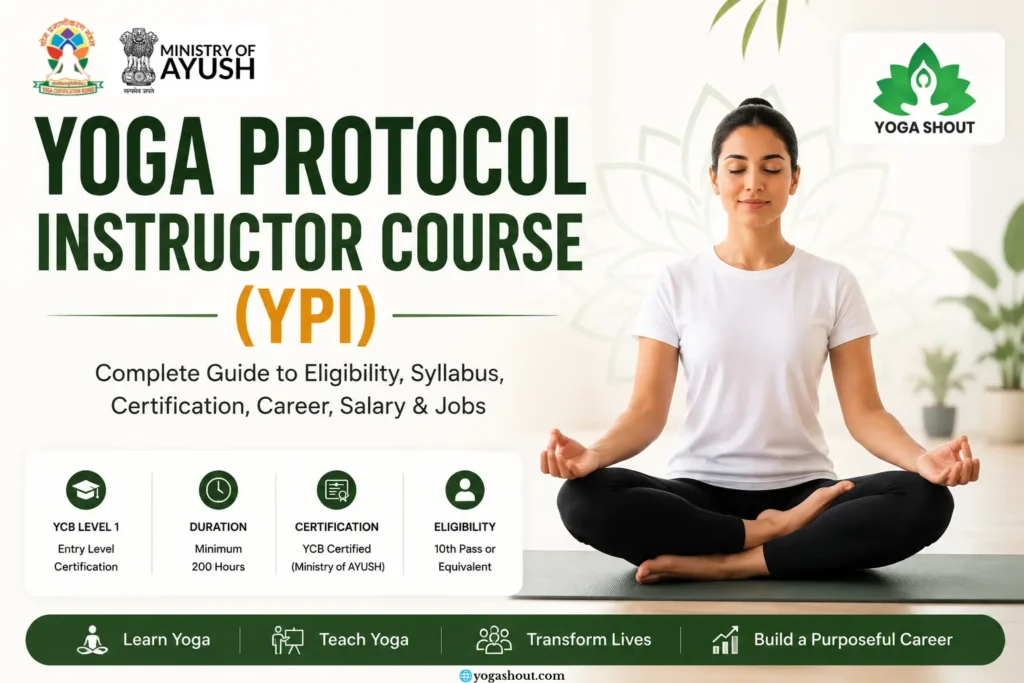
If you’re planning to build a career in yoga or want to become a government-certified yoga instructor in India, you’ve probably come across the Yoga Protocol Instructor (YPI) Course. It is one of the most popular entry-level professional yoga certifications under the Yoga Certification Board (YCB), established by the Ministry of AYUSH, Government of India.
The Yoga Protocol Instructor course is designed for individuals who want to learn the fundamentals of yoga, teach the Common Yoga Protocol, and conduct yoga sessions for beginners, communities, schools, residential societies, wellness centres, and various public health initiatives. The curriculum combines yogic philosophy, practical training, teaching methodology, and health promotion, making it an ideal starting point for aspiring yoga professionals. According to the syllabus, the course requires a minimum of 200 training hours and includes both theory and practical assessment, with a stronger emphasis on practical teaching skills.
However, many students still have questions:
- Is the Yoga Protocol Instructor Course government certified?
- Who is eligible to join?
- What is taught in the syllabus?
- Can I get a job after completing YPI?
- What is the salary of a Yoga Protocol Instructor?
- Is this course better than Yoga Volunteer?
- What should I do after YPI?
This guide answers all of those questions in one place.
Instead of giving only basic admission details, we’ve created a comprehensive resource that explains every aspect of the Yoga Protocol Instructor certification—from eligibility and course structure to career opportunities, examination, salary, and future learning pathways. Whether you’re a student, working professional, yoga practitioner, or someone planning to become a certified yoga teacher, this guide will help you make an informed decision.
Why This Guide is Different
Most websites provide only a brief overview of the Yoga Protocol Instructor course and focus primarily on admissions. In contrast, this guide is designed to help you understand the course in depth. We explain not only what the course includes, but also why each subject is taught, how the certification can support your career, and what learning path you can follow after completing it.
By the end of this guide, you’ll have a clear understanding of:
- What the Yoga Protocol Instructor Course is.
- Who should enroll.
- The complete syllabus explained in simple language.
- Practical training and teaching skills.
- Examination and certification process.
- Career opportunities and salary expectations.
- Progression to higher YCB certification levels.
- Answers to the most frequently asked questions.
Whether you’re preparing for the course or comparing different yoga certifications, this guide aims to become your single, reliable reference.
Yoga Protocol Instructor Course at a Glance
If you’re looking for a quick overview of the Yoga Protocol Instructor (YPI) Course, the table below summarizes the most important details. The following sections of this guide explain each topic in detail.
| Particular | Details |
| Course Name | Yoga Protocol Instructor (YPI) |
| Certification Level | Entry-Level Professional Yoga Certification |
| Certification Body | Yoga Certification Board (YCB), Ministry of AYUSH, Government of India |
| Course Duration | Minimum 200 Hours |
| Course Mode | Online, Offline or Hybrid (depending on the institution) |
| Full-Time Duration | Minimum 1 Month |
| Part-Time Duration | Minimum 3 Months |
| Recommended Eligibility | 10th Pass or equivalent (Institutions may define their own eligibility) |
| Minimum Age | No Age Limit |
| Credit Points | 12 Credits |
| Assessment | Theory + Practical Examination |
| Total Marks | 200 Marks |
| Theory Marks | 60 Marks |
| Practical Marks | 140 Marks |
| Focus Areas | Yoga Philosophy, Practical Yoga, Teaching Skills, Health Promotion |
| Career Opportunities | Yoga Instructor, Community Yoga Teacher, School Yoga Instructor, Corporate Yoga Trainer, Wellness Centre Instructor, Freelancer |
| Next Certification Level | Yoga Wellness Instructor (YWI) |
The course structure, duration, eligibility recommendations, credit allocation, and assessment pattern are based on the Yoga Protocol Instructor syllabus shared in this guide.
Key Highlights of the Yoga Protocol Instructor Course
The Yoga Protocol Instructor (YPI) Course is one of the most popular entry-level professional yoga certifications for individuals who want to begin a career in yoga teaching. It is designed to provide a strong foundation in yogic philosophy, practical training, teaching methodology, and health promotion.
Some of the key highlights of the course include:
- 200 hours of structured yoga training covering both theoretical knowledge and practical application.
- Government-recognized certification pathway under the Yoga Certification Board (YCB), Ministry of AYUSH.
- No minimum age restriction, making the course accessible to learners from different age groups.
- Suitable for beginners as well as individuals who wish to start teaching yoga professionally.
- Strong emphasis on practical skills, with 140 out of 200 marks allocated to demonstrations, teaching, field experience, and application of knowledge.
- Training in the Common Yoga Protocol, enabling graduates to conduct yoga sessions in schools, parks, residential societies, wellness centres, corporate organizations, and community programs.
- Acts as a stepping stone for higher-level YCB certifications such as Yoga Wellness Instructor (YWI), Assistant Yoga Therapist, and Yoga Therapist.
Who Should Read This Guide?
This guide is designed for anyone who wants a complete understanding of the Yoga Protocol Instructor Course before enrolling.
It is especially useful for:
- Students planning to build a professional career in yoga.
- Beginners who want to start with a government-recognized yoga certification.
- Existing yoga practitioners looking to formalize their knowledge through YCB certification.
- Fitness trainers and wellness professionals who want to add yoga instruction to their skill set.
- School teachers interested in conducting yoga classes.
- Individuals planning to teach yoga in community centres, residential societies, or corporate settings.
- Anyone comparing the Yoga Protocol Instructor Course with Yoga Volunteer, Yoga Wellness Instructor, or other yoga certifications.
Whether your goal is to teach yoga professionally, improve your personal practice, or continue toward advanced YCB certifications, this guide will help you understand where the Yoga Protocol Instructor Course fits into your learning journey.
Table of Contents
What is the Yoga Protocol Instructor (YPI) Course?
The Yoga Protocol Instructor (YPI) Course is an entry-level professional yoga certification designed for individuals who want to learn the fundamentals of yoga and teach the Common Yoga Protocol (CYP) developed for health promotion and disease prevention. It forms an important part of the structured certification pathway created by the Yoga Certification Board (YCB) under the Ministry of AYUSH, Government of India.
The course provides a balanced combination of yogic philosophy, practical yoga techniques, teaching methodology, and health education, enabling students to confidently conduct yoga sessions for beginners and the general public. According to the official syllabus, a certified Yoga Protocol Instructor is trained to teach basic yoga practices and conduct yoga classes in parks, schools, residential societies, wellness centres, community organizations, and similar public settings.
Unlike advanced yoga teacher training programs that focus on specialized teaching or therapeutic applications, the Yoga Protocol Instructor Course builds a strong foundation. Students learn not only how to perform yoga practices correctly, but also how to teach them safely, communicate effectively, and organize structured yoga classes for different groups of people.
For many aspiring yoga professionals, the YPI Course serves as the first step toward a long-term career in yoga education and opens the pathway to higher-level certifications such as Yoga Wellness Instructor (YWI), Assistant Yoga Therapist, Yoga Therapist, and beyond.
Why Was the Yoga Protocol Instructor Course Introduced?
Yoga has become an integral part of preventive healthcare and holistic well-being. As awareness of yoga continues to grow, there is an increasing need for trained instructors who can teach yoga safely and systematically to the public.
The Yoga Protocol Instructor certification was introduced to create a standardized framework for yoga education. Rather than allowing every institution to follow a different teaching approach, the course establishes a common baseline of knowledge and practical competence. This helps ensure that learners receive structured training in yoga philosophy, practical techniques, teaching methods, and health promotion.
Another important objective of the course is to prepare instructors who can effectively teach the Common Yoga Protocol, a standardized sequence of yoga practices promoted during International Day of Yoga and widely used in community yoga sessions across India. By completing the YPI Course, students gain the knowledge and practical skills needed to conduct these sessions with confidence and professionalism.
What Does a Yoga Protocol Instructor Do?
Many people assume that a Yoga Protocol Instructor simply teaches yoga classes. In reality, the role is much broader.
A certified Yoga Protocol Instructor is trained to:
- Conduct structured yoga sessions for beginners.
- Teach the Common Yoga Protocol in a safe and systematic manner.
- Demonstrate yoga postures, breathing techniques, relaxation practices, and meditation.
- Promote healthy lifestyle habits through yogic principles.
- Help individuals develop regular yoga practice for overall well-being.
- Organize yoga classes in educational institutions, parks, residential societies, wellness centres, community organizations, and corporate environments.
- Encourage preventive healthcare through yoga-based lifestyle practices.
The role focuses primarily on health promotion, wellness education, and community yoga instruction rather than clinical yoga therapy or treatment of medical conditions.
Objectives of the Yoga Protocol Instructor Course
The Yoga Protocol Instructor Course is designed to help students develop both theoretical understanding and practical teaching competence.
By the end of the course, learners are expected to:
- Understand the basic principles and philosophy of yoga.
- Learn the history, development, and major schools of yoga.
- Practice essential yogic techniques, including asanas, pranayama, meditation, relaxation, and cleansing practices.
- Develop the ability to teach yoga safely to different groups of people.
- Understand yogic concepts related to health promotion and disease prevention.
- Learn classroom management and lesson planning.
- Build confidence in conducting independent yoga sessions.
- Develop professional communication and instructional skills required for a yoga instructor.
The course emphasizes practical application, which is reflected in the assessment pattern where practical evaluation carries significantly more weight than theory.
Is the Yoga Protocol Instructor Course Right for You?
The Yoga Protocol Instructor Course is ideal for individuals who want to move beyond personal yoga practice and begin teaching others in a structured and professional manner.
This course may be a good choice if you:
- Want to start a career as a yoga instructor.
- Plan to teach yoga in schools, colleges, fitness centres, or wellness organizations.
- Wish to conduct community yoga sessions in parks, residential societies, or NGOs.
- Want a structured foundation before pursuing advanced YCB certifications.
- Are a fitness trainer looking to add yoga instruction to your professional skills.
- Want to deepen your understanding of yoga philosophy alongside practical training.
- Aspire to contribute to preventive healthcare and healthy lifestyle promotion through yoga.
However, if your primary goal is to specialize in therapeutic applications of yoga for managing specific health conditions, you may eventually need to progress to higher-level certifications such as Assistant Yoga Therapist or Yoga Therapist after completing the foundational stages.
Where Does the Yoga Protocol Instructor (YPI) Course Fit in the YCB Certification Path?
The Yoga Protocol Instructor (YPI) is the Level 1 certification in the Yoga Certification Board (YCB) framework and marks the beginning of a professional career in yoga instruction. While many people start their yoga journey by learning basic practices through the Yoga Volunteer (Level 0) program, the Yoga Protocol Instructor Course is the first certification that prepares learners to teach yoga professionally.
The Yoga Certification Board has developed a structured certification pathway that allows students to progress from beginner-level learning to advanced teaching, yoga therapy, research, and consultancy. Each certification level is designed with a specific purpose, gradually increasing the depth of knowledge, practical skills, and professional responsibilities.
Instead of considering the Yoga Protocol Instructor Course as the final destination, it should be viewed as the first professional milestone in a long-term yoga career.
Complete YCB Certification Roadmap
The Yoga Certification Board offers eight major certification levels. Each level is designed to build upon the previous one, allowing yoga professionals to gradually expand their expertise.
| Level | Certification | Duration | Purpose |
| Level 0 | Yoga Volunteer (YV) | 36 Hours | Introduction to yoga and community participation |
| Level 1 | Yoga Protocol Instructor (YPI) | 200 Hours | Learn to teach the Common Yoga Protocol and beginner-level yoga classes |
| Level 2 | Yoga Wellness Instructor (YWI) | 400 Hours | Teach yoga for preventive healthcare and wellness |
| Level 3 | Yoga Teacher & Evaluator (YTE) | 800 Hours | Advanced teaching, mentoring, and evaluation of yoga professionals |
| Level 4 | Yoga Master | 1600 Hours | Advanced study of yoga philosophy, teaching, and leadership |
| Level 5 | Assistant Yoga Therapist (AYTh) | 400 Hours | Assist in yoga therapy programs under qualified supervision |
| Level 6 | Yoga Therapist (YTh) | 800 Hours | Apply yoga therapeutically for specific health conditions |
| Level 7 | Therapeutic Yoga Consultant (TYC) | 1600 Hours | Advanced therapeutic practice, consultancy, and research |
This progressive framework enables learners to choose a career path that matches their interests. Some professionals continue toward advanced teaching certifications, while others specialize in yoga therapy and therapeutic applications.
What Comes After the Yoga Protocol Instructor Course?
Completing the Yoga Protocol Instructor Course opens the door to multiple career and learning pathways.
If your goal is to become a professional yoga teacher, the natural progression is:
Yoga Volunteer → Yoga Protocol Instructor → Yoga Wellness Instructor → Yoga Teacher & Evaluator → Yoga Master
This pathway focuses on teaching, education, and academic leadership within the yoga profession.
If you are interested in therapeutic applications of yoga, your progression may continue toward:
Assistant Yoga Therapist → Yoga Therapist → Therapeutic Yoga Consultant
This pathway is designed for professionals who wish to work in yoga therapy, preventive healthcare, rehabilitation, and therapeutic consultancy.
Why This Structured Pathway Matters
One of the biggest advantages of the YCB certification system is that it provides a clear roadmap for professional growth. Instead of enrolling in unrelated courses, learners can systematically build their knowledge and skills through progressively advanced certifications.
For most aspiring yoga teachers, the Yoga Protocol Instructor Course is the ideal starting point because it establishes the teaching skills, practical experience, and theoretical understanding needed before advancing to higher certifications such as Yoga Wellness Instructor or Yoga Teacher & Evaluator.
Yoga Protocol Instructor (YPI) Course Eligibility
One of the most common questions students ask before enrolling is:
“Am I eligible to join the Yoga Protocol Instructor Course?”
The good news is that the Yoga Protocol Instructor (YPI) Course has relatively flexible eligibility requirements, making it accessible to a wide range of learners.
According to the official syllabus, there is no mandatory eligibility criterion for open candidates. However, it is recommended that applicants have passed the 10th Standard (Secondary School Certificate) or an equivalent qualification from a recognized board. The syllabus also states that individual yoga institutions may define their own admission criteria depending on their academic policies.
This means that while the YCB provides general recommendations, the specific admission requirements may vary from one training institute to another. Therefore, it is always advisable to verify the eligibility criteria with the institute where you plan to enroll.
Educational Qualification
For most students, the recommended educational qualification is:
- 10th Pass (Secondary School Certificate) or equivalent
Since this recommendation is not an absolute requirement for open candidates, some institutions may also admit learners based on their own admission policies and the nature of the program they offer.
If you are unsure about your eligibility, contacting the training institute directly is the best approach.
Is There Any Age Limit?
No.
According to the official syllabus, there is no minimum or maximum age limit for the Yoga Protocol Instructor Course.
This makes the certification suitable for learners from diverse age groups, including:
- School students who wish to begin learning yoga professionally.
- College students exploring career opportunities in yoga.
- Working professionals looking for a career transition.
- Homemakers interested in teaching yoga.
- Retired individuals who wish to remain active and contribute to community well-being.
Your commitment to learning and teaching yoga is generally more important than your age.
Do You Need Prior Yoga Experience?
One of the biggest advantages of the Yoga Protocol Instructor Course is that it is designed for beginners as well as existing yoga practitioners.
You do not need to be an advanced yoga teacher before joining the course.
The curriculum starts with fundamental concepts such as:
- Introduction to Yoga
- History of Yoga
- Yogic Philosophy
- Basic Asanas
- Pranayama
- Meditation
- Teaching Methodology
As the course progresses, students gradually develop the practical and teaching skills required to conduct yoga classes confidently.
However, if you already practice yoga regularly, you may find it easier to understand and perform some of the practical components of the course.
Essential Personal Qualities of a Yoga Protocol Instructor
While academic qualifications are important, becoming an effective yoga instructor also requires certain personal qualities.
The official syllabus highlights several attributes that contribute to successful yoga teaching, including:
- Good communication skills.
- Self-discipline.
- Patience.
- Confidence.
- Compassion.
- Empathy.
- Active listening.
- Time management.
- Emotional maturity.
- Language proficiency.
- The ability to understand students’ body language.
These qualities help instructors create a safe, supportive, and engaging learning environment for their students.
Fortunately, many of these skills can be developed through regular teaching practice and experience.
Who Should Join the Yoga Protocol Instructor Course?
The YPI Course is suitable for anyone who wants to build a strong foundation in yoga education and begin teaching professionally.
This course is particularly beneficial for:
Students
If you’re looking for a meaningful career after school or college, YPI can provide a structured entry into the field of yoga instruction.
Yoga Enthusiasts
If you’ve been practicing yoga for personal well-being and now want to teach others, YPI is a logical next step.
Fitness Professionals
Gym trainers, fitness coaches, and wellness instructors can expand their expertise by incorporating yoga into their services.
School Teachers
Teachers interested in conducting yoga sessions in educational institutions can benefit from the structured teaching methodology covered in the course.
Working Professionals
Many professionals pursue YPI as a second career, side business, or part-time teaching opportunity.
Homemakers
Individuals looking for flexible work options often choose yoga instruction because classes can be conducted from home, online, or within local communities.
Retired Individuals
Retirement can be an excellent time to share knowledge, promote healthy living, and remain physically and mentally active through yoga teaching.
Can You Complete the YPI Course Online?
Today, many institutes offer online learning options to make yoga education more accessible. However, the availability of online, offline, or hybrid batches depends on the policies of the individual training institute.
When choosing an online program, students should consider factors such as:
- Live versus recorded classes
- Practical guidance and feedback
- Faculty experience
- Student support
- Assessment process
- Opportunities for teaching practice
Regardless of the mode of learning, consistent practice remains essential. Yoga is a practical discipline, and regular self-practice plays a key role in developing confidence and teaching skills.
How Many Hours Should You Practice Daily?
Although the syllabus specifies a minimum of 200 training hours, learning yoga extends beyond classroom instruction.
To gain maximum benefit from the course, students should also dedicate time to personal practice.
A balanced daily routine may include:
- Revision of theoretical concepts.
- Regular asana practice.
- Pranayama and meditation.
- Observation of teaching techniques.
- Reflection on yogic lifestyle principles.
Developing a consistent practice habit during the course makes it easier to retain knowledge and build confidence as a future yoga instructor.
Is One Month Enough to Learn Yoga?
This is one of the most frequently asked questions by prospective students.
The answer depends on what you expect from the course.
A one-month full-time YPI program is designed to provide the minimum structured training required under the prescribed curriculum. It equips learners with the foundational knowledge and practical skills necessary to begin teaching beginner-level yoga classes.
However, becoming an excellent yoga instructor is a continuous journey. The course provides the foundation, but real expertise develops through regular practice, teaching experience, continued study, and progression to higher certification levels.
In other words, the certification marks the beginning of professional learning, not the end.
What Will You Learn in the Yoga Protocol Instructor (YPI) Course?
The Yoga Protocol Instructor Course is much more than learning yoga postures. It is a structured training program that helps students understand the philosophy of yoga, develop practical teaching skills, and learn how to promote health and well-being through yogic practices.
The curriculum is carefully designed to create a balance between theoretical knowledge, practical training, and teaching experience. By the end of the course, students are expected to confidently conduct beginner-level yoga classes while understanding the principles behind every practice they teach.
According to the official syllabus, the course consists of three theory units and practical training, with a strong emphasis on demonstration skills, teaching methodology, and field experience. Out of the total 200 marks, 140 marks are allocated to practical assessment, highlighting the importance of hands-on learning.
Learning Outcomes of the Yoga Protocol Instructor Course
After successfully completing the course, learners will be able to:
- Understand the origin, philosophy, and purpose of yoga.
- Explain the basic concepts of yogic lifestyle and holistic health.
- Demonstrate common yoga practices with correct alignment and technique.
- Teach beginner-level yoga classes confidently and safely.
- Prepare structured yoga lesson plans for different groups.
- Guide students through breathing techniques, relaxation, and meditation.
- Promote healthy living through yoga-based lifestyle practices.
- Understand the role of yoga in disease prevention and health promotion.
- Develop effective communication and classroom management skills.
- Build the confidence required to begin a professional career as a yoga instructor.
These outcomes ensure that graduates are prepared not only to perform yoga practices but also to teach them responsibly in real-world settings.
How is the YPI Course Structured?
The curriculum is divided into two major components, ensuring a balance between knowledge and practical application.
1. Theory
The theoretical component helps students understand the science, philosophy, and principles of yoga.
It is divided into three major units:
Unit 1
Introduction to Yoga and Yogic Practices
Students learn the foundations of yoga, including its history, philosophy, guiding principles, major schools of yoga, and the basic concepts behind yogic practices.
Unit 2
Introduction to Yoga Texts
This unit introduces learners to important classical texts such as the Patanjali Yoga Sutras, Bhagavad Gita, and Hatha Pradipika, helping them understand the philosophical foundation of yoga.
Unit 3
Yoga for Health Promotion
Students explore how yoga contributes to physical, mental, and emotional well-being. Topics include healthy lifestyle practices, stress management, preventive healthcare, first aid, and the role of yoga in promoting overall wellness.
2. Practical Training
The practical component focuses on developing real teaching skills.
Students receive hands-on training in:
- Yogic cleansing techniques
- Sukshma Vyayama
- Sthula Vyayama
- Surya Namaskar
- Yoga Asanas
- Pranayama
- Meditation
- Mudras
- Bandhas
- Yoga Nidra
- Teaching methodology
- Demonstration techniques
- Lesson planning
- Field experience
This practical exposure prepares students to confidently conduct yoga sessions for beginners in various settings.
Theory vs Practical: Why Does the YPI Course Focus More on Practical Training?
One of the most distinctive features of the Yoga Protocol Instructor Course is its strong emphasis on practical learning.
The official assessment pattern clearly reflects this approach.
| Assessment Component | Marks |
| Theory | 60 |
| Practical | 140 |
| Total | 200 |
This means that 70% of the total assessment is based on practical performance, while theory contributes the remaining 30%.
This distribution highlights an important principle of yoga education:
A good yoga instructor is not judged only by what they know, but also by how effectively they can demonstrate, teach, and guide others.
Throughout the course, students repeatedly practice teaching techniques, improve their communication skills, and gain confidence through demonstrations and supervised teaching sessions.
Next: Complete Yoga Protocol Instructor Syllabus Explained
Now that you understand the overall structure of the course, let’s explore each unit of the syllabus in detail.
In the following sections, we won’t simply list the topics prescribed in the curriculum. Instead, we’ll explain:
- What each topic means.
- Why it is included in the course.
- How it contributes to your development as a yoga instructor.
- Where you will apply this knowledge in real teaching situations.
By understanding the purpose behind each subject, you’ll gain a much clearer picture of what the Yoga Protocol Instructor Course actually teaches and how it prepares you for a professional career in yoga.
Unit 1: Introduction to Yoga and Yogic Practices
The first unit of the Yoga Protocol Instructor (YPI) Course lays the foundation for everything you will learn throughout the program. Before teaching yoga to others, it is essential to understand what yoga truly is, where it originated, its guiding principles, and the philosophy behind its practices.
This unit introduces students to the history of yoga, its major schools, fundamental concepts, and basic yogic practices such as asanas, pranayama, meditation, and cleansing techniques. By the end of this unit, learners gain a clear understanding of yoga as a holistic system for physical, mental, and emotional well-being rather than just a form of exercise.
1.1 Yoga: Meaning, Definitions, Aim & Common Misconceptions
The course begins by introducing the true meaning of yoga. Students learn the Sanskrit origin of the word “Yoga,” its various definitions from classical texts, and the overall aim of yogic practice. This section also addresses common misconceptions, such as the belief that yoga is only about stretching or physical fitness.
Why is this topic important?
A Yoga Protocol Instructor should be able to explain what yoga really is before teaching it to others. Understanding its philosophy helps instructors answer students’ questions with confidence.
What will you learn?
- Meaning and origin of the word Yoga
- Classical definitions of Yoga
- Objectives of Yoga
- Common myths and misconceptions
- Yoga as a holistic way of life
1.2 Origin, History and Development of Yoga
Yoga has evolved over thousands of years and continues to benefit millions of people worldwide. In this topic, students explore the historical journey of yoga—from ancient Indian traditions to its recognition as a globally practiced discipline.
Rather than memorizing dates, the objective is to understand how yoga developed and why it continues to remain relevant in modern society.
Why is this topic important?
Students often ask questions like “Where did yoga originate?” or “How old is yoga?” A professional instructor should have a basic understanding of yoga’s historical background.
What will you learn?
- Ancient origin of yoga
- Major stages in the development of yoga
- Contribution of classical yoga traditions
- Evolution of modern yoga
1.3 Guiding Principles of Yoga Practice
Yoga is based on discipline, awareness, patience, and consistency. This topic introduces the fundamental principles that every yoga practitioner should follow during practice.
Instead of focusing only on physical postures, students learn how proper breathing, mindfulness, gradual progress, and respect for individual limitations contribute to safe and effective yoga practice.
Why is this topic important?
Following these principles helps instructors create safe, inclusive, and meaningful yoga classes for students of different ages and abilities.
What will you learn?
- Safe yoga practice principles
- Importance of awareness and breathing
- Consistency and discipline
- Respecting individual limitations
- Creating a positive learning environment
1.4 Fundamental Principles of Yoga
Although these philosophical ideas may seem complex at first, they provide a deeper understanding of how yoga aims to balance the body, mind, emotions, and consciousness.
One of the unique aspects of the YPI syllabus is the introduction to classical yogic concepts such as Triguna, Antahkarana Chatushtaya, and Panchakosha. These concepts help students understand yoga’s holistic view of human personality and well-being.
Why is this topic important?
A Yoga Instructor should understand that yoga addresses every dimension of human life, not just physical fitness. These concepts help explain the holistic approach of yoga.
What will you learn?
- Triguna (Sattva, Rajas and Tamas)
- Antahkarana Chatushtaya
- Panchakosha
- Holistic approach of yoga
1.5 Major Schools of Yoga
Yoga has evolved into several traditional paths, each focusing on a different approach to personal growth. During this topic, students receive an introduction to the major schools of yoga, including Jnana Yoga, Bhakti Yoga, Karma Yoga, Patanjali Yoga, and Hatha Yoga.
Rather than studying each school in great detail, learners gain an overview of their core philosophy and significance.
Why is this topic important?
Understanding different schools of yoga helps instructors appreciate the diversity of yogic traditions and explain them to students whenever required.
What will you learn?
- Jnana Yoga
- Bhakti Yoga
- Karma Yoga
- Patanjali Yoga
- Hatha Yoga
1.6 Introduction to Yoga Practices for Health and Well-being
Yoga is widely recognized for its role in promoting physical, mental, and emotional health. This topic introduces students to the concept of using yoga as a preventive and wellness-oriented practice.
Students gain an overview of how regular yoga practice contributes to flexibility, strength, stress management, relaxation, and overall quality of life.
Why is this topic important?
This topic helps future instructors explain the benefits of yoga in a simple, evidence-informed, and practical manner.
What will you learn?
- Role of yoga in healthy living
- Physical and mental benefits
- Wellness through regular practice
- Holistic health approach
1.7 Introduction to Shatkarma
Shatkarma refers to the traditional yogic cleansing techniques described in Hatha Yoga. In the YPI course, students receive an introductory understanding of these practices, their purpose, and their role in preparing the body for higher yogic practices.
What will you learn?
- Meaning of Shatkarma
- Purpose of cleansing practices
- Importance in yoga
- Basic introduction to traditional techniques
1.8 Sukshma Vyayama, Sthula Vyayama and Surya Namaskar
Before learning advanced asanas, students are introduced to preparatory yogic movements and Surya Namaskar. These practices help improve joint mobility, circulation, flexibility, coordination, and readiness for yoga practice.
What will you learn?
- Sukshma Vyayama
- Sthula Vyayama
- Surya Namaskar
- Warm-up techniques
- Preparation for yoga practice
1.9 Introduction to Yogasana
Asanas are one of the most recognizable aspects of yoga. This topic explains the meaning of Yogasana, its basic principles, and its role in promoting physical and mental well-being.
Students are introduced to the importance of posture, alignment, breathing, and relaxation while practicing asanas.
What will you learn?
- Meaning of Yogasana
- Principles of practice
- Health benefits
- Safe execution of postures
1.10 Introduction to Pranayama and Meditation
The final topic of Unit 1 introduces students to two essential components of yoga: Pranayama (breath regulation) and Dhyana (meditation).
Learners understand how conscious breathing improves mental focus and relaxation, while meditation helps cultivate awareness, emotional balance, and inner calm.
What will you learn?
- Meaning of Pranayama
- Basic breathing techniques
- Introduction to meditation
- Benefits for physical and mental health
Unit 2: Introduction to Yoga Texts
Yoga is much more than physical postures and breathing exercises. Its principles, philosophy, and practices have been preserved through several classical texts that continue to guide yoga practitioners even today.
In this unit, students are introduced to some of the most important yogic scriptures, including the Yoga Sutras of Patanjali, the Bhagavad Gita, and the Hatha Yoga Pradipika. The objective is not to become a scholar of these texts but to understand the core teachings that influence modern yoga education and practice.
By studying these texts, future Yoga Protocol Instructors develop a deeper understanding of yoga beyond physical practice, enabling them to explain the philosophy and values behind the techniques they teach.
2.1 Introduction to Patanjali Yoga Sutras
The Yoga Sutras of Patanjali is one of the most influential texts in the history of yoga. It presents yoga as a systematic path for achieving mental clarity, self-discipline, and inner peace.
As part of the YPI syllabus, students are introduced to selected sutras from the first chapter, helping them understand the basic philosophy of yoga and the importance of controlling the fluctuations of the mind.
Why is this topic important?
A Yoga Protocol Instructor should understand the philosophical foundation of yoga rather than viewing it only as physical exercise.
What will you learn?
- Introduction to Patanjali Yoga Sutras
- Selected Sutras from Chapter 1
- Basic concepts of Raja Yoga
- Importance of mental discipline
2.2 Introduction to the Bhagavad Gita
The Bhagavad Gita is one of India’s most respected spiritual texts and offers valuable guidance on duty, self-discipline, balanced living, and inner growth.
The YPI course introduces selected verses from Chapter 2 to help students understand how yogic principles can be applied in everyday life. Rather than focusing on religious interpretation, the emphasis is on universal values such as selfless action, emotional balance, and clarity of mind.
What will you learn?
- Introduction to the Bhagavad Gita
- Selected verses from Chapter 2
- Concept of Karma Yoga
- Balanced approach to life
2.3 Introduction to Hatha Yoga Pradipika
The Hatha Yoga Pradipika is one of the classical texts that forms the foundation of traditional Hatha Yoga.
It explains many practical aspects of yoga, including asanas, pranayama, mudras, bandhas, cleansing practices, and meditation. Since many modern yoga classes are based on Hatha Yoga traditions, understanding this text helps students appreciate the origin and purpose of many practices they perform daily.
What will you learn?
- Overview of Hatha Yoga
- Importance of classical yoga practices
- Relationship between body, breath, and mind
- Foundation of practical yoga techniques
2.4 Introduction to Prasthanatrayee
The syllabus also introduces students to Prasthanatrayee, a collective term for three important philosophical sources in Indian thought.
At the YPI level, students receive only a general introduction so they become familiar with these foundational texts and their significance in the broader tradition of yoga philosophy.
What will you learn?
- Meaning of Prasthanatrayee
- Basic introduction
- Importance in Indian philosophical traditions
2.5 Concept of Aahara (Diet) in Yoga
Yoga places great importance on food because diet directly influences physical health, energy levels, and mental well-being.
Students learn the concepts of Mitahara (moderate eating) and Yuktahara (balanced diet) as described in classical yoga literature. These principles encourage mindful eating, moderation, and choosing foods that support a healthy lifestyle rather than following restrictive diets.
Why is this topic important?
As a Yoga Instructor, students may often ask simple questions like:
- What should I eat before yoga?
- Can diet affect yoga practice?
- Is there a yogic approach to healthy eating?
This topic prepares instructors to answer such questions with confidence.
What will you learn?
- Yogic approach to nutrition
- Mitahara
- Yuktahara
- Healthy eating habits
- Importance of moderation
2.6 Significance of Hatha Yoga for Health and Well-being
Hatha Yoga is often the first style of yoga that beginners experience. This topic explains how regular Hatha Yoga practice contributes to flexibility, strength, balance, relaxation, and overall wellness.
Students also understand why Hatha Yoga remains one of the most widely practiced forms of yoga across the world.
What will you learn?
- Benefits of Hatha Yoga
- Physical and mental well-being
- Role of regular practice
- Foundation of modern yoga teaching
2.7 Mental Well-being According to Patanjali Yoga
Mental health is an important aspect of yoga.
This topic introduces Patanjali’s perspective on developing a calm, focused, and balanced mind through yogic discipline.
Students gain a basic understanding of how yoga supports emotional well-being and stress management through self-awareness and regular practice.
What will you learn?
- Yogic understanding of the mind
- Emotional balance
- Mental discipline
- Inner peace through yoga
2.8 Bahiranga and Antaranga Yoga
Patanjali’s Ashtanga Yoga is broadly divided into external (Bahiranga) and internal (Antaranga) practices.
Students receive an introduction to these concepts and understand how external disciplines gradually prepare practitioners for deeper states of concentration and meditation.
What will you learn?
- Bahiranga Yoga
- Antaranga Yoga
- Eight limbs of Yoga
- Progressive path of yogic practice
2.9 Healthy Living According to the Bhagavad Gita
The Bhagavad Gita emphasizes balance, moderation, self-discipline, and right action.
This topic helps students understand how these principles can be applied to modern life for maintaining physical, mental, and emotional well-being.
What will you learn?
- Balanced lifestyle
- Self-discipline
- Emotional stability
- Yogic approach to daily living
2.10 Importance of Personal Experience in Yoga
The final topic reminds students that yoga cannot be understood through reading alone.
Regular practice and personal experience are essential for understanding the true value of yoga.
As future Yoga Protocol Instructors, students are encouraged to experience the benefits of yoga personally before teaching others. Practical experience builds confidence, improves communication, and allows instructors to guide students more authentically.
What will you learn?
- Learning through regular practice
- Importance of self-experience
- Developing confidence as a teacher
- Connecting theory with practical yoga
Unit 3: Yoga for Health Promotion
One of the biggest reasons people practice yoga today is to improve their overall health and quality of life. The third unit of the Yoga Protocol Instructor (YPI) Course focuses on how yoga can support a healthy lifestyle, prevent lifestyle-related disorders, manage stress, and promote physical as well as mental well-being.
Rather than treating yoga only as a series of exercises, this unit helps students understand its role in preventive healthcare. Future Yoga Protocol Instructors learn how regular yoga practice, balanced daily habits, and positive mental attitudes can contribute to healthier living.
3.1 Brief Introduction to the Human Body
Before teaching yoga, it’s important to have a basic understanding of how the human body works. This topic provides an introductory overview of the body’s structure and major systems, helping students understand how yoga practices influence physical health.
The emphasis is on practical understanding rather than detailed medical knowledge.
Why is this topic important?
A Yoga Instructor should know the basics of the human body to teach yoga safely and explain the purpose of different practices.
What will you learn?
- Basic structure of the human body
- Introduction to major body systems
- Relationship between yoga and physical health
3.2 Health Promotion and the Role of Yoga
This topic introduces the concept of health promotion and explains how yoga contributes to maintaining physical, mental, and emotional well-being.
Students learn that yoga is not only useful for improving flexibility or strength but also for encouraging healthy habits, reducing stress, and enhancing overall quality of life.
What will you learn?
- Meaning of health promotion
- Importance of preventive healthcare
- Role of yoga in maintaining health
- Yoga as a holistic lifestyle practice
3.3 Yogic Positive Attitudes
Yoga encourages not only physical development but also positive mental and emotional qualities. In this topic, students are introduced to four important yogic attitudes:
- Maitri (Friendliness)
- Karuna (Compassion)
- Mudita (Joy in Others’ Success)
- Upeksha (Equanimity)
These qualities help create healthier relationships, emotional balance, and a positive approach to life.
Why is this topic important?
A Yoga Instructor interacts with people from different backgrounds every day. Developing these attitudes helps create a welcoming, supportive, and respectful learning environment.
What will you learn?
- Yogic values and ethics
- Positive mental attitudes
- Emotional well-being
- Building healthy relationships
3.4 Yogic Concepts for Personal Well-being
This topic introduces important yogic concepts such as Dharma, Jnana, Vairagya, and Aishvarya, and explains their role in personal growth and balanced living.
Students receive a basic understanding of these principles and how they contribute to mental clarity, self-discipline, and overall well-being.
What will you learn?
- Meaning of Dharma
- Importance of knowledge (Jnana)
- Detachment (Vairagya)
- Personal growth through yogic values
3.5 Dinacharya and Ritucharya
A healthy lifestyle is one of the pillars of yoga. This topic explains the concepts of Dinacharya (daily routine) and Ritucharya (seasonal routine), emphasizing how regular habits influence physical and mental health.
Students learn how simple lifestyle practices can complement yoga and support long-term wellness.
What will you learn?
- Yogic daily routine
- Seasonal lifestyle practices
- Importance of healthy habits
- Lifestyle management through yoga
3.6 Holistic Approach of Yoga Towards Health and Disease
Unlike approaches that focus only on physical symptoms, yoga considers health from a holistic perspective.
Students learn how yoga addresses multiple dimensions of well-being—including physical, mental, emotional, and lifestyle factors—and how this holistic approach supports overall wellness.
What will you learn?
- Holistic health concept
- Physical and mental well-being
- Yoga’s preventive approach
- Balanced lifestyle
3.7 Introduction to First Aid and CPR
Safety is an essential part of teaching yoga. This topic introduces students to the basic principles of First Aid and Cardiopulmonary Resuscitation (CPR).
Although Yoga Protocol Instructors are not healthcare professionals, having basic awareness of emergency response improves preparedness while conducting yoga sessions.
Why is this topic important?
Yoga classes may include participants of different ages and health conditions. Basic emergency awareness helps instructors respond responsibly until professional medical assistance is available.
What will you learn?
- Basic First Aid principles
- Introduction to CPR
- Emergency awareness
- Importance of participant safety
3.8 Yogic Management of Stress
Stress has become one of the most common health challenges in modern life.
This topic introduces students to the causes and effects of stress and explains how yoga practices such as asanas, pranayama, relaxation, and meditation can help individuals manage stress more effectively.
What will you learn?
- Understanding stress
- Effects of chronic stress
- Yogic stress management
- Relaxation techniques
3.9 Yoga for Metabolic and Respiratory Health
Regular yoga practice can support overall health and well-being, particularly when combined with a healthy lifestyle.
This topic introduces students to the role of yoga in promoting respiratory health and supporting individuals with metabolic health challenges as part of a preventive wellness approach.
Students gain a basic understanding of how appropriate yoga practices may contribute to improved breathing, mobility, and general fitness. The focus is on health promotion rather than medical treatment.
What will you learn?
- Yoga for respiratory wellness
- Yoga and metabolic health
- Preventive approach
- Importance of regular practice
3.10 Yoga for Personality Development
The final topic of this unit highlights how yoga contributes to personal growth.
Beyond improving physical fitness, yoga helps develop qualities such as confidence, discipline, emotional stability, concentration, patience, and effective communication—all of which are essential for a successful Yoga Protocol Instructor.
Why is this topic important?
Students learn that becoming a yoga instructor is not only about teaching techniques but also about developing the personality and professional qualities that inspire confidence in learners.
What will you learn?
- Self-confidence
- Discipline
- Emotional balance
- Communication skills
- Leadership qualities
Practical Training in the Yoga Protocol Instructor (YPI) Course
The practical component is the heart of the Yoga Protocol Instructor Course. While the theory classes help you understand the philosophy and principles of yoga, practical training develops the confidence and teaching skills needed to become a professional yoga instructor.
According to the official syllabus, the practical examination carries 140 marks, making it the most significant part of the course. Throughout the training, students practice yoga techniques daily, improve their demonstration skills, and learn how to conduct yoga classes for different groups of people.
4.1 Prayer and Yogic Opening Practices
Every yoga session traditionally begins with a prayer or invocation that helps prepare the mind for practice.
Students learn:
- Pranava (Om) chanting
- Selected prayers and hymns
- Creating a calm and focused learning environment
Why is this important?
Starting a yoga class with a mindful opening helps students settle their minds and transition into practice with greater awareness.
4.2 Yogic Cleansing Techniques (Shatkarma)
The YPI syllabus introduces students to basic yogic cleansing practices that are traditionally used to prepare the body for yoga.
Techniques Covered
| Practice | Purpose |
| Kapalabhati | Cleansing and energizing practice |
| Neti (Introduction) | Nasal cleansing awareness |
| Dhauti (Introduction) | Understanding yogic cleansing concepts |
Students primarily receive an introductory understanding of these techniques along with guidance on their purpose and significance in yoga.
4.3 Sukshma Vyayama & Sthula Vyayama
Before practicing asanas, students learn preparatory movements that gently warm up the body and improve mobility.
Sukshma Vyayama (Micro Movements)
Students practice movements for:
- Neck
- Shoulders
- Trunk
- Knees
- Ankles
These exercises help improve joint mobility, circulation, and body awareness before beginning yoga practice.
Sthula Vyayama (Macro Movements)
Students also learn larger body movements that prepare the muscles and improve coordination.
Examples include:
- Sarvanga Pushti
- Hrid Gati (Engine Run)
These practices help make the body more flexible and ready for yoga postures.
4.4 Surya Namaskar
Surya Namaskar, or the Sun Salutation, is one of the most recognized yoga sequences worldwide.
During the course, students learn:
- Correct sequence of postures
- Breathing coordination
- Proper demonstration techniques
- Teaching methodology
- Common mistakes to avoid
Since Surya Namaskar is commonly included in beginner yoga classes, mastering it is an essential skill for every Yoga Protocol Instructor.
4.5 Yogasana Training
A major portion of the practical curriculum focuses on learning and demonstrating yoga postures.
Students are introduced to a variety of standing, sitting, kneeling, prone, supine, and relaxation postures.
Standing Asanas
- Tadasana
- Vrikshasana
- Ardha Chakrasana
- Padahastasana
- Kati Chakrasana
- Trikonasana
Sitting Asanas
- Dandasana
- Sukhasana
- Padmasana
- Vajrasana
- Bhadrasana
- Mandukasana
- Ushtrasana
- Shashankasana
- Uttana Mandukasana
- Paschimottanasana
- Purvottanasana
- Vakrasana
- Gomukhasana
Prone Asanas
- Bhujangasana
- Shalabhasana
- Makarasana
Supine Asanas
- Pavanamuktasana
- Uttanapadasana
- Ardha Halasana
- Setubandhasana
- Vipareetakarani
- Saral Matsyasana
Relaxation
- Shavasana
What will you learn?
Students don’t simply memorize these postures. They learn:
- Correct alignment
- Demonstration techniques
- Benefits
- Precautions
- Basic contraindications
- Teaching sequence
These skills prepare learners to guide beginner yoga classes safely and effectively.
4.6 Preparatory Breathing Practices
Before learning pranayama, students practice foundational breathing techniques that improve breath awareness.
These include:
- Abdominal Breathing
- Thoracic Breathing
- Clavicular Breathing
- Yogic Deep Breathing
These practices help students understand proper breathing mechanics before progressing to formal pranayama techniques.
4.7 Pranayama
Breath regulation is an essential part of yoga practice.
The YPI course introduces students to:
| Pranayama | Focus |
| Anulom Vilom / Nadi Shodhana | Breath balancing |
| Sheetali | Cooling breath |
| Bhramari | Relaxation and mental calm |
Students also learn the concepts of:
- Puraka
- Rechaka
- Kumbhaka
These techniques help improve breath awareness, concentration, and relaxation.
4.8 Bandhas
Students receive an introduction to the three classical yogic locks:
- Jalandhara Bandha
- Uddiyana Bandha
- Mula Bandha
The focus is on understanding their purpose and role within yogic practice.
4.9 Mudras
Mudras are symbolic hand gestures commonly used during yoga and meditation.
Students learn:
- Chin Mudra
- Chinmaya Mudra
- Brahma Mudra
- Adi Mudra
- Jnana Mudra
- Dhyana Mudra
- Nasika Mudra
These mudras are introduced as supportive practices that complement breathing exercises and meditation.
4.10 Meditation & Relaxation Practices
The practical syllabus concludes with meditation and relaxation techniques that help cultivate mental calm and self-awareness.
Students practice:
- Om (Pranava) chanting
- Soham meditation
- Body awareness
- Breath awareness
- Yoga Nidra
- Selected prayers and invocations
These practices help students experience the calming and restorative aspects of yoga and prepare them to guide others through relaxation sessions.
Teaching Skills: Learning to Become a Yoga Instructor
One of the biggest differences between a yoga practitioner and a Yoga Protocol Instructor is the ability to teach others effectively.
The YPI course includes dedicated training in teaching methodology, enabling students to confidently conduct yoga classes in real-life settings.
During this training, students learn:
- How to prepare a yoga lesson plan.
- How to conduct beginner-friendly yoga classes.
- Teaching yoga to children, adults, senior citizens, women, and special groups.
- Class management techniques.
- Safety precautions and contraindications.
- Professional qualities of an ideal yoga instructor.
- Models of effective yoga lesson planning.
These teaching skills help bridge the gap between learning yoga and becoming a competent instructor.
Yoga Protocol Instructor (YPI) Examination Pattern
The Yoga Protocol Instructor Course is designed to evaluate both theoretical knowledge and practical teaching skills. Since yoga is a practical discipline, greater emphasis is placed on a student’s ability to perform and teach yoga rather than simply memorizing concepts.
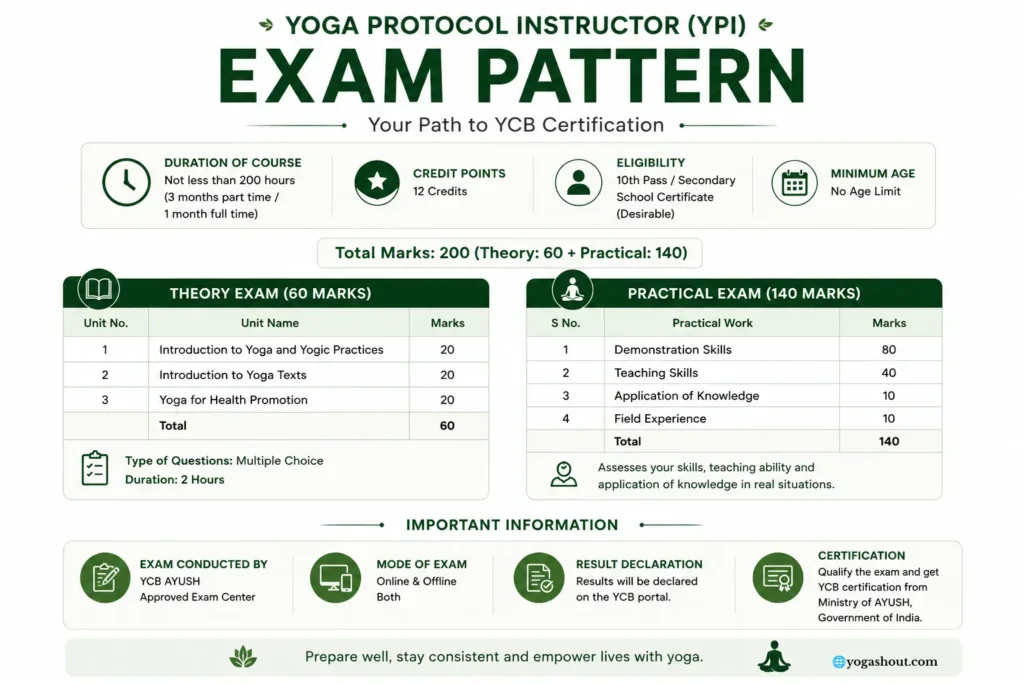
According to the official YPI syllabus, the total assessment carries 200 marks, divided between theory and practical evaluation. The practical examination accounts for 140 marks, while the theory examination carries 60 marks, highlighting the importance of hands-on learning and teaching competence.
YPI Exam Pattern at a Glance
| Assessment | Marks | Weightage |
| Theory Examination | 60 | 30% |
| Practical Examination | 140 | 70% |
| Total | 200 | 100% |
This balanced assessment ensures that students develop both conceptual understanding and practical teaching skills before becoming certified.
Theory Examination
The theory examination evaluates your understanding of the concepts covered during the course.
Questions are generally based on topics such as:
- Introduction to Yoga
- History and Development of Yoga
- Yoga Philosophy
- Classical Yoga Texts
- Yoga for Health Promotion
- Yogic Lifestyle
- Basic Anatomy
- Stress Management
- Role of Yoga in Wellness
Rather than testing memorization alone, the examination aims to assess whether students understand the principles of yoga and can apply them in practical teaching situations.
Practical Examination
The practical examination forms the most important part of the YPI assessment.
Students are evaluated on their ability to:
- Demonstrate yoga practices correctly.
- Maintain proper alignment.
- Coordinate breathing with movement.
- Guide participants safely.
- Communicate instructions clearly.
- Conduct a structured yoga class.
- Demonstrate confidence while teaching.
Since teaching is the primary role of a Yoga Protocol Instructor, practical performance receives the highest weightage in the evaluation process.
Practical Assessment Breakdown
| Component | Marks |
| Demonstration Skills | 80 |
| Teaching Skills | 40 |
| Application of Knowledge | 10 |
| Field Experience | 10 |
| Total | 140 Marks |
Each component evaluates a different aspect of professional competence.
Demonstration Skills (80 Marks)
This is the largest component of the practical examination.
Students may be assessed on:
- Correct performance of asanas
- Pranayama techniques
- Surya Namaskar
- Meditation practices
- Body alignment
- Breathing coordination
- Smooth demonstration
The focus is not on performing advanced yoga postures but on demonstrating the prescribed practices accurately and safely.
Teaching Skills (40 Marks)
Knowing yoga and teaching yoga are two different skills.
During this assessment, students demonstrate their ability to teach others effectively.
Evaluation may include:
- Giving clear verbal instructions
- Managing a yoga class
- Sequencing practices logically
- Correcting common mistakes
- Communicating confidently
- Maintaining class discipline
This section reflects the real responsibilities of a Yoga Protocol Instructor in professional settings.
Application of Knowledge (10 Marks)
This component assesses whether students can apply theoretical concepts during practical teaching.
For example, students may be expected to:
- Explain the benefits of a practice.
- Identify basic precautions.
- Choose appropriate practices for beginners.
- Demonstrate awareness of safe teaching principles.
Field Experience (10 Marks)
Field experience encourages students to apply their learning in real-world situations.
Depending on the institute, this may involve observing or conducting yoga sessions under guidance and gaining practical exposure to teaching different groups of learners.
Is the YPI Examination Difficult?
This is one of the most common questions asked by students.
The Yoga Protocol Instructor examination is not designed to be intimidating. It is designed to assess whether students have developed the knowledge and practical skills expected from an entry-level yoga instructor.
Students who:
- Attend classes regularly,
- Practice yoga consistently,
- Revise the theory topics,
- Participate actively in teaching practice,
are generally well-prepared for the assessment.
The course emphasizes continuous learning and regular practice rather than last-minute preparation.
Tips to Prepare for the YPI Examination
If you’re planning to enroll in the Yoga Protocol Instructor Course, these tips can help you prepare effectively:
Revise Theory Regularly
Instead of studying only before the examination, revise each topic as it is taught.
Practice Every Day
Yoga is a practical discipline. Daily practice helps improve confidence, alignment, and teaching ability.
Focus on Teaching Skills
Many students spend all their time practicing asanas but forget to practice giving instructions.
Teaching confidently is just as important as performing the posture correctly.
Understand, Don’t Memorise
The examination rewards understanding and practical application.
When you understand why a practice is performed, explaining it becomes much easier.
Ask Questions
Whenever you have doubts, discuss them with your faculty during the training instead of waiting until the examination.
Benefits of the Yoga Protocol Instructor (YPI) Course
Choosing a yoga certification is more than just earning a certificate—it’s about building knowledge, developing practical skills, and opening new career opportunities. The Yoga Protocol Instructor (YPI) Course is designed to provide a strong foundation for anyone who wants to begin teaching yoga professionally.
Whether your goal is to become a yoga instructor, start your own classes, or continue to higher YCB certifications, the YPI course offers several valuable benefits.
Let’s explore how this certification can support your personal and professional growth.
1. Learn Yoga in a Structured Way
Many people learn yoga through YouTube videos, mobile apps, or occasional classes. While these resources are useful for personal practice, they often lack a structured learning pathway.
The Yoga Protocol Instructor Course follows a well-defined curriculum that covers:
- Yoga philosophy
- Practical yoga techniques
- Teaching methodology
- Health promotion
- Class management
- Professional ethics
Instead of learning random yoga practices, students build their knowledge step by step under qualified guidance.
2. Build Confidence to Teach Yoga
Knowing yoga and teaching yoga are two different skills.
Many practitioners perform yoga regularly but hesitate when asked to teach others.
The YPI course includes teaching practice, lesson planning, class management, and demonstration skills that help students become confident instructors.
By the end of the training, learners are expected to conduct beginner-level yoga classes with greater clarity and confidence.
3. Develop a Strong Foundation for Your Yoga Career
Every profession requires a solid foundation, and yoga is no exception.
The Yoga Protocol Instructor Course introduces the essential knowledge and practical skills that every yoga teacher should develop before moving to more advanced certifications.
Rather than trying to specialize too early, students first build a strong understanding of yoga principles, safe teaching practices, and effective communication.
This foundation makes future learning much easier.
4. Progress to Higher YCB Certification Levels
One of the biggest advantages of completing the YPI course is that it becomes part of your long-term learning journey.
After gaining experience, students can continue their education through higher YCB certification levels such as:
- Yoga Wellness Instructor (YWI)
- Yoga Teacher & Evaluator (YTE)
- Yoga Master
Those interested in therapeutic applications of yoga can also explore specialized certifications in yoga therapy, depending on the applicable eligibility requirements.
This structured progression allows learners to continuously expand their expertise throughout their careers.
5. Improve Your Personal Yoga Practice
Even if your immediate goal is not teaching, the YPI course helps deepen your own understanding of yoga.
Students often experience improvements in:
- Body awareness
- Flexibility
- Breathing techniques
- Posture
- Discipline
- Self-confidence
- Knowledge of yogic lifestyle
As your understanding grows, your personal practice becomes more mindful and meaningful.
6. Learn Professional Teaching Skills
Teaching yoga involves much more than demonstrating postures.
The course introduces practical teaching skills such as:
- Lesson planning
- Voice modulation
- Giving clear instructions
- Managing groups
- Teaching beginners
- Maintaining safety during practice
These skills are valuable not only in yoga classes but also in workshops, wellness programs, and community events.
7. Better Understanding of Health and Wellness
The YPI curriculum emphasizes yoga as a tool for promoting healthy living.
Students learn about:
- Stress management
- Healthy lifestyle habits
- Daily routine (Dinacharya)
- Seasonal routine (Ritucharya)
- Positive mental attitudes
- Holistic health
This knowledge helps instructors explain the broader role of yoga in maintaining overall well-being.
8. Opportunity to Teach in Different Settings
After developing the necessary knowledge and teaching skills, Yoga Protocol Instructors may conduct beginner-level yoga sessions in various environments, depending on their experience and opportunities.
These may include:
- Yoga studios
- Wellness centres
- Schools
- Community halls
- Residential societies
- Parks
- Corporate wellness programs
- Online yoga classes
The actual opportunities available will depend on factors such as your skills, experience, communication abilities, and local demand.
9. Contribute to Community Health
Yoga is increasingly being used to encourage healthy lifestyles and regular physical activity.
As a Yoga Protocol Instructor, you may have opportunities to organize or participate in:
- Community yoga camps
- Wellness awareness programs
- International Day of Yoga events
- School yoga sessions
- Public health initiatives
Many instructors find this aspect of yoga particularly rewarding because it allows them to positively impact the lives of others.
10. A Step Towards Lifelong Learning
One of the most valuable benefits of the YPI course is that it encourages continuous learning.
Completing the certification is not the end of your yoga journey—it is the beginning.
With regular practice, teaching experience, and advanced certifications, many instructors continue to expand their knowledge and refine their teaching throughout their careers.
Career Opportunities After Completing the Yoga Protocol Instructor (YPI) Course
One of the most common questions students ask before enrolling is:
“What can I do after completing the Yoga Protocol Instructor Course?”
The answer depends on your interests, skills, experience, and career goals.
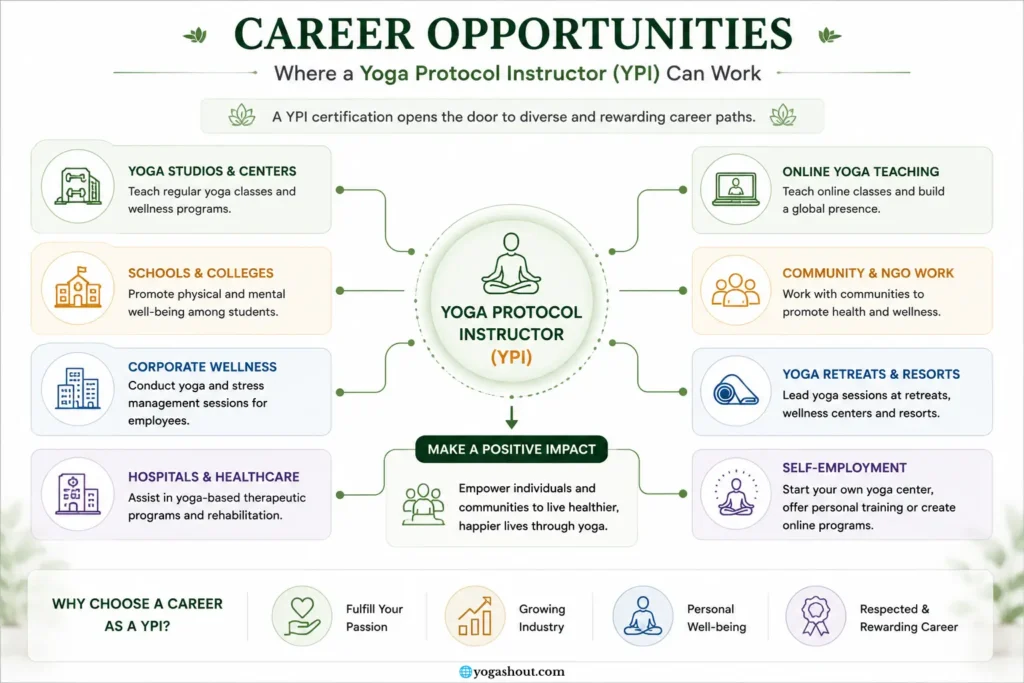
The Yoga Protocol Instructor (YPI) Course prepares you to teach beginner-level yoga and the Common Yoga Protocol while building a strong foundation in yoga philosophy, practical training, and teaching methodology. After gaining experience, many instructors choose to work independently, join wellness organizations, teach in educational institutions, or continue toward higher YCB certification levels.
Let’s explore the most common career opportunities available after completing the course.
1. Become a Yoga Instructor
The most direct career path after completing the YPI course is working as a Yoga Instructor.
As a Yoga Instructor, your primary responsibility is to guide individuals or groups through safe and structured yoga sessions.
Depending on your workplace, your responsibilities may include:
- Conducting beginner yoga classes
- Teaching the Common Yoga Protocol
- Demonstrating yoga postures
- Guiding breathing exercises
- Leading relaxation and meditation sessions
- Encouraging healthy lifestyle habits
This role allows you to apply both the theoretical and practical skills learned during the course.
2. Teach Community Yoga Classes
The official role description of a Yoga Protocol Instructor specifically includes conducting yoga sessions in community settings such as parks, residential societies, and similar public spaces.
Community yoga classes are becoming increasingly popular because they make yoga accessible to people of all age groups.
Examples include:
- Morning park sessions
- Society clubhouse classes
- Community halls
- NGO wellness programs
- Local health awareness camps
Many instructors begin their teaching journey by building experience through community classes before expanding into private or corporate sessions.
3. Work with Yoga Studios and Wellness Centres
Private yoga studios and wellness centres regularly look for instructors who can conduct beginner and general yoga classes.
Depending on the organization, you may teach:
- Beginner Yoga
- General Fitness Yoga
- Morning Yoga Batches
- Evening Yoga Batches
- Group Sessions
- One-to-One Sessions
Working in an established studio also helps new instructors gain valuable teaching experience while learning from senior teachers.
4. Corporate Yoga Instructor
Many companies now include wellness initiatives as part of their employee health programs.
Corporate yoga sessions often focus on:
- Stress management
- Desk yoga
- Back and neck mobility
- Breathing exercises
- Relaxation techniques
These sessions are usually conducted before office hours, during lunch breaks, or as part of employee wellness programs.
If you enjoy working with professionals, corporate yoga can become an excellent career option.
5. School Yoga Instructor
Many schools include yoga as part of their physical education or wellness activities.
A Yoga Protocol Instructor may have opportunities to conduct:
- Morning yoga sessions
- Assembly yoga
- Wellness workshops
- Yoga awareness programs
- International Day of Yoga activities
The exact eligibility requirements for school positions vary depending on the institution and applicable recruitment rules. Before applying, always review the specific qualifications required by the school or education authority.
6. Conduct Online Yoga Classes
Technology has made it possible for yoga instructors to teach students from anywhere in the world.
Many instructors now conduct:
- Live Zoom classes
- Google Meet sessions
- Membership communities
- Online workshops
- Small group coaching
Online teaching offers flexibility and allows instructors to reach students beyond their local area.
Success in online teaching often depends on teaching quality, communication skills, consistency, and the ability to build trust with students.
7. Start Your Own Yoga Classes
Many Yoga Protocol Instructors eventually choose to become self-employed.
You can begin with a small batch of students and gradually expand as your experience grows.
Some common ways to start include:
- Home yoga classes
- Society clubhouse batches
- Rental studio sessions
- Weekend workshops
- Personal training
One of the biggest advantages of this approach is the flexibility to choose your own schedule and teaching style.
8. Offer Private Yoga Sessions
Some students prefer personalized instruction rather than group classes.
Private sessions allow instructors to:
- Focus on individual learning goals
- Provide closer attention
- Adjust practices according to the student’s needs
- Build long-term student relationships
These sessions are often conducted at the student’s home, the instructor’s studio, or online.
9. Participate in Yoga Events and Wellness Programs
Yoga instructors are frequently invited to contribute to:
- Health awareness campaigns
- Community wellness events
- International Day of Yoga celebrations
- College wellness programs
- Public yoga demonstrations
- Local fitness festivals
These opportunities help instructors gain visibility, build confidence, and connect with a wider audience.
10. Continue to Higher YCB Certifications
Many students see the YPI course as the beginning of a long-term career rather than the final goal.
After gaining teaching experience, you can continue your professional development through higher YCB certification levels such as:
- Yoga Wellness Instructor (YWI)
- Yoga Teacher & Evaluator (YTE)
- Yoga Master
If your interests lie in therapeutic applications of yoga, you may also explore the Yoga Therapy pathway, subject to the applicable eligibility requirements.
Higher certifications often expand your knowledge and open additional professional opportunities.
Which Career Path is Best After YPI?
There is no single “best” career option. The right path depends on your interests, experience, and long-term goals.
| Career Goal | Recommended Path |
| Teach beginners | Community or studio classes |
| Flexible work | Freelance or private sessions |
| Employee wellness | Corporate yoga |
| Work with children | School yoga programs |
| Build your own brand | Online classes + personal studio |
| Long-term professional growth | Continue to higher YCB certifications |
Many successful instructors combine several of these opportunities. For example, an instructor might teach morning community classes, conduct evening online sessions, and organize weekend workshops.
How Can You Grow Your Career Faster?
Completing the YPI course is only the first step. Long-term success depends on continuously improving your skills and expanding your professional presence.
Here are a few practical suggestions:
- Practice yoga consistently.
- Continue learning through advanced certifications.
- Improve your communication and teaching skills.
- Build a professional online presence.
- Collect student feedback and testimonials.
- Stay updated with developments in yoga education.
- Participate in workshops and yoga events.
- Teach regularly to gain practical experience.
The instructors who grow the fastest are usually those who combine technical knowledge with consistent teaching experience and a genuine commitment to helping their students.
How to Build a Successful Career After Completing the Yoga Protocol Instructor Course
Completing the Yoga Protocol Instructor (YPI) Course is an important milestone, but it’s only the beginning of your professional journey. Like any profession, success in yoga depends on continuous learning, regular practice, teaching experience, and building trust with your students.
Many aspiring instructors believe that obtaining a certificate automatically leads to career opportunities. In reality, the certification provides the foundation, while your skills, consistency, and experience determine how your career grows.
If your goal is to become a full-time yoga instructor, here’s a practical roadmap that can help you progress step by step.
Step 1: Master Your Own Practice
Before teaching others, focus on becoming confident in your own practice.
Make yoga a part of your daily routine by regularly practicing:
- Asanas
- Pranayama
- Meditation
- Surya Namaskar
- Relaxation techniques
The more consistently you practice, the more natural your teaching will become.
Remember: Students trust instructors who demonstrate confidence, discipline, and consistency.
Step 2: Revise the Fundamentals
After completing the course, don’t put your study materials aside.
Continue revising topics such as:
- Basic yoga philosophy
- Teaching methodology
- Contraindications
- Alignment principles
- Breathing techniques
- Class sequencing
Strong fundamentals make you a better teacher and prepare you for advanced certifications in the future.
Step 3: Start Teaching in a Small Group
Many new instructors hesitate because they feel they need years of experience before teaching.
The best way to build confidence is to start with a small, familiar group.
You can begin by teaching:
- Family members
- Friends
- Neighbours
- Small community groups
Teaching even a few students helps you improve your communication, observation, and class management skills.
Step 4: Gain Practical Teaching Experience
Every class you teach improves your confidence.
As you gain experience, you’ll naturally become better at:
- Giving instructions
- Correcting postures
- Managing different age groups
- Handling beginner questions
- Planning class sequences
- Creating a positive learning environment
Practical experience is one of the most valuable assets in a yoga career.
Step 5: Build Your Professional Identity
Once you’re comfortable teaching, begin presenting yourself professionally.
Simple steps include:
- Creating a professional profile
- Maintaining a consistent teaching schedule
- Using a professional profile photo
- Sharing educational yoga content online
- Collecting testimonials from students
People are more likely to join your classes when they see consistency and professionalism.
Step 6: Continue Learning
Yoga is a lifelong journey.
As your experience grows, continue improving your knowledge through:
- Workshops
- Seminars
- Self-study
- Daily practice
- Higher YCB certifications
Continuous learning helps you stay updated and expand your teaching abilities.
Step 7: Expand Your Teaching Opportunities
Once you’ve built confidence, gradually explore different teaching environments.
For example:
- Community yoga classes
- Yoga studios
- Schools
- Corporate wellness programs
- Online yoga classes
- Personal training
- Weekend workshops
Teaching in different settings exposes you to diverse students and helps you develop as an instructor.
Step 8: Build Long-Term Student Relationships
One of the most successful ways to grow your yoga career is through student satisfaction.
Instead of focusing only on finding new students, focus on helping your existing students achieve their goals.
Satisfied students often:
- Continue learning with you.
- Recommend your classes to others.
- Leave positive reviews.
- Become long-term members of your yoga community.
A strong reputation is one of the greatest assets for any yoga instructor.
Step 9: Continue Your YCB Journey
As your teaching experience increases, consider progressing to higher-level YCB certifications.
A structured progression might look like this:
Yoga Protocol Instructor (YPI)
Yoga Wellness Instructor (YWI)
Yoga Teacher & Evaluator (YTE)
Yoga Master
Each certification helps you expand your knowledge, teaching capabilities, and professional opportunities.
Step 10: Think Beyond Teaching Classes
Many successful yoga professionals eventually expand their work beyond daily classes.
Depending on your interests, you may explore opportunities such as:
- Organizing yoga workshops
- Conducting wellness camps
- Creating online yoga courses
- Writing yoga blogs or books
- Building a YouTube channel
- Offering personalized coaching
- Starting your own yoga institute
Your YPI certification provides the foundation, but your career can evolve in many different directions as your experience grows.
Common Mistakes New Yoga Instructors Should Avoid
Many beginners slow their own growth by making avoidable mistakes.
Here are a few to watch out for:
Waiting until you feel “perfect”
No instructor knows everything. Start teaching, keep learning, and improve with experience.
Ignoring Personal Practice
A good instructor never stops being a student. Continue your own yoga practice regularly.
Copying Other Teachers
Learn from experienced instructors, but gradually develop your own authentic teaching style.
Focusing Only on Certificates
Certificates are important, but students stay because of your teaching quality, communication, and professionalism.
Stopping Learning After Certification
The best yoga instructors continue learning throughout their careers through advanced education, workshops, and practical teaching.
Final Thoughts on Building a Successful Career
The Yoga Protocol Instructor Course gives you the knowledge and practical foundation to begin your teaching journey. What you do after completing the course plays an equally important role in shaping your career.
By practicing regularly, teaching consistently, continuing your education, and building meaningful relationships with students, you can gradually establish yourself as a trusted yoga professional.
Success in yoga rarely happens overnight—but with patience, dedication, and continuous improvement, the Yoga Protocol Instructor Course can become the first step toward a rewarding and meaningful career.
Yoga Protocol Instructor Salary in India
One of the first questions students ask before enrolling in the Yoga Protocol Instructor (YPI) Course is:
“How much can I earn after completing this course?”
The answer isn’t fixed because a Yoga Protocol Instructor’s income depends on several factors, including experience, teaching skills, location, specialization, reputation, and whether they work independently or with an organization.
Unlike many salaried professions, yoga offers multiple earning models. Some instructors work as full-time employees, while others combine studio classes, private sessions, online teaching, and workshops to build their income.
Rather than focusing on a single salary figure, it’s more useful to understand the different ways a Yoga Protocol Instructor can earn.
Factors That Influence Your Income
Two Yoga Protocol Instructors with the same certification may earn very different incomes.
Some of the biggest factors include:
- Teaching experience
- Communication skills
- Quality of instruction
- Location (Metro vs Small City)
- Number of classes conducted
- Full-time or part-time work
- Online presence
- Student retention
- Additional certifications
- Professional reputation
Your certificate opens the door, but your skills and consistency determine how far you go.
Common Earning Models for Yoga Protocol Instructors
One of the advantages of a yoga career is its flexibility.
Many instructors earn through multiple sources rather than relying on a single job.
1. Monthly Salary
Some instructors work with:
- Yoga studios
- Wellness centres
- Schools
- Fitness centres
- Health clubs
In these roles, they usually receive a fixed monthly salary based on their responsibilities and experience.
2. Per-Class Payment
Many organizations pay instructors on a per-session basis.
For example:
- Morning batch
- Evening batch
- Weekend classes
- Special workshops
The more classes you conduct, the greater your earning potential.
3. Private Yoga Sessions
Personal training often allows instructors to work with individuals or small groups who prefer personalized attention.
Private sessions may be conducted:
- At the student’s home
- Online
- At the instructor’s studio
Because of the personalized nature of these sessions, instructors often charge differently than for group classes.
4. Online Yoga Classes
Many instructors now teach students across different cities and countries through online platforms.
Possible formats include:
- Live online classes
- Small group sessions
- Monthly memberships
- Recorded programs
Online teaching can help instructors reach a wider audience while offering greater scheduling flexibility.
5. Workshops and Special Programs
Experienced instructors often organize:
- Weekend workshops
- Yoga camps
- Corporate wellness sessions
- International Day of Yoga events
- Special interest classes
These programs can become an additional source of income while helping instructors build their professional reputation.
Beginner vs Experienced Instructor
Income usually grows with experience.
Beginner Yoga Instructor
A newly certified instructor generally focuses on:
- Building confidence
- Gaining teaching experience
- Developing communication skills
- Growing a student base
At this stage, the priority should be learning rather than maximizing income.
Experienced Yoga Instructor
As instructors gain experience, they often expand their services by:
- Teaching multiple batches
- Conducting private sessions
- Working with organizations
- Building an online audience
- Pursuing advanced certifications
Experience often creates more opportunities than certification alone.
Does Location Affect Salary?
Yes. Income opportunities often vary depending on:
- City size
- Local demand
- Cost of living
- Type of clients
- Availability of wellness centres
- Corporate presence
For example, metropolitan cities may offer more corporate and studio opportunities, while smaller towns may provide greater potential for building a loyal local student community.
Can You Earn Full-Time Through Yoga?
Many professional yoga instructors eventually build a full-time career through yoga.
However, this usually happens by combining different income sources rather than relying on a single class or employer.
For example, an instructor might:
- Teach morning community classes.
- Conduct private sessions in the afternoon.
- Lead online classes in the evening.
- Organize workshops on weekends.
Diversifying your services often creates greater career stability.
How Can You Increase Your Income?
If your goal is to grow professionally, focus on increasing your value rather than chasing quick income.
Some practical ways include:
- Continue practicing regularly.
- Improve your teaching skills.
- Build long-term relationships with students.
- Learn online teaching.
- Develop communication skills.
- Pursue higher YCB certifications.
- Offer specialized programs as your expertise grows.
- Build a professional website and online presence.
The instructors who consistently invest in their skills often create more opportunities over time.
Is Yoga a Good Career Financially?
Yoga may not provide instant high earnings immediately after certification, but it offers something that many professions don’t:
- Flexibility
- Independence
- Multiple earning opportunities
- Personal fulfillment
- Continuous professional growth
For individuals who enjoy teaching, helping others, and continuously learning, yoga can become a rewarding long-term profession.
Rather than viewing the Yoga Protocol Instructor Course as a shortcut to high income, it is better to see it as the first step in building a sustainable and meaningful career.
Frequently Asked Questions About Salary
Can I earn immediately after completing the YPI course?
Yes, some graduates begin teaching beginner-level classes soon after certification. However, actual opportunities depend on your teaching ability, confidence, local demand, and the requirements of employers or clients.
Will higher certifications increase earning potential?
Higher-level certifications can expand your knowledge and may qualify you for broader teaching roles or specialized opportunities. However, income also depends on practical experience, reputation, and the quality of your teaching.
Is freelancing better than a salaried job?
Both have advantages.
A salaried position may provide greater stability, while freelance teaching offers flexibility and the possibility of combining multiple income streams. The right choice depends on your career goals and personal preferences.
Job Opportunities After Completing the Yoga Protocol Instructor (YPI) Course
One of the biggest concerns for aspiring yoga professionals is:
“What job opportunities are available after completing the Yoga Protocol Instructor Course?”
The Yoga Protocol Instructor (YPI) Course prepares learners to teach beginner-level yoga and the Common Yoga Protocol in community and wellness settings. According to the course role description, certified Yoga Protocol Instructors are trained to conduct yoga classes for health promotion and disease prevention in places such as parks, residential societies, and similar community environments.
Beyond these roles, career opportunities depend on your teaching skills, experience, additional qualifications, and the requirements of individual employers.
Let’s explore some of the most common employment opportunities.
1. Yoga Instructor at Yoga Studios
Private yoga studios regularly hire instructors to conduct beginner and general yoga classes.
Typical responsibilities include:
- Teaching group classes
- Demonstrating yoga postures
- Guiding breathing exercises
- Conducting relaxation sessions
- Assisting new students
Working in a studio helps instructors gain valuable teaching experience while building confidence and improving communication skills.
2. Wellness Centres
Many wellness centres include yoga as part of their holistic health programs.
Depending on the organization, instructors may conduct sessions focusing on:
- General wellness
- Flexibility and mobility
- Stress management
- Relaxation practices
- Healthy lifestyle awareness
Some centres may also encourage instructors to continue their education through advanced yoga certifications as they take on broader responsibilities.
3. Schools and Educational Institutions
Many schools organize yoga sessions as part of physical education, health awareness programs, or co-curricular activities.
A Yoga Protocol Instructor may find opportunities to conduct:
- Morning yoga sessions
- Yoga awareness workshops
- International Day of Yoga programs
- Wellness activities for students
However, it’s important to note that schools may have additional recruitment requirements, such as educational qualifications, teacher eligibility criteria, or institution-specific policies. Always check the eligibility criteria of the school or education board before applying.
4. Corporate Wellness Programs
Corporate organizations increasingly recognize the importance of employee wellness.
Yoga instructors may be invited to conduct:
- Workplace yoga sessions
- Desk yoga
- Stress management workshops
- Breathing exercises
- Wellness awareness programs
Corporate sessions are often organized as part of employee health initiatives and may be conducted on-site or online.
5. Community Yoga Programs
Community teaching remains one of the most accessible opportunities for newly certified Yoga Protocol Instructors.
Examples include:
- Public parks
- Residential societies
- Community centres
- NGOs
- Local wellness initiatives
These programs allow instructors to gain teaching experience while promoting healthy lifestyles within their communities.
6. Online Yoga Teaching
The growth of digital learning has created new opportunities for yoga instructors to teach students remotely.
Popular formats include:
- Live online classes
- Small group coaching
- One-to-one online sessions
- Membership-based yoga communities
Online teaching allows instructors to reach learners across different cities and even internationally, provided they build trust and maintain consistent teaching quality.
7. Self-Employment
Many Yoga Protocol Instructors eventually choose to build their own independent practice.
Some common options include:
- Home yoga classes
- Personal yoga coaching
- Weekend yoga batches
- Community classes
- Rental studio sessions
Self-employment offers flexibility and allows instructors to gradually build their own student base.
8. Health & Fitness Centres
Gyms, fitness clubs, and recreation centres often include yoga within their fitness programs.
Instructors may conduct:
- Beginner yoga
- Stretching sessions
- Mobility classes
- Recovery-focused yoga
- Group wellness sessions
Requirements vary depending on the organization and the specific role.
9. International Day of Yoga & Government-Supported Wellness Events
Every year, organizations across India conduct yoga programs during the International Day of Yoga and other wellness initiatives.
Yoga Protocol Instructors may have opportunities to participate in:
- Public yoga demonstrations
- Community awareness campaigns
- School events
- Wellness camps
- Yoga workshops
These events also provide valuable networking opportunities with other yoga professionals.
Can You Get a Government Job After Completing the YPI Course?
This is one of the most searched questions online.
The honest answer is:
The Yoga Protocol Instructor certification can strengthen your profile for certain yoga-related opportunities, but it does not automatically guarantee a government job.
Government recruitment depends on several factors, including:
- The eligibility criteria mentioned in the official recruitment notification.
- Educational qualifications.
- Experience requirements.
- Reservation policies (where applicable).
- Selection procedures.
Whenever applying for a government vacancy, always read the official notification carefully to confirm whether the YPI certification is accepted for that specific post.
Can You Teach Yoga in Schools?
Yes, opportunities may exist to teach yoga in schools, particularly where yoga forms part of wellness or physical education activities.
However, eligibility requirements vary from one institution to another.
Some schools may require:
- Additional educational qualifications
- Teaching experience
- Teacher training credentials
- Institution-specific certifications
Before applying, review the recruitment criteria issued by the school or education authority.
Can You Open Your Own Yoga Studio After YPI?
Many yoga instructors eventually establish their own yoga centres or studios after gaining teaching experience.
While the YPI course provides foundational teaching skills, successfully running a yoga studio also involves:
- Building a student community
- Managing operations
- Marketing your services
- Delivering consistent teaching quality
- Continuing your professional development
Many instructors begin with small community batches before expanding into a dedicated studio.
Can You Teach Yoga Abroad?
The recognition of yoga qualifications varies between countries and employers.
Some international organizations may evaluate:
- Your certification
- Practical teaching experience
- Communication skills
- Additional qualifications
- Local legal or employment requirements
If your long-term goal is to teach internationally, it’s advisable to research the requirements of the specific country or organization where you wish to work.
Tips for Improving Your Job Prospects
Regardless of where you plan to work, employers and students generally value instructors who combine certification with practical skills.
To improve your career opportunities:
- Practice yoga consistently.
- Build teaching experience.
- Continue your education through advanced certifications.
- Develop strong communication skills.
- Learn to teach different age groups.
- Maintain a professional portfolio.
- Collect testimonials from students.
- Stay updated with developments in yoga education.
Your long-term career growth will depend not only on your certification but also on your commitment to continuous learning and professional development.
How to Choose the Best Yoga Protocol Instructor Course
Today, many institutes offer the Yoga Protocol Instructor (YPI) Course in both online and offline formats. While having multiple options is beneficial, it can also make choosing the right institute more challenging.
The quality of your learning experience depends not only on the syllabus but also on how the course is taught. Two institutes may follow the same curriculum, yet the learning outcomes can be very different depending on the faculty, practical training, and student support they provide.
Before enrolling, it’s worth comparing a few important factors.
1. Does the Course Follow the Official YPI Syllabus?
The first thing you should check is whether the institute teaches the complete Yoga Protocol Instructor syllabus.
A good course should cover:
- Theory modules
- Practical yoga training
- Teaching methodology
- Demonstration skills
- Lesson planning
- Examination preparation
Avoid courses that focus only on yoga practice while ignoring the theoretical and teaching components.
2. Is Practical Training Given Enough Importance?
Yoga is a practical discipline.
Simply watching recorded videos is rarely enough to become a confident instructor.
Look for a course that includes:
- Live demonstrations
- Practice sessions
- Teaching practice
- Feedback from trainers
- Class presentation opportunities
The more practical exposure you receive, the more confident you’ll feel while teaching real students.
3. Who Are the Trainers?
Your learning experience depends greatly on the faculty.
Before enrolling, check:
- Teaching experience
- Yoga qualifications
- Experience in conducting YPI training
- Ability to explain concepts clearly
- Student reviews and feedback
Experienced trainers often make complex yogic concepts much easier to understand.
4. Is Student Support Available?
Learning doesn’t stop after the live class ends.
A good institute should provide support whenever students have questions or need clarification.
For example:
- Doubt-solving sessions
- Assignment guidance
- Faculty interaction
- Community support
- Prompt communication
Good support helps students stay motivated throughout the course.
5. Does the Course Balance Theory and Practice?
A strong Yoga Protocol Instructor Course should maintain a healthy balance between classroom learning and practical application.
Students should not only understand yoga philosophy but also develop the confidence to:
- Demonstrate yoga practices
- Teach beginners
- Plan yoga sessions
- Conduct complete classes independently
6. Is the Learning Mode Suitable for You?
Different students have different learning preferences.
Depending on the institute, you may find:
- Online live classes
- Offline classroom training
- Hybrid learning
- Weekend batches
- Regular weekday batches
Choose a format that fits your schedule while giving you enough opportunity to practice regularly.
7. Are You Looking Beyond Just a Certificate?
Many students focus only on receiving a certificate.
However, the real value of the course lies in the knowledge, confidence, and teaching skills you gain during the training.
When comparing institutes, ask yourself:
“Will this course prepare me to teach yoga confidently?”
If the answer is yes, you’re likely making a better long-term investment.
Why Many Students Choose Yoga Shout
At Yoga Shout, our goal is not just to help students complete a course but to help them become confident yoga instructors.
Our Yoga Protocol Instructor Course is designed around the official curriculum while placing strong emphasis on practical learning and student support.
Some of the key features include:
- Comprehensive coverage of the YPI syllabus.
- Experienced yoga faculty.
- Live interactive training sessions.
- Focus on practical teaching skills.
- Guidance for examinations and assessments.
- Continuous student support throughout the learning journey.
Whether you’re a beginner or an aspiring yoga professional, our objective is to help you build a strong foundation for your future career in yoga.
Explore our Yoga Protocol Instructor Course to view the latest batch schedule, curriculum, and admission details.
Before You Enroll: A Quick Checklist
Use this checklist while comparing different institutes:
✅ Complete syllabus coverage
✅ Qualified and experienced trainers
✅ Practical teaching sessions
✅ Student doubt support
✅ Live interaction with faculty
✅ Transparent course information
✅ Suitable learning format
✅ Positive student feedback
If an institute meets most of these criteria, you’re more likely to receive a meaningful learning experience rather than just completing a certification.
Yoga Protocol Instructor (YPI) vs Yoga Wellness Instructor (YWI): Which Course is Right for You?
Many aspiring yoga professionals are confused about the difference between the Yoga Protocol Instructor (YPI) and Yoga Wellness Instructor (YWI) courses.
Since both certifications are offered under the Yoga Certification Board (YCB), it’s natural to wonder:
- Which course should I choose?
- Can I directly enroll in YWI?
- Is YWI better than YPI?
- What are the career differences?
The simple answer is:
These courses are not competitors—they are designed to complement each other.
The Yoga Protocol Instructor Course builds your foundation as a yoga teacher, while the Yoga Wellness Instructor Course expands your knowledge and prepares you for broader teaching responsibilities.
Quick Comparison
| Feature | Yoga Protocol Instructor (YPI) | Yoga Wellness Instructor (YWI) |
| Certification Level | Level 1 | Level 2 |
| Training Hours | 200 Hours | 400 Hours |
| Primary Focus | Teaching beginner-level yoga | Teaching yoga for health and wellness |
| Suitable For | Aspiring yoga instructors | Instructors who want to advance professionally |
| Course Depth | Foundation teaching skills | Advanced knowledge and teaching competencies |
| Career Growth | Entry-level professional teaching | Expanded teaching and wellness opportunities |
What is the Yoga Wellness Instructor Course?
The Yoga Wellness Instructor Course represents the next stage in professional development.
While YPI focuses on foundational teaching, YWI expands your understanding of yoga as a tool for promoting health and wellness.
Students generally explore:
- Broader wellness applications of yoga.
- More advanced teaching competencies.
- Deeper understanding of yogic principles.
- Expanded practical knowledge.
- Working with diverse learner groups.
It is designed for instructors who want to continue growing professionally after establishing a solid teaching foundation.
The Biggest Difference
The easiest way to understand the difference is this:
Yoga Protocol Instructor teaches you how to become a yoga instructor.
Yoga Wellness Instructor helps you become a more skilled and knowledgeable yoga professional.
Think of it like this:
- YPI builds the foundation.
- YWI builds upon that foundation.
One prepares you to begin teaching.
The other prepares you to teach with greater depth, confidence, and understanding.
Course Structure Comparison
| Area | YPI | YWI |
| Yoga Philosophy | ✔️ Foundation | ✔️ More Detailed |
| Practical Yoga | ✔️ | ✔️ Advanced |
| Teaching Skills | ✔️ | ✔️ Expanded |
| Health Promotion | ✔️ Basic | ✔️ More Comprehensive |
| Professional Development | Entry Level | Advanced Level |
Which Course Should You Choose?
Choose Yoga Protocol Instructor if:
- You want to begin your professional yoga journey.
- You are looking for your first instructor-level certification.
- You want to develop teaching confidence.
- You plan to conduct beginner yoga classes.
- You want to build a strong foundation before pursuing higher certifications.
Choose Yoga Wellness Instructor if:
- You have already developed a foundation in yoga instruction.
- You want to expand your professional knowledge.
- You are ready for a more comprehensive learning experience.
- You plan to continue progressing within the YCB certification pathway.
Can You Join YWI Directly?
This is a common question.
The answer depends on the current eligibility criteria prescribed for the Yoga Wellness Instructor Course and the admission requirements of the institute offering the program.
Before enrolling, always verify the latest eligibility requirements with your chosen training institute and the applicable YCB guidelines.
For many students, progressing step by step through the certification pathway provides a more structured and rewarding learning experience.
Which Course Offers Better Career Opportunities?
This isn’t really a question of “better.”
Instead, think about career progression.
A Yoga Protocol Instructor begins by developing the skills needed to teach yoga professionally.
As experience grows, completing the Yoga Wellness Instructor Course can broaden knowledge, strengthen teaching capabilities, and support further professional development.
In other words:
YPI helps you start your career.
YWI helps you grow your career.
Is the Yoga Protocol Instructor (YPI) Course Worth It?
If you’ve read this guide so far, you probably have one final question:
“Is the Yoga Protocol Instructor Course worth joining?”
The answer depends on your goals.
The YPI Course is not designed for everyone. It is a professional certification intended for people who want to develop teaching skills and build a career in yoga.
If your expectations match the purpose of the course, it can be an excellent investment in your personal and professional growth.
Let’s understand who will benefit the most.
The YPI Course is Worth It If…
✅ You Want to Become a Yoga Instructor
If your goal is to teach yoga professionally, the Yoga Protocol Instructor Course provides a structured introduction to:
- Yoga philosophy
- Practical yoga training
- Teaching methodology
- Class management
- Demonstration skills
Instead of learning yoga randomly, you follow a systematic curriculum that prepares you to teach beginner-level classes with confidence.
✅ You Want a Career in Yoga
If you see yoga as more than a hobby, this course is a logical first step.
Many students complete YPI with plans to:
- Teach yoga professionally.
- Conduct community classes.
- Start independent yoga batches.
- Work with wellness centres.
- Continue toward higher YCB certifications.
For anyone planning long-term growth in the yoga field, YPI provides a solid foundation.
✅ You Enjoy Helping Others
Teaching yoga is not only about demonstrating postures.
It also involves:
- Motivating students.
- Creating a safe learning environment.
- Encouraging healthy habits.
- Supporting people in their wellness journey.
If helping others gives you satisfaction, you’ll likely enjoy teaching yoga.
✅ You Want Structured Learning
Many people try learning yoga through videos or occasional classes but struggle to build a complete understanding.
The YPI Course offers a structured pathway that combines:
- Theory
- Practical training
- Teaching skills
- Health promotion
- Assessment
This organized approach makes learning more systematic.
✅ You Plan to Continue Learning
The YPI Course is often the beginning rather than the destination.
If you want to continue progressing through advanced yoga certifications and expand your knowledge over time, YPI provides the foundation on which future learning can build.
The YPI Course May Not Be the Right Choice If…
Being honest about who the course is not for builds trust with readers.
❌ You Only Want Occasional Yoga Practice
If your only goal is to practice yoga once or twice a week for personal fitness, a professional instructor course may be more than you currently need.
A beginner-friendly foundation program may be a better starting point.
❌ You Want Instant Career Success
No certification can guarantee immediate success.
Like any profession, yoga requires:
- Practice
- Teaching experience
- Communication skills
- Continuous improvement
Students who understand this usually build stronger and more sustainable careers.
❌ You Are Looking Only for a Certificate
The real value of the course lies in the skills you develop—not simply the certificate you receive.
Students who actively participate in practical sessions and teaching practice generally gain much more from the course than those who focus only on certification.
Our Honest Opinion
If your goal is simply to collect another certificate, this course may not provide the value you’re looking for.
However, if you genuinely want to:
- Learn yoga properly,
- Build confidence as a teacher,
- Develop practical teaching skills,
- Begin a professional yoga journey,
then the Yoga Protocol Instructor Course is well worth considering.
The knowledge and confidence you gain during the training can continue to benefit you long after the course has ended.
Why We Believe the YPI Course is Valuable
At Yoga Shout, we’ve interacted with students from different backgrounds—beginners, working professionals, homemakers, fitness enthusiasts, and aspiring yoga teachers.
One pattern we’ve consistently observed is that students who approach the course with curiosity, regular practice, and a willingness to teach often gain much more than technical knowledge.
They become:
- More confident communicators.
- Better practitioners.
- More disciplined in daily life.
- More comfortable leading yoga sessions.
- Better prepared for advanced learning.
While every student’s journey is unique, the skills developed during the course often extend beyond the yoga classroom.
Frequently Asked Questions (FAQs) About Yoga Protocol Instructor (YPI) Course
General Questions
1. What is the Yoga Protocol Instructor (YPI) Course?
The Yoga Protocol Instructor (YPI) Course is a Level 1 professional yoga certification under the Yoga Certification Board (YCB). It is designed to prepare learners to teach beginner-level yoga classes by combining yoga philosophy, practical training, teaching methodology, and health promotion.
2. Who should join the Yoga Protocol Instructor Course?
The course is suitable for:
- Aspiring yoga teachers
- Yoga practitioners who want to teach professionally
- Fitness professionals
- School teachers interested in yoga
- Homemakers
- Working professionals looking for a second career
3. Is the Yoga Protocol Instructor Course suitable for beginners?
Yes. Although the course prepares students for professional teaching, the curriculum starts with yoga fundamentals. Beginners who are willing to learn and practice consistently can successfully complete the course.
4. What is the duration of the Yoga Protocol Instructor Course?
According to the official curriculum, the course requires a minimum of 200 training hours. Generally:
- Full-time: Minimum 1 month
- Part-time: Minimum 3 months
The exact schedule depends on the training institute.
5. Is the Yoga Protocol Instructor Course difficult?
Not usually. Students who attend classes regularly, practice consistently, and revise the syllabus generally find the course manageable. The practical examination carries more weight than theory, so regular practice is important.
Eligibility FAQs
6. What is the eligibility for the Yoga Protocol Instructor Course?
The official syllabus recommends a 10th pass (Secondary School Certificate) or equivalent for open candidates. Training institutes may specify their own admission criteria.
7. Is there an age limit for the YPI Course?
No. The syllabus does not prescribe a minimum or maximum age limit.
8. Can I join the YPI Course after Class 10?
Yes. The recommended educational qualification is passing the 10th standard or an equivalent examination.
9. Do I need previous yoga experience?
No. Previous experience is helpful but not compulsory. The course starts with the basics before progressing toward teaching skills.
10. Can working professionals join this course?
Yes. Many institutes offer part-time, weekend, or online batches suitable for working professionals.
Course & Examination FAQs
11. What subjects are taught in the YPI Course?
The curriculum includes:
- Yoga philosophy
- History of Yoga
- Yoga texts
- Health promotion
- Yogasana
- Pranayama
- Meditation
- Teaching methodology
- Practical yoga training
12. Does the course include practical training?
Yes. Practical training forms the largest part of the course and includes yoga practices, demonstration skills, lesson planning, and teaching practice.
13. How many marks are allotted for practical examination?
The practical assessment carries 140 marks, while theory carries 60 marks, making practical performance the major component of evaluation.
14. Is attendance important?
Yes. Since yoga is a practical discipline, regular attendance helps students develop confidence, improve technique, and prepare effectively for practical assessments.
15. What happens if I fail the examination?
The examination and re-assessment process may vary depending on the applicable YCB guidelines and the policies of the training institute. Students should check the latest rules with their institute.
Certification FAQs
16. Will I receive a certificate after completing the course?
Eligible students who successfully complete the training and assessment receive certification through the applicable Yoga Certification Board (YCB) process.
17. Is the YPI certificate valid across India?
The certificate is issued under the applicable YCB framework. Its acceptance for employment depends on the eligibility criteria of individual employers and recruitment authorities.
18. Is this a Government certification?
The Yoga Certification Board functions under the Ministry of AYUSH, Government of India. Students should always verify the latest certification process and requirements with their institute before enrolling.
Career FAQs
19. What can I do after completing the Yoga Protocol Instructor Course?
After completing the course, you may explore opportunities such as:
- Yoga studios
- Wellness centres
- Community yoga programs
- Corporate wellness sessions
- Online yoga classes
- Independent yoga coaching
Career opportunities depend on your skills, experience, and employer requirements.
20. Can I teach yoga online after YPI?
Yes. Many instructors conduct online classes through video conferencing platforms or membership-based communities.
21. Can I open my own yoga centre after completing YPI?
Many instructors eventually start their own yoga classes or studios after gaining practical teaching experience and building a student base.
22. Can I teach yoga abroad?
Opportunities depend on the country, employer, visa regulations, and local qualification requirements. Always check the requirements of the country where you plan to teach.
23. Can I get a government job after YPI?
The YPI certification may be considered for certain yoga-related positions where it meets the eligibility criteria. However, it does not automatically guarantee a government job. Always refer to the official recruitment notification for specific eligibility requirements.
Salary FAQs
24. How much can a Yoga Protocol Instructor earn?
Income varies depending on:
- Experience
- Teaching skills
- Location
- Number of classes
- Employment type
- Student base
There is no fixed salary for all instructors.
25. Can I work part-time after completing YPI?
Yes. Many instructors begin by teaching part-time before transitioning to full-time yoga teaching.
26. Does experience affect salary?
Absolutely. As instructors gain teaching experience, improve their skills, and build a reputation, they often become eligible for more opportunities and higher-paying roles.
Course Comparison FAQs
27. Should I choose Foundation Course in Yoga or YPI?
If you’re completely new to yoga and want to build confidence, the Foundation Course in Yoga is an excellent starting point. If your goal is to teach yoga professionally, the Yoga Protocol Instructor Course is the more appropriate choice.
28. What is the difference between YPI and YWI?
YPI is the entry-level professional instructor certification, while YWI is the next level that builds on this foundation with broader knowledge and teaching competencies.
29. Can I join YWI directly?
Yes, you can, but Admission depends on the current eligibility criteria prescribed for the Yoga Wellness Instructor Course and the institute’s admission requirements. Always verify the latest guidelines before applying.
Admission FAQs
30. How do I choose the best Yoga Protocol Instructor Course?
Look for an institute that offers:
- Complete syllabus coverage
- Experienced trainers
- Practical teaching sessions
- Student support
- Transparent information
- Live interaction and feedback
31. Is an online YPI Course worth it?
An online course can be effective if it includes live practical sessions, opportunities for interaction with trainers, and regular feedback. The quality of teaching and practical guidance is often more important than the delivery mode itself.
32. What should I check before enrolling?
Before joining any institute, consider:
- Course curriculum
- Faculty experience
- Practical training
- Student reviews
- Assessment process
- Learning support
- Fee transparency
33. Is the Yoga Protocol Instructor Course worth it?
If your goal is to become a yoga instructor and build a professional career in yoga, the Yoga Protocol Instructor Course provides a structured pathway to develop the knowledge, practical skills, and teaching confidence needed to begin that journey.
Conclusion
The Yoga Protocol Instructor (YPI) Course is an excellent starting point for anyone who wants to build a professional career in yoga. With a structured curriculum, practical training, and YCB certification, it helps you develop the knowledge and teaching skills needed to confidently conduct yoga sessions.
If you’re planning to enroll, choose an institute that focuses on quality training, practical learning, and student support—not just certification.
At Yoga Shout, we are committed to providing a comprehensive learning experience through live classes, experienced faculty, practical sessions, and dedicated guidance to help students prepare for the YCB examination with confidence.
Before you go, you may also find these guides helpful:
- Government Yoga Certification (YCB) Guide
- Yoga Wellness Instructor (YWI) Course
- Yoga Therapist Course
- Yoga Teacher & Evaluator Course
We hope this guide has helped you understand the Yoga Protocol Instructor Course and make an informed decision. We wish you success on your yoga journey. Namaste! 🙏