
If you’ve already read our Yoga Certification Board (YCB) guide, you know the government has built a clear ladder for yoga teachers in India — Yoga Volunteer, then Yoga Protocol Instructor (Level 1), then Yoga Wellness Instructor (Level 2), then Yoga Teacher & Evaluator (Level 3), and so on. This article is about the second step on that ladder: the Yoga Wellness Instructor (YWI) course.
If you’ve done the Yoga Protocol Instructor (YPI) course, or you already teach basic asanas and pranayama somewhere, YWI is the natural next move. It’s where you stop just “leading a class” and start actually understanding why a practice works, who it’s suitable for, and how to teach it safely to real people with real bodies — students, office-goers, seniors, people managing lifestyle conditions.
This is not a fluff certificate. It’s a 400-hour, government-recognised Level 2 qualification under the Yoga Certification Board, Ministry of AYUSH, built around three theory units (Yoga philosophy, Yoga texts, and Yoga for Wellness) and a much heavier practical component — shatkarma, asanas, pranayama, bandhas, mudras, and teaching methodology.
In this guide, we’re going to walk through everything the official YCB syllabus covers — not just list it, but actually explain it in plain language: what each topic means, why YCB put it in the syllabus, what you’ll actually learn, and how it helps you once you’re standing in front of a class. Alongside that, we’ll cover eligibility, duration, fees, exam pattern, certification, career paths, and how YWI compares to the courses before and after it (Foundation Course, YPI, and YTE) — so you know exactly where this fits in your journey and whether it’s the right next step for you.
One honest note before we start: we’re not going to throw big salary numbers at you or promise instant jobs. Yoga is a skill-and-trust profession — what you earn and where you work depends on your teaching, your niche, and your effort after certification. What we can tell you clearly is what the course actually teaches, what it takes to complete it, and what doors it realistically opens. Let’s get into it
Yoga Wellness Instructor Course at a Glance
| Detail | Information |
| Course Name | Yoga Wellness Instructor (YWI) |
| YCB Level | Level 2 |
| Governing Body | Yoga Certification Board (YCB), Ministry of AYUSH, Govt. of India |
| Eligibility | Open to all; 12th pass (or equivalent) suggested |
| Minimum Age | No age limit |
| Course Duration | Minimum 400 hours |
| Credit Points | 24 credits |
| Total Marks | 200 (Theory: 60 + Practical: 140) |
| Theory Units | 3 (Yoga & Yogic Practices, Yoga Texts, Yoga for Wellness) |
| Practical Marks Split | Demonstration: 80, Teaching Skills: 40, Application of Knowledge: 10, Field Experience: 10 |
| Certificate Issued By | YCB, Ministry of AYUSH (verifiable by QR code) |
| Role After Certification | Teach yoga for prevention of illness and wellness promotion — schools, studios, workplaces, wellness centres, primary health care centres |
| Comes After | Yoga Protocol Instructor (Level 1) |
| Leads To | Yoga Teacher & Evaluator (Level 3) |
A quick way to think about it: YPI teaches you to lead a class. YWI teaches you to understand and adapt it.
Table of Contents
What is Yoga Wellness Instructor Course?
The Yoga Wellness Instructor (YWI) course is a Level 2 certification created by the Yoga Certification Board (YCB) under the Ministry of AYUSH, Government of India. In simple terms, it trains you to teach yoga specifically for preventing illness and promoting wellness — not just leading a general asana class, but understanding how yoga practices affect the body and mind well enough to guide people safely and purposefully.
Where the Foundation-level and YPI courses focus on the basics — getting comfortable with common postures, breathing practices, and simple teaching — YWI goes a level deeper. You study yoga philosophy from classical texts (not just as history, but to understand why yoga is structured the way it is), you learn a much wider range of asanas, pranayama, shatkarma (cleansing techniques), bandhas and mudras, and you spend real time on teaching methodology — lesson planning, class management, spotting and correcting mistakes.
Officially, YCB describes the role of a certified Yoga Wellness Instructor as someone who can teach yoga “for prevention of illness and promotion of wellness in schools, Yoga studios, work places, Yoga wellness centres, Primary Health care centres etc.” That’s a genuinely broader scope than the Level 1 role, which is largely about basic Common Yoga Protocol sessions in parks and community settings.
It helps to think of YWI as the course where yoga stops being something you demonstrate and starts becoming something you teach with understanding. You’re expected to know not just the “what” of a practice, but the “why” — why a particular asana helps with a particular issue, why certain breathing techniques calm the nervous system, why sequencing matters. That understanding is what separates someone who can follow a routine from someone people trust with their health.
It’s also worth being clear about what YWI is not. It’s not a therapy or medical qualification — you’re not being trained to treat diagnosed conditions or replace a doctor. It’s a wellness-and-prevention qualification. And it’s not a shortcut — at 400 hours, it asks for real time and consistency, not a weekend crash course.
If YPI was about learning to hold a class, YWI is about learning to actually serve the people in it.
Yoga Wellness Instructor Course Eligibility
The good news: YWI has no strict entry barrier. The official YCB syllabus is clear on this — for open candidates, there is no eligibility criterion at all. That said, it’s suggested (not mandatory) that a candidate should have passed 12th standard (higher secondary) from a recognised board, or equivalent. Individual training institutions are also allowed to set their own admission criteria, so it’s worth checking with the specific institute you’re enrolling with.
There’s also no minimum or maximum age limit, which means whether you’re a college student exploring yoga as a career, a working professional planning a shift, or someone in their 40s or 50s wanting to teach after years of personal practice — you’re eligible to apply.
Do you need prior yoga experience? YCB does not require prior yoga experience as an eligibility condition. However, because the YWI syllabus is extensive and practical, beginners may find prior yoga practice or YPI training helpful.
Who should take this course? YWI tends to be the right fit if you fall into one of these groups:
- You’ve completed the Foundation Course or YPI (Level 1) and want to move to a more serious, teaching-focused qualification.
- You already teach basic yoga informally and want a government-recognised credential to back it up.
- You want to work in schools, wellness centres, corporate wellness programs, or studios, where a deeper understanding of practices (not just demonstration) is expected.
- You’re personally experienced in yoga and want to turn that into a structured, credible teaching qualification.
If you’re a complete beginner who’s never stepped onto a mat, it’s worth starting with the Foundation Course or YPI first — YWI will make a lot more sense once the basics are already familiar.
Documents typically required for enrollment:
- Proof of age and identity (Aadhaar card, passport, or similar government ID)
- Educational certificate (10th/12th marksheet, where applicable)
- Passport-size photographs
- Any prior yoga certification (if applicable — not mandatory, but useful for the institute’s records)
Exact document requirements can vary slightly by training institute, so it’s best to confirm this with wherever you enroll.
Yoga Wellness Instructor Course Duration
The Yoga Wellness Instructor (YWI) course duration is a minimum of 400 hours, as fixed by the Yoga Certification Board — covering live instruction, guided practical training, assessments, and independent practice time.
It’s worth understanding that 400 hours was never meant to be 400 hours of continuous live lecturing. A meaningful share of it is naturally self-practice — because no instructor can do your asanas or pranayama repetitions for you; you have to build that competence yourself, the same way a driving course includes hours you spend actually driving, not just sitting in a classroom. YCB’s total hour requirement accounts for exactly this: live teaching, supervised practical correction, assessment time, and your own independent practice, combined.
Part-time vs full-time — which should you pick?
- Part-time format suits people balancing YWI alongside a job or other commitments — training is spread out so it’s easier to sustain daily life alongside it.
- Full-time, condensed daily format suits people who want focused, efficient training without dragging the calendar out over many months — ideal if you want to get certified and start teaching sooner, without compromising on actual hours.
Yoga Wellness Instructor Course Fees
Before we get into numbers, one important thing to understand: YWI fees have two separate parts, and people often confuse them.
- Training/Course Fee — paid to the institute (like Yoga Shout) for the actual 400-hour training, study material, and guidance in preparing for the exam.
- Certification Exam Fee — paid separately, directly to the YCB-approved exam centre, when you sit for the theory and practical exams.
Why the fee varies so much between institutes:
- Online vs offline mode
- Live sessions vs recorded/self-paced content
- Language of instruction (English, Hindi, Hinglish)
- Whether personal mentorship, doubt-clearing sessions, or study material is included
- Domestic vs international candidates (foreign candidates are often charged differently)
Our honest advice before you pay for any course:
- Ask the institute for a clear breakup: what’s included in the training fee, and what the exam fee will separately cost.
- Confirm the exam fee is paid directly to the YCB-approved exam centre — not bundled in an unclear way.
- Be cautious of any institute promising a “guaranteed pass” for extra money — that’s not how a government-conducted exam works.
For current, exact YWI pricing at Yoga Shout, it’s best to check our Yoga Wellness Instructor course page directly, since fees can be updated from time to time and we don’t want to quote a number here that goes stale.
Complete Yoga Wellness Instructor Syllabus
Unit 1: Introduction to Yoga and Yogic Practices (20 Marks)
This unit builds your philosophical foundation — the “why” behind everything you’ll later teach. Skip it, and you’re just copying movements; understand it, and you can actually answer a student’s questions with confidence.
1.1 Yoga: Etymology, Definitions, Aim, Objectives and Misconceptions You’ll study what “Yoga” really means — its Sanskrit root “Yuj” (to unite) — and how it’s defined across the Patanjala Yoga Sutra, Bhagavad Gita, and Kathopanishad. This matters because most people walking into your class carry wrong assumptions: that yoga is just stretching, or a religion, or needs flexibility to start. Clearing that up on day one, with real textual grounding rather than guesswork, immediately builds student trust.
1.2 Yoga: Its Origin, History and Development A timeline of yoga’s evolution — from Vedic roots through the classical Patanjali period to Hatha Yoga and its modern global spread. This context helps you place any style a student mentions (power yoga, hot yoga, restorative yoga) accurately, instead of vaguely saying “it’s all yoga,” and answer the common “is this the real yoga?” question with actual substance.
1.3 Brief Introduction to Samkhya and Yoga Darshana Samkhya and Yoga Darshana are two of the six classical Indian philosophical schools. Samkhya explains reality through Purusha (consciousness) and Prakriti (matter), and Yoga builds a practical path on that base. This is genuinely one of the harder theory topics, but it’s what lets you answer deeper “why” questions from serious students later on — terms like Guna and Prakriti won’t make sense without it.
1.4 Life Sketches and Teachings of Yoga Masters You’ll study the core teachings of Maharishi Ramana, Shri Aurobindo, Swami Vivekananda, and Swami Dayananda Saraswati — each representing a different approach to yoga, from self-inquiry to practical Vedanta. Having credible reference points to quote adds real authenticity to your teaching, well beyond generic social-media-style yoga content.
1.5 Principles of Yoga and Practices of Healthy Living This connects on-the-mat practice to daily life — diet, sleep, discipline, and lifestyle habits. Students often expect yoga alone to “fix” their health while ignoring everything else. Being able to give realistic, whole-life guidance (not just a 45-minute routine) is exactly what keeps students returning and referring others to you.
1.6 Principles and Practices of Jnana Yoga Jnana Yoga is the path of knowledge — using self-inquiry and discernment between the real and unreal to reach clarity. It’s useful for teaching reflective, philosophically-minded students who want more than physical postures, letting you introduce contemplative practice meaningfully rather than superficially.
1.7 Principles and Practices of Bhakti Yoga Bhakti Yoga is the path of devotion, expressed through chanting, prayer, and surrender. Understanding it properly lets you lead or explain any prayer/chanting component of a class with genuine meaning, not just as a ritual formality — especially valuable with devotionally-inclined students.
1.8 Principles and Practices of Karma Yoga Karma Yoga — selfless action without attachment to outcome, as taught in the Bhagavad Gita — is arguably the most practically relevant path for modern life. Most students can’t renounce daily responsibilities, but everyone works and acts. This teaching often resonates with stressed, working professionals more than any physical posture will.
1.9 Sukshma Vyayama, Sthula Vyayama, and Surya Namaskara These are your warm-up tools — subtle joint-loosening movements (Sukshma), bigger circulation-building movements (Sthula), and the structured Surya Namaskara sequence. Knowing their purpose and sequencing logic means you can build a genuinely safe warm-up — something many self-taught instructors skip or rush, leading to avoidable injuries.
1.10 Shatkarma: Meaning, Types, Principles and Significance Shatkarma covers the six classical Hatha Yoga cleansing techniques (Neti, Dhauti, Kapalbhati, and others), meant to purify the body before deeper pranayama and meditation work. Many general fitness-yoga instructors never learn this properly — knowing it well sets you apart as a more classically grounded teacher.
1.11 Yogasana: Meaning, Definition, Types and Significance This corrects a common misconception: asana isn’t just a shape, it’s “Sthira Sukham Asanam” — a steady, comfortable posture, one limb among eight. This shifts how you teach postures — with intention and comfort in mind, not just alignment — which is both safer and more aligned with authentic yoga teaching.
1.12 Pranayama: Meaning, Definition, Types and Significance Pranayama — control and extension of breath — is one of yoga’s most powerful and most misused tools; taught carelessly, it can cause dizziness or anxiety rather than calm. This topic builds the theoretical base before the practical pranayama training later in the syllabus, making it one of the highest-value topics in the whole course.
1.13 Introduction to Tri Bandha and Their Health Benefits Tri Bandha covers the three energy locks of Hatha Yoga — Jalandhara, Uddiyana, and Mula Bandha — used to direct energy during pranayama and advanced practice. These are frequently taught incorrectly or skipped by undertrained instructors; understanding them properly means you can teach them safely, or knowingly leave them out for beginners.
1.14 Dhyana and Its Significance in Health and Wellbeing Dhyana (meditation) means a sustained, unbroken flow of attention — different from simply “sitting quietly.” Since stress relief is one of the top reasons people join yoga classes, being able to teach meditation with real structure (not vague “just breathe” cues) is a major professional advantage.
1.15 Yogic Relaxation Techniques, with Special Reference to Yoga Nidra This covers structured relaxation methods, especially Yoga Nidra — a guided, systematic technique often called “yogic sleep,” though awareness is maintained throughout. A strong, well-guided closing relaxation is often the single biggest reason students return to your class week after week.
Unit 2: Introduction to Yoga Texts (20 Marks)
This unit takes you into the classical scriptures themselves — Bhagavad Gita, Patanjala Yoga Sutra, and Hatha Yoga texts. It’s where you move from “what yoga teaches” to “what the original texts actually say,” which is what real depth in yoga teaching is built on.
2.1 Prasthanatrayee, Purushartha Chatushtaya and the Goal of Human Life Prasthanatrayee refers to the three foundational texts of Vedanta (Upanishads, Bhagavad Gita, Brahma Sutras), and Purushartha Chatushtaya is the classical framework of the four aims of human life — Dharma, Artha, Kama, Moksha. Understanding this gives you a framework to explain to students why yoga isn’t just about physical goals, but a complete life philosophy.
2.2 Yoga in Kathopanishad, Prashnopanishad, Taittiriyopanishad This covers key Upanishadic teachings, with special focus on Panchakosha Vivek (the five sheaths of human existence) and Ananda Mimamsa (the inquiry into bliss). This is genuinely deep material — it gives you language to explain layered wellbeing (physical, mental, energetic) rather than treating a person as just a body.
2.3 Sthitaprajna, Bhakti, Karma and Dhyana in Bhagavad Gita You’ll study the Gita’s concept of a “person of steady wisdom” (Sthitaprajna), alongside its teachings on devotion, action, and meditation. This gives you one of the most quotable, relatable sources in all of yoga philosophy — genuinely useful when students are going through stress or difficult life situations.
2.4 Significance of Bhagavad Gita in Day-to-Day Life Beyond theory, this topic focuses on practical application — how Gita teachings translate into handling modern stress, decision-making, and daily conduct. This is one of the most directly usable topics for real conversations with students who want philosophy that actually applies to their lives.
2.5 Concept of Healthy Living in Bhagavad Gita (Ahara, Vihara, Achara, Vichara) The Gita’s framework for balanced living covers diet (Ahara), lifestyle/recreation (Vihara), conduct (Achara), and thought patterns (Vichara). This gives you a structured, text-backed way to counsel students on lifestyle — far more credible than generic “eat clean, sleep well” advice.
2.6 Study of Patanjal Yoga Sutra (Selected Sutras: I-1 to 12, II-46-51, III-1 to 4) You’ll study specific sutras covering the definition of yoga, control of mind-fluctuations, the description of Asana, and the beginning of Dharana-Dhyana-Samadhi. These are foundational sutras every serious yoga teacher is expected to know — direct, original-source knowledge rather than second-hand paraphrasing.
2.7 Chitta, Chitta Bhumi, Chitta Vritti, Chitta Vikshepa, Chittaprasadanam This covers Patanjali’s model of the mind — its states, fluctuations, distractions, and how to bring it to a settled, clear state. This is directly relevant to modern mental wellness conversations; you’ll be able to explain “why the mind wanders” and “how to calm it” using a 2000-year-old, still-accurate framework.
2.8 Bahiranga Yoga of Maharishi Patanjali (Yama, Niyama, Asana, Pranayama, Pratyahara) The first five, more “external” limbs of Ashtanga Yoga — ethical restraints, observances, posture, breath, and sense-withdrawal. This gives structure to everything practical you teach — asana and pranayama aren’t standalone techniques, they’re part of a bigger, sequential path.
2.9 Antaranga Yoga of Maharishi Patanjali (Dharana, Dhyana, Samadhi) The three “internal” limbs — concentration, meditation, and absorption — representing the deeper, more subtle stages of the yogic path. Understanding this progression helps you guide students who are ready to move beyond physical practice into genuine meditation work.
2.10 Concept of Mental Wellbeing According to Patanjala Yoga This draws together Patanjali’s teachings specifically around mental health and emotional stability. Given how many students today are seeking yoga primarily for anxiety, stress, or mental clarity, this topic directly equips you to address the single most common reason people show up to class.
2.11 Hatha Yoga: Parampara, Hatha Pradipika and Gherand Samhita An introduction to the Hatha Yoga tradition and its two major texts, plus how Hatha Yoga relates to Raja Yoga. This is where the physical practices you teach — asana, pranayama, shatkarma — actually originate from in written tradition, giving you real source material instead of secondhand instructions.
2.12 Sadhaka and Badhaka Tatva — Principles for a Hatha Yoga Practitioner This covers what helps (Sadhaka) versus what hinders (Badhaka) a Hatha Yoga practitioner’s progress, as described in classical texts. It’s practical guidance you can pass on to serious students who want to deepen their personal practice beyond just attending classes.
2.13 Concept of Matha, Mitahara, Pathya and Apathya These are classical dietary and lifestyle guidelines — moderate eating (Mitahara), suitable versus unsuitable foods/habits (Pathya/Apathya). This gives you a text-based, non-fad way to answer the diet questions students inevitably ask, grounded in yogic tradition rather than trending nutrition advice.
2.14 Nadis, Prana and Pranayama for Subjective Experiences This covers the classical energy-channel model (Nadis) and Prana (life force) as understood in yogic physiology, and how pranayama is meant to work with them. It gives you the theoretical “why” behind the sensations students sometimes report during breathing practices, so you can respond with understanding instead of uncertainty.
2.15 Hatha Yoga Practices for Wellness (Shatkarma, Asana, Pranayama, Mudra, Nadanusandhana) A consolidated look at how all the Hatha Yoga practices work together — cleansing, posture, breath, gesture, and inner sound meditation — as a unified system for wellness. This ties the whole unit together, showing students (and reinforcing for you) that these aren’t isolated techniques but parts of one coherent tradition.
Unit 3: Yoga for Wellness (20 Marks)
This unit is where philosophy meets the body — anatomy, physiology, and the practical application of yoga for preventing and managing common health issues. It’s the most directly “useful” unit for real-world teaching.
3.1 General Introduction to Human Body and Nine Major Systems A foundational overview of the body’s major systems — skeletal, muscular, respiratory, circulatory, digestive, nervous, endocrine, excretory, and reproductive. This is the baseline anatomy knowledge every yoga teacher needs, so that when you say an asana “helps digestion” or “opens the chest,” you actually understand the mechanism behind it.
3.2 Introduction to Sensory Organs (Eyes, Nose, Ears, Tongue, Skin) A basic understanding of how the five sense organs function. This matters because several yogic practices — like Neti (nasal cleansing) or Trataka (eye-gazing) — work directly on these organs, and you need to know their basic structure to teach these practices safely.
3.3 Basic Functions of the Nine Systems and Homeostasis Beyond structure, this covers how each system functions and how the body maintains internal balance (homeostasis). This gives you the “why” behind yoga’s calming effects — for instance, understanding how the nervous system responds to slow breathing helps you explain results to students, not just promise them.
3.4 Yogic Concept of Health and Wellness This contrasts the yogic definition of health (a balanced state across body, mind, and energy) with the purely physical, symptom-free definition most people default to. It reframes “wellness” for your students as something broader than “not being sick” — closer to genuine balance and vitality.
3.5 Tridoshas, Sapta Dhatu, Agni, Vayu and Mala Concepts from Ayurveda-adjacent yogic thought — the three doshas (body constitution types), seven tissues, digestive fire, vital air, and waste elimination — and their role in overall wellness. This gives you a complementary lens to explain individual variation: why the same practice affects different students differently.
3.6 Dinacharya and Ritucharya — Daily and Seasonal Routines Classical guidance on structuring daily habits (Dinacharya) and adjusting them with the seasons (Ritucharya). This is genuinely practical advice you can give students — simple, text-backed lifestyle guidance that goes well beyond the yoga mat.
3.7 Importance of Ahara, Nidra and Brahmacharya in Wellbeing The three pillars of foundational wellness in yogic thought: proper diet (Ahara), adequate sleep (Nidra), and disciplined energy management (Brahmacharya). This gives you a simple, memorable framework to share with students who ask “what else should I be doing besides yoga class?”
3.8 Yogic Concept of Mental Hygiene: Maitri, Karuna, Mudita, Upeksha Four mental attitudes from classical yoga — friendliness, compassion, joy for others, and equanimity — recommended for maintaining a healthy, settled mind. These give you a genuinely practical toolkit for addressing interpersonal stress and emotional reactivity, topics that come up constantly in real students’ lives.
3.9 Importance of Psychosocial Environment for Health and Wellness This covers how relationships, work environment, and social context affect a person’s overall health — not just diet and exercise. It’s a reminder (useful for you as a teacher) that yoga works best alongside a supportive environment, not as an isolated fix for a stressful life.
3.10 Yogic Principles of Ahara: Mitahara and Yuktahara A deeper look at yogic dietary principles — moderate eating (Mitahara) and appropriate, suitable eating (Yuktahara). This equips you to answer diet-related questions from a yogic (not fad-diet) perspective, staying within your scope as a wellness instructor rather than overstepping into nutrition counselling.
3.11 Health Benefits of Surya Namaskara, Shatkarma, Asana, Pranayama and Dhyana Practices This connects every major practice type from the practical syllabus to its documented health benefits. It’s essentially your evidence base — the reasoning you’ll give students for why you’re teaching a particular sequence or technique, rather than just instructing without explanation.
3.12 Salient Features and Contraindications of Yoga Practices Just as important as benefits — this covers when specific practices should be modified or avoided (for pregnancy, certain medical conditions, injuries, and so on). This is one of the most professionally critical topics in the entire course — teaching without knowing contraindications is how injuries happen.
3.13 Knowledge of Common Diseases — Prevention and Management by Yoga An overview of common lifestyle-related conditions and how yoga practice can support prevention and general management alongside medical care. This is squarely about supportive, preventive wellness — not diagnosis or treatment, which stays outside a Yoga Wellness Instructor’s scope.
3.14 Role of Yoga in Management of Non-Communicable Diseases (NCDs) A closer look at how yoga practice is used to support the management of conditions like diabetes, hypertension, and obesity, alongside conventional care. Given how common these conditions are, this knowledge is directly relevant to a large share of students you’re likely to teach.
3.15 Concept of Stress and Yogic Management of Stress and Its Consequences This covers what stress actually is physiologically, and how yogic practices (breathing, relaxation, meditation) are used to manage it. Since stress relief is the single most common reason people seek out yoga in the first place, this may be the most immediately useful topic in the whole theory syllabus.
Yoga Wellness Instructor Practical Training
The practical component carries the bulk of the marks (140 out of 200) — and rightly so, since YWI is fundamentally about being able to teach, not just recite theory. Here’s what the practical syllabus covers, grouped the way YCB structures it.
1. Prayer You’ll learn the concept and recitation of Pranava (Om), selected hymns, and universal prayers/invocations used to open a class with the right tone — grounded and focused, not just a formality.
2. Yogic Shatkarma Hands-on training in three cleansing techniques: Neti (Sutra Neti and Jala Neti, for nasal passages), Dhauti (specifically Vamana Dhauti/Kunjal, a stomach-cleansing technique), and Kapalbhati (Vatakrama, a cleansing breath practice). These require careful, supervised practice — this is where classroom theory becomes real, hands-on skill.
3. Sukshma and Sthula Vyayama (Micro and Macro Circulation Practices) A full set of joint-loosening and circulation-building movements — covering the neck, shoulders, trunk, knees, and ankles (Griva, Bhuja, Kati, Jangha, Janu, Gulpha-Pada series), plus broader movements like Sarvanga Pushti and Hrid Gati. This is your complete toolkit for building safe, structured warm-ups.
4. Surya Namaskara with Mantra Practicing the full Sun Salutation sequence along with its traditional mantras — learning both the physical flow and its recitation, so you can lead it with proper rhythm and meaning, not just as a stretch sequence.
5. Yogasana (Postures) This is the largest section — over 25 postures across categories: standing (Tadasana, Trikonasana, Vrikshasana), seated (Padmasana, Vajrasana, Paschimottanasana), prone (Bhujangasana, Shalabhasana, Dhanurasana), supine (Setubandhasana, Pavanamuktasana), and relaxation (Shavasana). You’ll learn correct alignment, benefits, and how to cue and correct each one — not just perform it yourself.
6. Preparatory Breathing Practices Sectional breathing (abdominal, thoracic, clavicular), Yogic Deep Breathing, and Anuloma Viloma/Nadi Shodhana — the foundational breathing skills that come before formal pranayama, and that most beginner students actually need most.
7. Pranayama Training in the mechanics of Puraka (inhalation), Rechaka (exhalation), and Kumbhaka (retention), followed by four specific pranayamas: Ujjayee, Sheetalee, Sitkaree, and Bhramaree (all without Kumbhaka at this level). This builds directly on the breathing theory from Unit 1.
8. Bandha (Energy Locks) Practical demonstration of Jalandhara, Uddiyana, and Mula Bandha — the three energy locks introduced in theory, now practiced under guidance so you learn correct technique and timing, not just the concept.
9. Mudra (Gestures/Seals) Practice of Yoga Mudra, Maha Mudra, and Vipareetakarani Mudra — combining posture, breath, and focus into single integrated practices.
10. Practices Leading to Dhyana (Meditation) A progression from body and breath awareness, through Yoga Nidra and Antarmauna (inner silence), to recitation of Pranava/Soham and hymns, culminating in actual Dhyana practice. This is where all the earlier practices come together into genuine meditation training.
Teaching Skills (Methodology) Alongside all of the above, you’ll be trained in how to teach — lesson planning for individuals and groups, use of voice and body language, lecture-cum-demonstration techniques, and how to assess a class and correct student mistakes. This is arguably the most professionally valuable part of the entire practical syllabus, since it’s what actually turns a practitioner into an instructor.
Yoga Wellness Instructor Examination Pattern
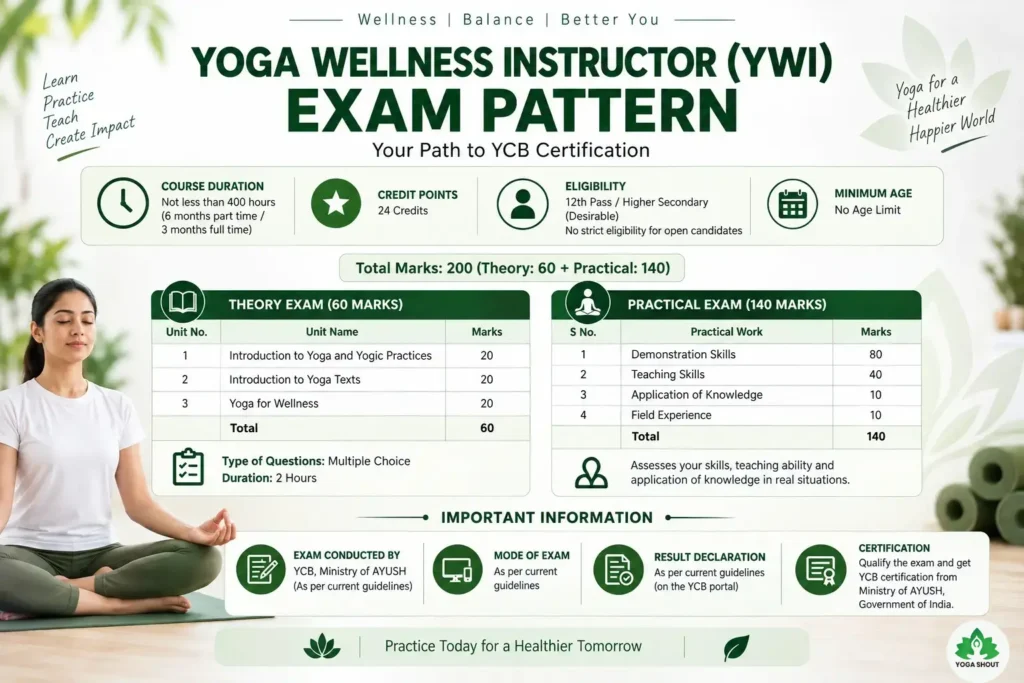
The YWI exam is conducted by YCB-approved exam centres and is split into two parts — Theory and Practical — with a total of 200 marks.
Theory Exam — 60 Marks
- Unit 1: Introduction to Yoga and Yogic Practices — 20 marks
- Unit 2: Introduction to Yoga Texts — 20 marks
- Unit 3: Yoga for Wellness — 20 marks
This is typically a written exam testing your understanding of definitions, concepts, classical texts, and applied knowledge — not rote memorisation alone.
Practical Exam — 140 Marks
| Component | Marks | What It Tests |
| Demonstration Skills | 80 | Your ability to correctly perform Shatkarma, Asanas, Pranayama, Bandha, Mudra, and Dhyana practices with proper technique |
| Teaching Skills | 40 | Your ability to actually teach — lesson planning, instruction, cueing, correcting others |
| Application of Knowledge | 10 | Applying theoretical understanding to practical/teaching situations |
| Field Experience | 10 | Practical exposure gained during training (real teaching/observation experience) |
Why the weighting matters: Notice that Demonstration Skills (80) and Teaching Skills (40) alone make up 120 of the 200 total marks. YCB has deliberately weighted this exam toward doing and teaching, not just knowing — which reflects what the Yoga Wellness Instructor role actually requires in the real world.
A few practical notes on the exam:
- Both theory and practical exams generally need to be cleared to receive certification — check the specific passing criteria with your exam centre, as these are set and occasionally updated by YCB.
- The practical exam is usually conducted by an assessor/evaluator appointed through the YCB-approved exam centre.
- Your training institute prepares you for the syllabus, but the exam itself is conducted independently by the YCB-approved centre — this is what keeps the certification credible and standardised nationwide.
For the most current exam fee, scheduling, and centre details, it’s best to check directly with your training institute or the official YCB exam portal, since these details can be updated by YCB from time to time.
Yoga Wellness Instructor Certification
Once you clear both the theory and practical exams, you’re awarded the official Yoga Wellness Instructor (Level 2) certificate, issued directly by the Yoga Certification Board, Ministry of AYUSH, Government of India.
What makes this certification different from a generic yoga certificate:
- It’s stored on YCB’s official dashboard. Once issued, your certificate is stored permanently on the YCB, AYUSH website and is trackable there — it’s not just a PDF that can be lost or questioned.
- It’s verifiable by QR code. Anyone — an employer, a wellness centre, a client — can verify your certificate is genuine by scanning the QR code on it, which checks directly against YCB’s records. This matters a lot in a field where “yoga certificate” claims are otherwise hard to verify.
- It carries 24 credit points, which factor into eligibility for higher-level YCB certifications later (like YTE, Level 3).
What the certificate actually represents: It’s not just proof you attended a course — it’s confirmation that you cleared a standardised, government-set bar across both theoretical knowledge and practical/teaching competence. That’s the whole point of the YCB system: making sure a “certified yoga instructor” label actually means something consistent, no matter which institute trained you.
A note on renewal: Like most professional certifications, YCB certifications may require periodic renewal (through YCB’s CYE — Continuing Yoga Education — programs) to stay current. It’s worth checking YCB’s latest renewal guidelines closer to when your certificate is due, since these norms can be updated by the Board over time.
Bottom line: This certificate is your credible, checkable proof that you’re qualified to teach yoga for wellness and illness prevention — recognised across India, and increasingly respected internationally as yoga’s global demand grows.
Benefits of the Yoga Wellness Instructor Course
A genuinely deeper understanding of yoga, not just movements By the time you finish YWI, you’re not someone who just knows a sequence of postures — you understand the philosophy, the anatomy, and the reasoning behind what you teach. That depth changes how you show up in a class, and students can feel the difference between someone reciting instructions and someone who actually understands them.
A structured teaching skillset The teaching methodology component — lesson planning, class management, correcting mistakes, adapting for individuals vs. groups — is something most self-taught or informally trained instructors never get proper exposure to. This alone can make you a noticeably more effective teacher than experience alone would.
Credibility that’s independently verifiable Because your certificate comes from a government body and can be verified by QR code, you’re not asking people to just take your word for it. That matters when you’re trying to build trust with new students, employers, or institutions who don’t know you yet.
A foundation for specialising later YWI’s Unit 3 (Yoga for Wellness) introduces you to yoga’s role in managing common lifestyle conditions and stress. While this isn’t a therapy qualification, it does lay groundwork if you later want to move toward more specialised, therapeutic-leaning yoga education.
Personal practice benefits, not just professional ones It’s easy to forget this, but 400 hours of structured study and practice will also deepen your own physical and mental wellbeing — better body awareness, a calmer default state, and habits (from Dinacharya to breathing practices) that tend to stick with you well beyond the course.
A clear next step, not a dead end Completing YWI also puts you in a position to move to YTE (Level 3) if you want to keep growing — you’re not left wondering “what’s next” once you’re certified.
Yoga Wellness Instructor Career Opportunities
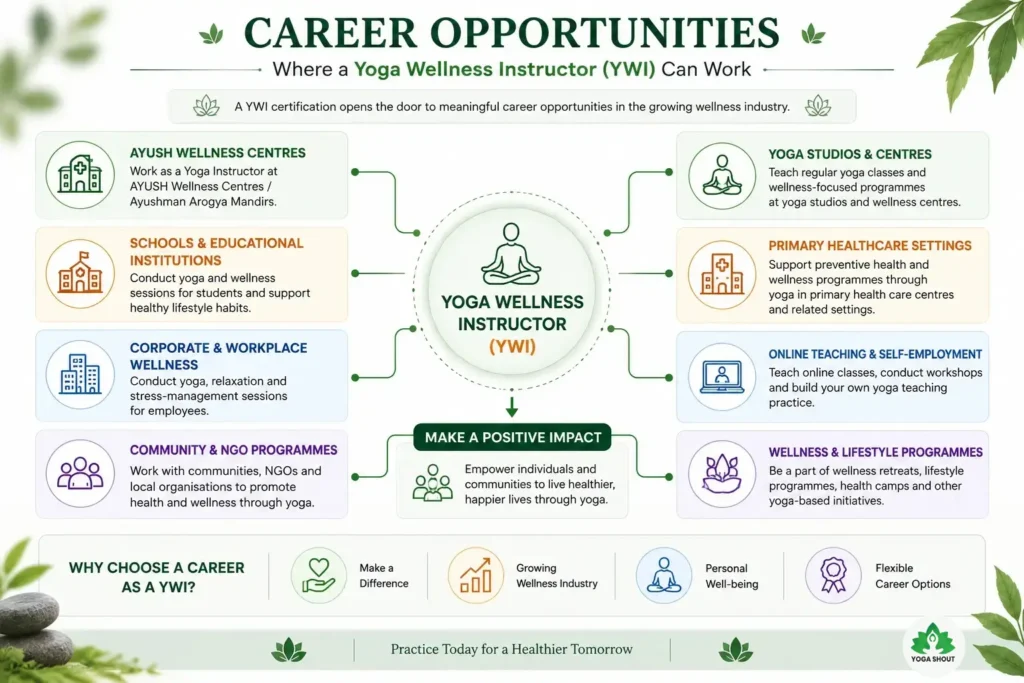
Schools and Educational Institutions YWI can be relevant for yoga teaching roles in schools and educational institutions, subject to the requirements of the employer or institution.
Yoga Studios and Wellness Centres Independent yoga studios, wellness centres, and holistic health spaces regularly look for instructors who can teach structured, safe classes — not just lead a routine. YWI’s depth in anatomy, contraindications, and teaching methodology is directly relevant here.
Corporate Wellness Programs More workplaces are introducing yoga or stress-management sessions for employees as part of wellness initiatives. This typically calls for an instructor who can explain the “why” behind practices to a professional audience — which is exactly what YWI trains you for.
Wellness Centres and Primary Health Care Centres YCB’s own syllabus explicitly names “Yoga wellness centres/ Primary Health care centres” as part of the YWI role description. This reflects the growing integration of yoga into preventive health initiatives under AYUSH.
Starting Your Own Classes or Studio With a verifiable government certification, teaching methodology training, and a wider practice base than YPI, many YWI-certified instructors choose to start their own group classes, private sessions, or eventually a small studio.
Government and AYUSH-Linked Programs Government yoga promotion initiatives (like International Day of Yoga events, AYUSH wellness camps) often look for certified instructors — YCB certification specifically is recognised for this kind of involvement.
A grounded note on “job opportunities”: We’re deliberately not going to promise guaranteed placements or specific job openings here — that’s not how this field works, and we don’t want to oversell it. What YWI does give you is a recognised, verifiable qualification that’s a real prerequisite or strong advantage for most of the roles above. What you do with it — how actively you build a student base, apply to institutions, or market yourself — is genuinely up to your own effort after certification.
Yoga Wellness Instructor Salary Guide
YWI Instructor Salary in India
There is no fixed salary for a YWI-certified instructor. Income varies based on location, experience, employment type, teaching setting and whether you work independently or for an organisation.
| Work model | Income depends on |
|---|---|
| School/Institution | Employer & location |
| Yoga Studio | Experience & class load |
| AYUSH/Contract Role | Vacancy & applicable rules |
| Corporate Yoga | Client & session arrangement |
| Private Classes | Number of students & pricing |
| Online Teaching | Audience & business model |
Skills You’ll Develop in the YWI Course
Technical/Practical Skills
- Correctly demonstrating and cueing 25+ yogasanas across standing, seated, prone, supine, and relaxation categories
- Safely teaching Shatkarma cleansing techniques (Neti, Dhauti, Kapalbhati)
- Guiding preparatory breathing and pranayama practices (Ujjayee, Sheetalee, Sitkaree, Bhramaree) with correct technique
- Demonstrating and explaining Bandhas and Mudras accurately
- Leading structured relaxation and meditation, including Yoga Nidra and Antarmauna
Anatomical and Safety Knowledge
- Basic understanding of the body’s nine major systems and how yogic practices affect them
- Recognising contraindications — knowing when a practice should be modified or avoided for a student’s safety
- Understanding the physiological basis of stress and how specific practices help manage it
Teaching and Communication Skills
- Structuring a proper lesson plan, for both individuals and groups
- Using voice, pacing, and body language effectively in a class setting
- Observing a class and correcting student mistakes in real time
- Adapting the same practice for different audiences (beginners, seniors, corporate groups, students)
Philosophical and Conceptual Depth
- Explaining yoga’s philosophical foundations (Samkhya, Ashtanga Yoga, Bhagavad Gita teachings) in accessible, non-textbook language
- Applying classical concepts (Mitahara, Dinacharya, mental hygiene practices) to practical, modern-day lifestyle advice
- Answering the “why” behind a practice, not just demonstrating the “how”
Soft Skills (often underrated, genuinely valuable)
- Patience and active listening — dealing with students at very different fitness and comfort levels
- Confidence in public instruction and group management
- Self-discipline, since consistent personal practice is really what sustains good teaching over time
Why this matters more than it sounds: A lot of these skills — especially teaching methodology, contraindication awareness, and lesson planning — are exactly what separates a YWI-trained instructor from someone who’s simply practiced yoga for years and started teaching informally. Personal practice makes you a good practitioner; this training is what makes you a competent teacher.
How to Choose the Best Institute for Yoga Wellness Instructor Course
1. Does the Course Follow the Official YWI Syllabus? Confirm the institute is preparing you specifically for the official YCB syllabus (the one this article covers) and not a generic “yoga teacher training” that only loosely maps to it. Ask directly, and cross-check against the syllabus if you’re unsure.
2. Who are the actual instructors, and what are their qualifications? Ask who will be teaching you — their own certifications, teaching experience, and specifically whether they have experience teaching this syllabus, not just yoga in general. A good practitioner isn’t automatically a good teacher of teachers.
3. What’s the format, and does it match how you learn best? Online, offline, or hybrid; live sessions vs. recorded content; group classes vs. more personal attention. Given how much of YWI is genuinely practical (140/200 marks), be cautious of a fully pre-recorded, no-live-correction format — technique correction is hard to get right without real-time feedback.
4. Is exam preparation clearly separated from the training fee? As covered in the Fees section, make sure the institute is transparent about what their training fee covers versus the separate YCB exam fee — and that they’re not vague or evasive about this distinction.
5. Check reviews and past student outcomes, not just marketing claims Look for genuine student reviews, ideally people who’ve actually cleared the YCB exam through that institute — not just testimonials on the institute’s own website. A quick search or asking in yoga teacher communities can surface honest feedback.
Yoga Protocol Instructor (YPI) vs Yoga Wellness Instructor (YWI)
| Aspect | YPI (Level 1) | YWI (Level 2) |
| Duration | 200 hours minimum | 400 hours minimum |
| Credit Points | 12 credits | 24 credits |
| Total Marks | 200 (Theory: 60 + Practical: 140) | 200 (Theory: 60 + Practical: 140) |
| Theory Focus | Basics of Yoga, intro to Patanjali Yoga Sutra & Gita, basic well-being | Full 3-unit theory — deeper philosophy, complete texts study, wellness application |
| Practical Scope | Common Yoga Protocol — basic asanas, pranayama, simple shatkarma | Wider practice — 25+ asanas, full shatkarma set, bandha, mudra, meditation practices |
| Teaching Training | Basic introduction to teaching methods | Full, dedicated teaching methodology unit with 40 marks |
| Official Role Description | Teach Common Yoga Protocol — parks, societies, RWAs, IDY events | Teach yoga for illness prevention & wellness — schools, studios, workplaces, wellness centres |
| Best Suited For | First formal teaching-oriented certification | Those ready for serious, professional-level teaching |
(Refer to official YCB Level 1 syllabus for exact YPI marks breakdown before publishing.)
Can you skip YPI and go straight to YWI? Yes. The YCB YWI syllabus does not require candidates to complete YPI first. However, beginners may find YPI or prior yoga practice useful before entering the more extensive YWI syllabus.
Yoga Wellness Instructor (YWI) vs Yoga Teacher & Evaluator (YTE)
| Aspect | YWI (Level 2) | YTE (Level 3) |
| Duration | 400 hours minimum | 800 hours minimum |
| YCB Level | Level 2 | Level 3 |
| Role Scope | Teach yoga for illness prevention & wellness — schools, studios, workplaces, wellness centres | Advanced teaching + ability to evaluate/assess other candidates for YCB certifications |
| Depth | Solid philosophy, wider asana/pranayama range, teaching methodology | Deeper anatomy & physiology, advanced therapeutic applications, evaluator training |
| Who It’s For | Instructors ready to teach professionally at an intermediate-advanced level | Instructors ready to teach at an advanced level and potentially assess/certify others |
| Typical Next Step After | YTE (Level 3) | Further specialisation, senior teaching roles, or evaluator assignments with YCB |
Yoga Wellness Instructor Course FAQs
1. What is the Yoga Wellness Instructor (YWI) course? YWI is a Level 2 certification under the Yoga Certification Board (YCB), Ministry of AYUSH, Government of India. It trains you to teach yoga for the prevention of illness and promotion of wellness in schools, studios, workplaces, and wellness centres.
2. Is YWI a government-recognised certification? Yes. YWI is issued directly by the Yoga Certification Board, a body established by the Ministry of AYUSH, Government of India — not by a private institute.
3. Who is eligible for the YWI course? There’s no strict eligibility criterion for open candidates. It’s suggested (not mandatory) that candidates have passed 12th standard or equivalent. There’s no age limit.
4. Do I need prior yoga experience to join YWI? Not officially required, but it helps. Since YWI builds on basic yoga knowledge, having some prior practice (even informal) makes the course easier to follow.
5. How long is the YWI course? YCB requires a minimum of 400 hours.
6. How many credit points does YWI carry? YWI carries 24 credit points under the YCB certification system.
7. What is the total marks distribution for YWI? 200 total marks — 60 for theory (20 marks each across 3 units) and 140 for practical (Demonstration Skills: 80, Teaching Skills: 40, Application of Knowledge: 10, Field Experience: 10).
8. What topics does the YWI theory syllabus cover? Three units: Introduction to Yoga and Yogic Practices, Introduction to Yoga Texts, and Yoga for Wellness — covering philosophy, classical texts (Gita, Patanjali Yoga Sutra, Hatha Pradipika), and applied wellness knowledge.
9. What does the YWI practical syllabus include? Prayer, Shatkarma (Neti, Dhauti, Kapalbhati), Sukshma/Sthula Vyayama, Surya Namaskara, 25+ Yogasanas, breathing practices, Pranayama, Bandha, Mudra, meditation practices, and teaching methodology.
10. Is YWI the same as Level 2 YCB certification? Yes, Yoga Wellness Instructor is officially the Level 2 certification under YCB’s structured pathway.
11. What comes before YWI in the YCB pathway? Yoga Protocol Instructor (YPI), which is Level 1 (200 hours). YPI isn’t mandatory before YWI, but it’s a natural first step for beginners.
12. What comes after YWI? Yoga Teacher & Evaluator (YTE), which is Level 3 (800 hours) — for those who want to teach at an advanced level and potentially evaluate other YCB candidates.
13. Can I skip YPI and directly join YWI? Yes, YWI has no formal requirement to complete YPI first. It’s a reasonable option if you already have solid personal yoga practice experience.
14. How much does the YWI course cost? Course fees vary by institute, mode (online/offline), and format. There’s also a separate YCB exam fee paid directly to the exam centre. Check with your specific training institute for current pricing.
15. Is the YWI certificate valid for government jobs? YCB certifications are increasingly recognised for AYUSH-linked government yoga programs and initiatives. For specific government job eligibility, it’s best to check the exact requirements listed in that job’s official notification.
16. Can I verify a YWI certificate’s authenticity? Yes. Every YCB certificate is stored on YCB’s official dashboard and is verifiable via QR code, so anyone can confirm it’s genuine.
17. Does YWI certification expire? Like most professional certifications, YCB certifications may require periodic renewal through YCB’s Continuing Yoga Education (CYE) programs. Check YCB’s current renewal guidelines closer to your certificate’s due date.
18. Can I teach yoga professionally right after completing YWI? Yes — YWI is specifically designed to qualify you to teach yoga for wellness and illness prevention in schools, studios, workplaces, and wellness centres.
19. Is YWI suitable for complete beginners? It’s possible, but not ideal. YWI assumes some basic familiarity with yoga. Complete beginners often benefit from starting with a Foundation Course or YPI first.
20. What’s the difference between YWI and a Foundation/Yoga Volunteer course? Foundation Course (~36 hours) is a basic introduction to yoga. YWI (400 hours) is a full professional teaching qualification with deep philosophy, wide practical training, and dedicated teaching methodology.
21. What’s the difference between YWI and YPI? YPI (200 hours, Level 1) covers Common Yoga Protocol basics. YWI (400 hours, Level 2) covers significantly deeper philosophy, a wider practical syllabus, and formal teaching skill training.
22. Is YWI harder than YPI? Generally yes — it covers more theory depth (including classical texts like the Gita and Patanjala Yoga Sutra) and a much wider practical syllabus, including shatkarma, bandha, and mudra.
23. Can I do YWI online? Many institutes offer YWI training online or in hybrid format. Since the practical component is significant, check whether live sessions with real-time correction are included, not just recorded content.
24. How is the YWI practical exam conducted? It’s conducted by an assessor/evaluator through a YCB-approved exam centre, evaluating your Demonstration Skills, Teaching Skills, Application of Knowledge, and Field Experience.
25. What if I fail the YWI theory or practical exam? Re-examination policies are set by YCB and the exam centre. Check with your specific exam centre for their current re-attempt process and any associated fees.
26. Does YWI include shatkarma (cleansing techniques)? Yes — Neti (Sutra Neti, Jala Neti), Dhauti (Vamana Dhauti/Kunjal), and Kapalbhati are all part of the practical syllabus.
27. Does YWI cover pranayama? Yes — including Ujjayee, Sheetalee, Sitkaree, and Bhramaree pranayama (without Kumbhaka at this level), along with foundational breathing practices.
28. Does YWI teach meditation (Dhyana)? Yes — including body/breath awareness, Yoga Nidra, Antarmauna, and recitation practices leading up to formal Dhyana practice.
29. Does YWI include Bandha and Mudra training? Yes — practical training covers Jalandhara, Uddiyana, and Mula Bandha, along with Yoga Mudra, Maha Mudra, and Vipareetakarani Mudra.
30. Is teaching methodology part of the YWI syllabus? Yes — it’s a dedicated component worth 40 practical marks, covering lesson planning, teaching methods, use of voice and body language, and correcting student mistakes.
31. How many asanas are covered in the YWI syllabus? Over 25 postures across standing, seated, prone, supine, and relaxation categories, including Trikonasana, Padmasana, Bhujangasana, Dhanurasana, and Shavasana.
32. Does YWI cover yoga anatomy and physiology? Yes — Unit 3 (Yoga for Wellness) covers the body’s nine major systems, sensory organs, and how yogic practices affect them, along with contraindications for various practices.
33. Does YWI teach yoga for specific health conditions? It covers yoga’s role in preventing and supporting management of common lifestyle conditions and non-communicable diseases (like diabetes, hypertension) — but as a wellness/prevention approach, not clinical treatment.
34. Is YWI a therapeutic or medical yoga qualification? No. YWI focuses on prevention and wellness. For clinical/therapeutic yoga work with medical patients, additional specialised training is needed beyond YWI.
35. What classical texts does YWI cover? Selected portions of the Bhagavad Gita, Patanjala Yoga Sutra (specific sutras from Chapters I, II, and III), Hatha Pradipika, and Gherand Samhita, along with Upanishadic teachings.
36. Do I need to memorise Sanskrit shlokas or sutras for YWI? Yes, specific selected sutras and concepts are part of the syllabus and benefit from proper memorisation, not just conceptual understanding.
37. Can I work in schools after completing YWI? Yes — teaching yoga in schools is one of the roles explicitly covered under YWI’s official scope, especially with growing wellness-focused programs in education.
38. Can I work in corporate wellness after YWI? Yes — many workplaces run yoga/stress-management programs for employees, and YWI’s depth (explaining the “why” behind practices) is well-suited for a professional audience.
39. Can I start my own yoga studio after YWI? Yes — many YWI-certified instructors go on to start their own classes or studios, backed by a verifiable government certification and structured teaching training.
40. Is YWI recognised internationally? YCB states that its certification is valid in other countries. However, employers, institutions and regulatory requirements can vary by country, so candidates should check the requirements of the specific market or organisation.
41. How much can I earn as a YWI-certified instructor? There is no fixed YWI salary. Income depends on location, experience, employment type, number of classes, student base and whether you work independently or for an organisation.
42. Does YWI guarantee a job? No, and no honest yoga certification can promise that. YWI makes you qualified and credible for teaching roles — how much work you get depends on your effort, location, and how you build your student base afterward.
43. What documents do I need to enrol in YWI? Typically: proof of age/identity (Aadhaar, passport, etc.), educational certificate (if applicable), passport-size photos, and any prior yoga certification (optional). Exact requirements can vary by institute.
44. Is there an age limit for YWI? No. YWI has no minimum or maximum age requirement — it’s open to students, working professionals, and older adults alike.
45. How is the YWI exam different from the training? Your institute (like Yoga Shout) trains you for the syllabus, but the actual theory and practical exam is conducted independently by a YCB-approved exam centre — keeping the certification standardised and credible.
46. Can I complete YWI part-time while working? Yes — YCB allows a part-time format, designed specifically for people balancing the course alongside a job or other commitments.
47. What personal qualities help in the YWI course and profession? Good communication skills, patience, self-discipline, active listening, empathy, and time management — all explicitly listed as attributes YCB expects from Yoga Wellness Instructors.
48. Is YWI worth it if I already teach yoga informally? Often yes — it adds a government-recognised, verifiable credential to skills you may already have, and fills in formal teaching methodology and safety knowledge that informal teaching sometimes lacks.
49. How is YWI different from a generic 200-hour or 300-hour yoga teacher training (YTT)? Generic YTTs vary widely in quality and aren’t independently regulated. YWI follows a standardised YCB syllabus, government issuance, QR-verifiable certification, and a fixed marks/exam structure — offering more consistency and credibility.
50. Does completing YWI mean I have to pursue YTE (Level 3) next? No. YWI is a Level 2 certification and does not require you to continue to YTE. Whether you pursue YTE depends on your professional goals and the requirements of the roles you want to pursue.
51. Can foreigners enrol in the YWI course? Yes, YWI is generally open to international candidates too, though fee structures and logistics (like exam centre availability) may differ. Check with your training institute for specifics.
Conclusion
If you’ve made it this far, you already understand what the Yoga Wellness Instructor course actually asks of you — 400 hours of real theory and practice, a genuine dive into yoga philosophy and classical texts, a wide practical skillset, and dedicated training in how to actually teach, not just perform. It’s the point in the YCB pathway where you stop being someone who follows a routine and become someone who understands and can safely guide one.
We’ve tried to walk you through this honestly — the depth of the syllabus, the real challenges students face, what it costs in time and effort, what it does and doesn’t guarantee professionally. No inflated salary promises, no “guaranteed job” claims — just what the course actually covers and what it realistically opens up for you.
If you’re already committed to yoga — whether you’ve completed YPI, practiced for years on your own, or you simply know teaching is the direction you want to go — YWI is a solid, credible, government-recognised next step. It won’t do the work of building your teaching career for you, but it will genuinely equip you with the knowledge, safety awareness, and teaching skill to do that work well.
If you’re ready to begin, you can explore Yoga Shout’s Yoga Wellness Instructor course — designed around the official YCB syllabus, with live instructor-led classes to make sure the practical, hands-on part of your training gets the attention it actually needs. Wherever you are in your yoga journey, we hope this guide gave you a clear, honest picture of what YWI really involves — so whatever you decide next, you’re deciding with real information, not marketing.
Pingback: Ultimate Guide to the Yoga Volunteer Certification Course
Pingback: Yoga Protocol Instructor Course (YPI): Complete Guide 2026