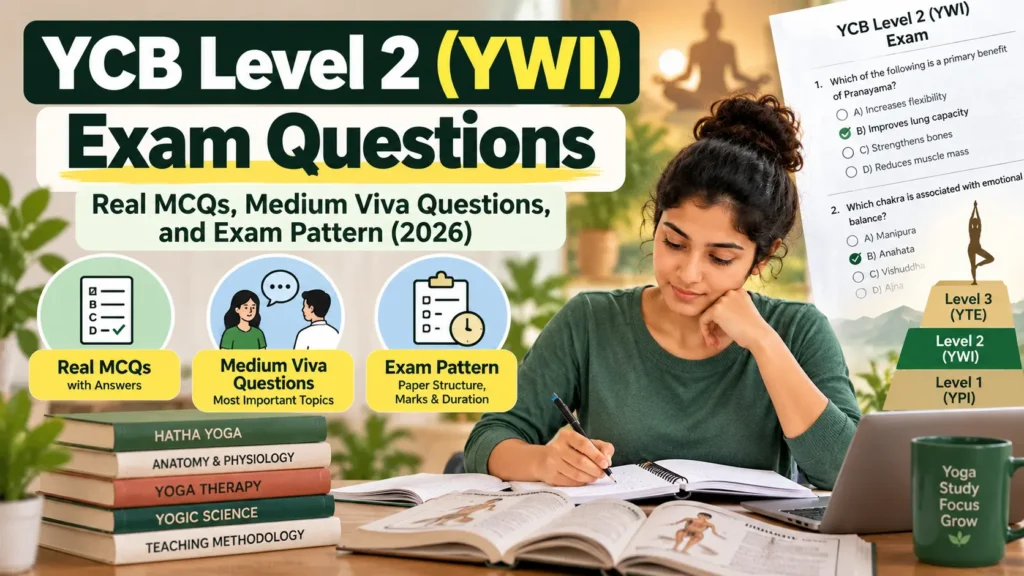
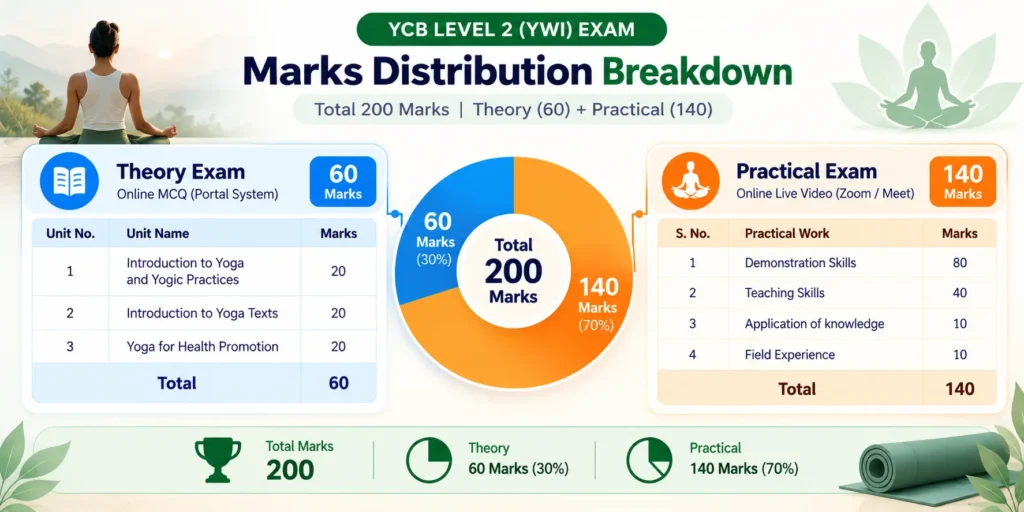
The Yoga Certification Board (YCB) Level 2 certification, officially titled Yoga Wellness Instructor (YWI), is the government-recognized credential under the Ministry of AYUSH for teaching yoga for illness prevention and holistic wellness promotion across studios, schools, corporate workplaces, and primary healthcare centers. The examination carries a total of 200 marks, split between a 60-mark Theory exam and a 140-mark Practical and Viva assessment, with a mandatory 70% passing threshold in each section separately.
Because Level 2 transitions from basic protocol delivery to wellness-oriented instruction, examiners evaluate not only what you practice, but why and how you adapt practices for different constitutions and lifestyle needs. Understanding the exact exam delivery format, solving application-based multiple-choice questions (MCQs), and mastering practical viva cueing are essential steps to passing on your first attempt.
How the YCB Level 2 Examination is Conducted
YCB examinations are organized either offline or online through approved Personnel Certification Bodies (PrCBs) or an accredited Yoga Institute. Today, the vast majority of candidates appear via the Online Examination Mode.
1. The Online Theory Examination
- Portal-Based System: Candidates log in to a secure online exam portal provided by the examining agency or authorized institute.
- Duration: The theory exam is scheduled for 2 hours.
- Question Format: It consists of 60 Multiple Choice Questions (MCQs) carrying 1 mark each, distributed evenly across three syllabus units:
- Unit 1: Introduction to Yoga and Yogic Practices (20 Marks) — Etymology, Darshanas, schools of Yoga, Shatkarma, Asana, Pranayama, Tri-Bandha, and Yoga Nidra principles.
- Unit 2: Introduction to Yoga Texts (20 Marks) — Prasthanatrayi, Upanishads (Kathopanishad, Prashnopanishad, Taittiriya Upanishad & Panchakosha), Bhagavad Gita, Patanjali Yoga Sutra, Hatha Yoga Pradipika, and Gheranda Samhita.
- Unit 3: Yoga for Wellness (20 Marks) — Nine major systems of the human body, homeostasis, Tridoshas, Sapta Dhatu, Dinacharya, Ritucharya, Brahmaviharas, stress management, and non-communicable diseases (NCDs).
- Passing Requirement: Candidates must score at least 70% (42 out of 60 marks) to qualify.
- Remote Proctoring: Webcams and screen monitoring ensure compliance throughout the session.
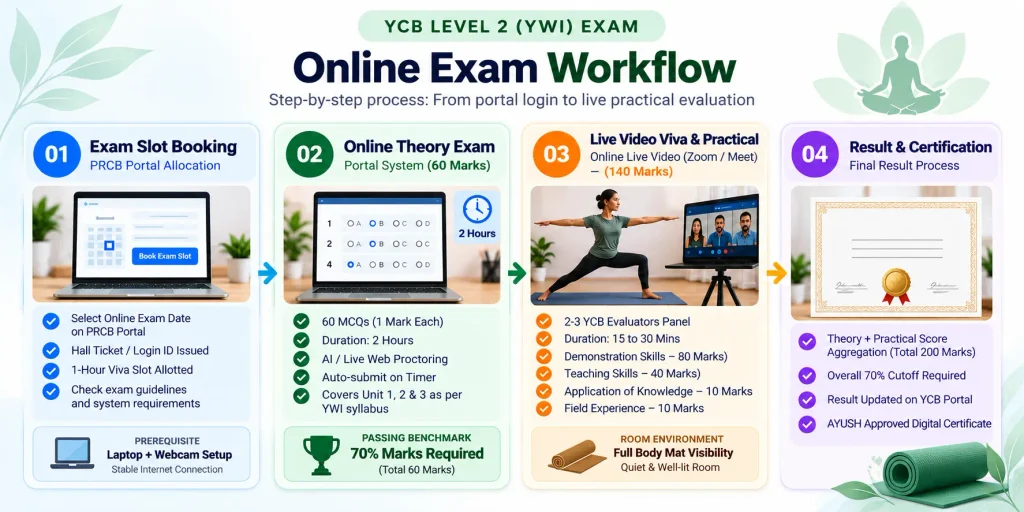
2. The Online Practical & Viva Examination
- Meeting Platform: The practical assessment takes place over video platforms such as Zoom or Google Meet.
- Slot Allocation: Candidates are assigned an individual 1-hour time slot window, during which they join the waiting room and are admitted for their turn.
- Examiner Panel: The evaluation is conducted by a panel of 2 to 3 YCB-approved examiners.
- Test Duration (15–30 Minutes): The actual one-on-one examination lasts between 15 to 30 minutes. To pass the practical stage, candidates must secure at least 70% (98 out of 140 marks). During this window, the examiners evaluate the following competencies:
- Demonstration Skills (80 Marks): Performing prescribed Shatkarmas (Neti, Dhauti, Kapalabhati), Sukshma and Sthula Vyayama (Sarvanga Pushti, Hrid Gati), Surya Namaskara with Mantra, intermediate cultural and meditative Asanas (including inversions like Sirshasana and Sarvangasana), Preparatory Breathing, Pranayama, Tri-Bandhas, Mudras (Yoga Mudra, Maha Mudra, Viparitakarani), and Dhyana Sadhana.
- Teaching Skills (40 Marks): Conducting a live simulated class segment, giving precise step-by-step verbal cues, stating contraindications, correcting alignment, and demonstrating lesson-planning structure.
- Viva Voce, Application of Knowledge & Field Experience (20 Marks — split as 10 Marks Application + 10 Marks Field Experience): Answering conceptual and applied questions connecting classical scriptures, human physiology, Tridosha balance, and yogic lifestyle principles to real-world wellness instruction.
30 Solved YCB Level 2 Exam MCQ Questions
The following 30 questions have been selected from authentic YWI exam papers and syllabus blueprints to highlight high-weightage topics where Level 2 candidates frequently lose marks.
Yoga Philosophy, Vedas and Scriptures MCQs / योग दर्शन, वेद और शास्त्र MCQs
Q1. Who among the following is also known as Krishnadvaipayana? / निम्नलिखित में से किसे कृष्णद्वैपायन भी कहा जाता है?
Correct answer / सही उत्तर: B. Maharshi Vedvyasa / महर्षि वेदव्यास
Maharshi Vedvyasa was born on an island (dvipa) in the Yamuna and had a dark complexion (krishna), so he is called Krishnadvaipayana. He compiled the Vedas and authored the Mahabharata. / महर्षि वेदव्यास का जन्म यमुना के एक द्वीप पर हुआ था और उनका वर्ण श्याम (कृष्ण) था, इसलिए उन्हें कृष्णद्वैपायन कहा जाता है। उन्होंने वेदों का संकलन किया और महाभारत की रचना की।
Q2. Sri Aurobindo mainly preached which type of yoga? / श्री अरविंद ने मुख्य रूप से किस प्रकार के योग का प्रचार किया?
Correct answer / सही उत्तर: C. Integral Yoga / पूर्ण (समग्र) योग
Sri Aurobindo taught Integral Yoga (Purna Yoga), which combines knowledge, devotion and action to transform the whole being. / श्री अरविंद ने पूर्ण योग (Integral Yoga) सिखाया, जो ज्ञान, भक्ति और कर्म को मिलाकर संपूर्ण व्यक्तित्व के रूपांतरण पर बल देता है।
Q3. Who was the proponent of Vishishtadvaita? / विशिष्टाद्वैत के प्रतिपादक कौन थे?
Correct answer / सही उत्तर: B. Ramanujacharya / रामानुजाचार्य
Ramanujacharya propounded Vishishtadvaita (qualified non-dualism), in which the individual soul and the world are real parts of Brahman. / रामानुजाचार्य ने विशिष्टाद्वैत (विशिष्ट अद्वैत) का प्रतिपादन किया, जिसमें जीवात्मा और जगत् ब्रह्म के वास्तविक अंश माने गए हैं।
Q4. Prasthanatrayi includes ………. / प्रस्थानत्रयी में सम्मिलित हैं ……….
Correct answer / सही उत्तर: C. Bhagavad Gita, Upanishads, Brahmasutra / भगवद्गीता, उपनिषद, ब्रह्मसूत्र
Prasthanatrayi, the three foundational texts of Vedanta, are the Upanishads, the Bhagavad Gita and the Brahma Sutras. / प्रस्थानत्रयी, यानी वेदांत के तीन आधार ग्रंथ, उपनिषद, भगवद्गीता और ब्रह्मसूत्र हैं।
Q5. Which is not one of the four main Vedas? / चार मुख्य वेदों में से कौन-सा वेद नहीं है?
Correct answer / सही उत्तर: D. Ayurveda / आयुर्वेद
The four main Vedas are Rigveda, Samaveda, Yajurveda and Atharvaveda. Ayurveda is an Upaveda (supplementary science), not one of the four. / चार मुख्य वेद ऋग्वेद, सामवेद, यजुर्वेद और अथर्ववेद हैं। आयुर्वेद एक उपवेद (सहायक विज्ञान) है, चार मुख्य वेदों में नहीं आता।
Q6. Karmas by which one passes to hell are called …………. / जिन कर्मों से व्यक्ति नरक को प्राप्त होता है, वे क्या कहलाते हैं?
Correct answer / सही उत्तर: C. Krishna Karma / कृष्ण कर्म
Krishna Karma (dark, harmful actions) leads to suffering and lower states of existence. Karma is classed as Shukla (virtuous), Krishna (harmful) and mixed Shukla-Krishna. / कृष्ण कर्म (काले या हानिकारक कर्म) दुःख और निम्न गति की ओर ले जाते हैं। कर्म शुक्ल (पुण्य), कृष्ण (पाप) और मिश्रित शुक्ल-कृष्ण में बाँटे गए हैं।
Q7. To bear pain and hardship without complaining is ………….. / बिना शिकायत किए दर्द और कठिनाइयों को सहना क्या कहलाता है?
Correct answer / सही उत्तर: B. Titiksha / तितिक्षा
Titiksha is the endurance of pain, heat, cold and hardship without complaint. It is one of the six virtues (Shatsampatti) of Vedanta. / तितिक्षा दर्द, गर्मी, सर्दी और कठिनाइयों को बिना शिकायत सहने की क्षमता है। यह वेदांत की छह संपत्तियों (षट्सम्पत्ति) में से एक है।
Q8. Which type of Yoga is explained in the Shiva Samhita? / शिव संहिता में किस प्रकार के योग का वर्णन है?
Correct answer / सही उत्तर: C. Hatha Yoga / हठ योग
The Shiva Samhita describes four yogas (Mantra, Laya, Hatha and Raja) and gives special importance to Hatha Yoga. / शिव संहिता चार योगों (मंत्र, लय, हठ और राज) का वर्णन करती है और हठ योग को विशेष महत्त्व देती है।
Patanjali Yoga Sutra, Mind and Siddhis MCQs / पतंजलि योग सूत्र, मन और सिद्धि MCQs
Q9. How many types of chitta vrittis are there according to the Patanjali Yoga Sutra? / पतंजलि योग सूत्र के अनुसार चित्त की वृत्तियाँ कितने प्रकार की होती हैं?
Correct answer / सही उत्तर: A. 5
Patanjali lists five types of chitta vrittis: Pramana, Viparyaya, Vikalpa, Nidra and Smriti (Sutra 1.6). / पतंजलि ने चित्त की पाँच वृत्तियाँ बताई हैं: प्रमाण, विपर्यय, विकल्प, निद्रा और स्मृति (सूत्र 1.6)।
Q10. What is the meaning of the word “Abhinivesha”? / “अभिनिवेश” शब्द का क्या अर्थ है?
Correct answer / सही उत्तर: A. Fear of death / मृत्यु का भय
Abhinivesha is the instinctive clinging to life and fear of death, the fifth of the five Kleshas. / अभिनिवेश जीवन से चिपके रहने की सहज प्रवृत्ति और मृत्यु का भय है। यह पाँच क्लेशों में पाँचवाँ क्लेश है।
Q11. Which of the following is a part of Antaranga Yoga practice? / निम्नलिखित में से कौन-सा अंतरंग योग साधना का भाग है?
Correct answer / सही उत्तर: C. Dhyana / ध्यान
Antaranga (inner) yoga comprises Dharana, Dhyana and Samadhi. Asana and Pranayama are Bahiranga (outer) limbs. / अंतरंग (आंतरिक) योग में धारणा, ध्यान और समाधि आते हैं। आसन और प्राणायाम बहिरंग योग के अंग हैं।
Q12. To focus the mind on one object, image or sound is ……….. / मन को किसी एक वस्तु, चित्र या ध्वनि पर केंद्रित करना क्या कहलाता है?
Correct answer / सही उत्तर: B. Dharana / धारणा
Dharana is concentrating the mind on a single point, such as an object, image or sound. When this attention flows unbroken, it becomes Dhyana. / धारणा मन को किसी एक बिंदु, जैसे वस्तु, चित्र या ध्वनि, पर टिकाना है। जब यह एकाग्रता बिना रुके प्रवाहित होती है, तो वह ध्यान बन जाती है।
Q13. Mental ailments are known as ………… / मानसिक रोगों को क्या कहा जाता है?
Correct answer / सही उत्तर: A. Adhija / आधिज
Mental ailments are termed Adhi (Adhija), whereas physical ailments are called Vyadhi. / मानसिक रोगों को आधि (आधिज) कहा जाता है, जबकि शारीरिक रोगों को व्याधि कहते हैं।
Q14. The ability to change the body size to the minimum is a ………. siddhi. / शरीर का आकार न्यूनतम करने की क्षमता ……… सिद्धि है।
Correct answer / सही उत्तर: B. Anima / अणिमा
Anima is the siddhi of becoming extremely small. Mahima is expanding, Laghima is becoming light and Garima is becoming heavy. / अणिमा अत्यंत सूक्ष्म होने की सिद्धि है। महिमा विशाल होना, लघिमा हल्का होना और गरिमा भारी होना है।
Q15. What moves when prana moves, according to Hatha Yoga? / हठ योग के अनुसार प्राण के चलने पर क्या चलता है?
Correct answer / सही उत्तर: D. Chitta / चित्त
The Hatha Yoga Pradipika (2.2) says that when prana moves, chitta moves, and when prana is still, chitta is still. Hence pranayama steadies the mind. / हठ योग प्रदीपिका (2.2) कहती है कि प्राण के चलने पर चित्त चलता है और प्राण के स्थिर होने पर चित्त स्थिर होता है। इसीलिए प्राणायाम मन को स्थिर करता है।
Hatha Yoga, Asana, Bandha and Kriya MCQs / हठ योग, आसन, बंध और क्रिया MCQs
Q16. The literal meaning of Bandha in Sanskrit is ……….. / संस्कृत में ‘बंध’ शब्द का शाब्दिक अर्थ क्या है?
Correct answer / सही उत्तर: C. To lock / बाँधना (लॉक करना)
The Sanskrit root “bandh” means to bind, hold or lock. In Bandhas, specific areas of the body are locked to direct and conserve prana. / संस्कृत धातु “बंध” का अर्थ है बाँधना, पकड़ना या लॉक करना। बंधों में शरीर के विशेष भागों को बाँधकर प्राण को दिशा दी जाती है और संरक्षित किया जाता है।
Q17. ………… is the second stage of Nadanusandhana. / ………… नादानुसंधान की दूसरी अवस्था है।
Correct answer / सही उत्तर: B. Ghata Avastha / घट अवस्था
According to the Hatha Yoga Pradipika, the four stages of Nada practice are Arambha, Ghata, Parichaya and Nishpatti. So Ghata Avastha is the second. / हठ योग प्रदीपिका के अनुसार नाद साधना की चार अवस्थाएँ हैं: आरंभ, घट, परिचय और निष्पत्ति। इसलिए घट अवस्था दूसरी है।
Q18. Ardha Matsyendrasana is very beneficial for …………… / अर्धमत्स्येन्द्रासन किसके लिए अत्यंत लाभकारी है?
Correct answer / सही उत्तर: A. Diabetes / मधुमेह
Ardha Matsyendrasana massages the abdominal organs and stimulates the pancreas, which is why it is traditionally recommended for diabetes. / अर्धमत्स्येन्द्रासन पेट के अंगों की मालिश करता है और अग्न्याशय (पैंक्रियास) को सक्रिय करता है, इसीलिए इसे मधुमेह के लिए पारंपरिक रूप से लाभकारी माना जाता है।
Q19. Which kriya is recommended immediately after the practice of Jala Neti? / जलनेति के अभ्यास के तुरंत बाद कौन-सी क्रिया करने की सलाह दी जाती है?
Correct answer / सही उत्तर: C. Kapalbhati / कपालभाति
After Jala Neti, Kapalbhati is practised to expel the remaining water and dry the nasal passages. / जलनेति के बाद बचा हुआ पानी बाहर निकालने और नासिका मार्ग को सुखाने के लिए कपालभाति की जाती है।
Q20. According to the Hatha Yoga Pradipika, the ultimate aim of Hatha Yoga practice is ………… / हठ योग प्रदीपिका के अनुसार हठ योग अभ्यास का अंतिम लक्ष्य क्या है?
Correct answer / सही उत्तर: B. Raja Yoga / राज योग
The Hatha Yoga Pradipika presents Hatha Yoga as a stairway to Raja Yoga, the state of Samadhi. / हठ योग प्रदीपिका हठ योग को राज योग, यानी समाधि की अवस्था, तक पहुँचने की सीढ़ी बताती है।
Q21. In normal life one must practise asanas ………………….. / सामान्य जीवन में आसनों का अभ्यास कैसे करना चाहिए?
Correct answer / सही उत्तर: D. According to one’s capacity / अपनी क्षमता के अनुसार
In daily life, asanas should be practised within one’s own capacity, avoiding strain and respecting individual limits. / दैनिक जीवन में आसन अपनी क्षमता के भीतर करने चाहिए, खिंचाव से बचते हुए और अपनी सीमाओं का सम्मान करते हुए।
Q22. How many types of kumbhakas are described in the Hatha Yoga Pradipika? / हठ योग प्रदीपिका ग्रंथ में कितने प्रकार के कुंभक बताए गए हैं?
Correct answer / सही उत्तर: B. 8
The Hatha Yoga Pradipika describes eight kumbhakas: Surya Bhedana, Ujjayi, Sitkari, Sheetali, Bhastrika, Bhramari, Murchha and Plavini. / हठ योग प्रदीपिका में आठ कुंभक बताए गए हैं: सूर्यभेदन, उज्जायी, सीत्कारी, शीतली, भस्त्रिका, भ्रामरी, मूर्च्छा और प्लावनी।
Prana, Koshas, Anatomy and Physiology MCQs / प्राण, कोश, शरीर रचना और शरीर क्रिया विज्ञान MCQs
Q23. Chakras and Nadis are components of which Kosha? / चक्र और नाड़ियाँ किस कोश के घटक हैं?
Correct answer / सही उत्तर: B. Pranamaya / प्राणमय
Pranamaya Kosha is the energy sheath, made up of prana, the five vayus, chakras and nadis. / प्राणमय कोश ऊर्जा का आवरण है, जो प्राण, पाँच वायु, चक्रों और नाड़ियों से बना है।
Q24. Which upa-prana regulates our hunger and thirst? / कौन-सा उप-प्राण हमारी भूख और प्यास को नियंत्रित करता है?
Correct answer / सही उत्तर: C. Krikala / कृकल
Krikala triggers hunger and thirst. Devadatta is associated with yawning and Kurma with blinking. / कृकल भूख और प्यास को उत्पन्न करता है। देवदत्त का संबंध जम्हाई से और कूर्म का पलक झपकने से है।
Q25. Which Kosha is related to the gross body? / कौन-सा कोश स्थूल शरीर से संबंधित है?
Correct answer / सही उत्तर: C. Annamaya / अन्नमय
Annamaya Kosha is the physical (gross) body, nourished by food. / अन्नमय कोश भौतिक (स्थूल) शरीर है, जिसका पोषण अन्न से होता है।
Q26. Keeping a constant physiological environment in our body is called ………. / हमारे शरीर में स्थिर शारीरिक वातावरण बनाए रखना क्या कहलाता है?
Correct answer / सही उत्तर: C. Homeostasis / होमियोस्टेसिस (समस्थापन)
Homeostasis is the body’s ability to maintain a stable internal environment, such as temperature, pH and blood sugar. / होमियोस्टेसिस शरीर की वह क्षमता है जिससे वह तापमान, pH और रक्त शर्करा जैसे आंतरिक वातावरण को स्थिर रखता है।
Q27. Which is the largest bone in the human body? / मानव शरीर की सबसे बड़ी हड्डी कौन-सी है?
Correct answer / सही उत्तर: B. Femur / फीमर (जाँघ की हड्डी)
The femur (thigh bone) is the longest and strongest bone of the human body. / फीमर (जाँघ की हड्डी) मानव शरीर की सबसे लंबी और मजबूत हड्डी है।
Yoga Teaching Methodology MCQs / योग शिक्षण पद्धति MCQs
Q28. A yoga teacher should begin the yoga session with ………. / योग शिक्षक को योग सत्र की शुरुआत किससे करनी चाहिए?
Correct answer / सही उत्तर: A. Prayer / प्रार्थना
A yoga session begins with an invocatory prayer, which calms the mind and sets a focused, positive intention. / योग सत्र की शुरुआत प्रार्थना से होती है, जिससे मन शांत होता है और एकाग्र, सकारात्मक भाव बनता है।
Q29. A student is not able to practise to your satisfaction. How will you deal with this student? / कोई छात्र आपकी अपेक्षा के अनुसार अभ्यास नहीं कर पा रहा है। आप उसके साथ कैसे व्यवहार करेंगे?
Correct answer / सही उत्तर: A. Encourage the student to have patience and continue to practise / छात्र को धैर्य रखने और अभ्यास जारी रखने के लिए प्रोत्साहित करें
A good teacher is patient and supportive. Encouragement builds confidence, whereas force or neglect can cause injury and loss of motivation. / अच्छा शिक्षक धैर्यवान और सहयोगी होता है। प्रोत्साहन से आत्मविश्वास बढ़ता है, जबकि ज़बरदस्ती या उपेक्षा से चोट लग सकती है और प्रेरणा घटती है।
Q30. Learning by doing is ……….. / करके सीखना …….. है।
Correct answer / सही उत्तर: B. Project Method / प्रोजेक्ट विधि
In the Project Method, learners acquire knowledge by actively doing and completing practical tasks, which is learning by doing. / प्रोजेक्ट विधि में शिक्षार्थी व्यावहारिक कार्य स्वयं करके ज्ञान प्राप्त करते हैं, यानी करके सीखना।
YCB Level 2 Exam Viva Questions (With Model Answers)
In the Level 2 live oral examination, examiners expect deeper physiological and scriptural clarity than at Level 1. Use the model answers below to structure crisp, authoritative responses during your viva.
1. How do you explain the Panchakosha framework from the Taittiriya Upanishad, and how does a Yoga Wellness Instructor address all five sheaths in a single class?
- Examiner Focus: Scriptural application (Unit 2) and holistic class structuring.
- Model Answer: “The Taittiriya Upanishad describes five concentric layers of human existence: Annamaya Kosha (physical body), Pranamaya Kosha (vital energy sheath), Manomaya Kosha (mental-emotional sheath), Vijnanamaya Kosha (wisdom/discriminative sheath), and Anandamaya Kosha (bliss sheath). In a structured wellness session, I address Annamaya Kosha through Shatkarma, Sukshma Vyayama, and Asanas; Pranamaya Kosha through sectional breathing and Pranayama; Manomaya Kosha through Pratyahara, chantings, and Antarmauna; Vijnanamaya Kosha through mindful witness awareness during Dhyana; leading the practitioner toward the deep inner stillness of Anandamaya Kosha.”
2. While teaching Kapalabhati (Vatakrama), what is the exact respiratory mechanism, and which students must be excluded from practicing it?
- Examiner Focus: Precision in Shatkarma instruction and safety screening.
- Model Answer: “Unlike normal breathing where inhalation is active and exhalation is passive, Kapalabhati reverses the mechanism: exhalation (Rechaka) is short, forceful, and driven by rapid inward contraction of the lower abdominal muscles, while inhalation (Puraka) happens passively by simply relaxing the abdomen. Before cueing the practice, I explicitly instruct students with uncontrolled hypertension, cardiac ailments, hernia, gastric ulcers, epilepsy, recent abdominal surgery, vertigo, or women who are pregnant or menstruating to refrain from the practice.”
3. Why must Jalandhara Bandha always be applied before Uddiyana Bandha or internal breath retention (Antar Kumbhaka)?
- Examiner Focus: Physiological understanding of Tri-Bandha and safety.
- Model Answer: “Jalandhara Bandha (the chin lock) compresses the carotid sinuses in the neck, which triggers the baroreceptor reflex to prevent a sudden spike in cranial blood pressure and heart rate during breath retention. Applying Jalandhara Bandha prior to Antar Kumbhaka or Uddiyana Bandha protects the delicate blood vessels in the brain, eyes, and inner ear from upward pranic and intra-thoracic pressure.”
4. What is the difference between Sarvanga Pushti and Hrid Gati in Sthula Vyayama, and when do you avoid them?
- Examiner Focus: Practical mastery of macro-circulation practices (Sthula Vyayama).
- Model Answer: “Both are macro-circulation practices introduced by Swami Dhirendra Brahmachari. Sarvanga Pushti involves wide-stance alternating spinal rotations combined with deep breath retention and interlocking wrist transitions to strengthen the entire musculoskeletal frame. Hrid Gati (Engine Daud) is a dynamic rhythmic jogging-in-place movement coordinated with vigorous piston-like arm movements and active breathing to stimulate cardiopulmonary stamina. Because both rapidly elevate heart rate and intra-abdominal pressure, they are contraindicated for individuals with severe hypertension, heart disease, acute sciatica, or knee osteoarthritis.”
5. A student in your wellness batch complains of chronic work stress and insomnia. How do you explain the stress response and design a 30-minute evening protocol for them?
- Examiner Focus: Applied wellness management for stress (Unit 3).
- Model Answer: “Chronic stress locks the nervous system into sympathetic dominance (fight-or-flight), keeping cortisol and heart rate elevated. To shift the student into parasympathetic dominance (rest-and-digest) and restore homeostasis, I avoid dynamic backbends or heating practices like Bhastrika in the evening. Instead, I sequence 5 minutes of gentle joint loosening (Sukshma Vyayama), restorative forward folds and supine postures like Shashankasana, Viparitakarani, and Supta Baddha Konasana, followed by 10 minutes of Anuloma Viloma and Bhramari Pranayama, concluding with 10 minutes of guided Yoga Nidra.”
6. How do Sadhaka Tattvas and Badhaka Tattvas from Hatha Yoga Pradipika apply to modern yoga students?
- Examiner Focus: Connecting Hatha Yoga texts to student counseling.
- Model Answer: “Swami Swatmarama lists six Badhaka Tattvas (obstacles) in Hatha Yoga Pradipika (1.15): Atyahara (overeating), Prayasa (over-exertion), Prajalpa (unnecessary talking), Niyamagraha (fanatical adherence to rigid rules), Jana-sanga (excessive socializing), and Laulya (fickleness of mind). Conversely, the six Sadhaka Tattvas (1.16) are Utsaha (enthusiasm), Sahasa (perseverance), Dhairya (patience), Tattvajnana (discriminative knowledge), Nischaya (firm resolve), and Jana-sangha-parityaga (avoiding distracting company). In a wellness setting, helping students moderate Atyahara and Prayasa while cultivating Dhairya and consistency is foundational to sustainable health.”
7. What is the difference between Yoga Mudra and Maha Mudra in the Level 2 practical syllabus?
- Examiner Focus: Accurate demonstration and differentiation of Mudras.
- Model Answer: “Yoga Mudra is performed sitting in Padmasana with the hands clasped or holding the wrist behind the back, exhaling to fold the forehead to the floor while maintaining awareness at Manipura or Ajna Chakra. Maha Mudra, by contrast, is performed with one heel pressing firmly against the perineum (Yoni Sthana) and the other leg extended straight; the practitioner holds the big toe of the extended foot, inhales, applies Jalandhara and Mula Bandha (creating Maha Bandha action), and channels prana upward along the Sushumna Nadi.”
8. How do Dinacharya and Ritucharya support Tridosha balance in preventive wellness?
- Examiner Focus: Ayurvedic and Yogic lifestyle integration (Unit 3).
- Model Answer: “Health depends on the dynamic equilibrium of the three Doshas—Vata (movement/nervous regulation), Pitta (metabolism/digestion), and Kapha (structure/lubrication)—alongside balanced Agni (digestive fire). Dinacharya aligns daily habits (waking during Brahma Muhurta, Shatkarma, Asana, timely Mitahara, and restful Nidra) with the circadian rhythm of the Doshas. Ritucharya adapts diet and yogic practices across seasonal transitions—for instance, emphasizing cooling practices like Sheetali and Sitkari during Grishma/Sharad (high Pitta seasons) and warming practices like Surya Namaskara and Kapalabhati during Shishira/Vasanta (high Kapha seasons).”
9. What is the difference in scope between a Level 2 Yoga Wellness Instructor (YWI) and a Yoga Therapist?
- Examiner Focus: Understanding professional boundaries and ethical scope of practice.
- Model Answer: “A Level 2 Yoga Wellness Instructor is certified to teach yoga for illness prevention, stress reduction, and general wellness promotion to healthy individuals or those seeking lifestyle improvement in studios, schools, corporate offices, and wellness centers. While a YWI understands basic precautions for common non-communicable conditions like mild hypertension or obesity, clinical diagnosis and individualized therapeutic rehabilitation for acute or complex medical pathologies fall strictly under the scope of a certified Yoga Therapist working alongside medical professionals.”
10. How do you structure a 60-minute YCB Level 2 wellness class from start to finish?
- Examiner Focus: Lesson planning and Teaching Skills (40-mark segment).
- Model Answer: “A standard 60-minute Level 2 lesson plan follows a progressive physiological arc:
- Centering & Invocation (3 mins): Calm posture, breath awareness, and Pranava/Vedic prayer with Nishpatti Bhava.
- Preparatory Practices (10 mins): Targeted Sukshma Vyayama, Sthula Vyayama, and 3–5 rounds of Surya Namaskara with Mantra.
- Core Yogasana Sequence (22 mins): Standing postures for stability, sitting postures, prone backbends, supine postures, inversions (with counter-poses), and spinal twists.
- Deep Relaxation (7 mins): Guided Shavasana or short Yoga Nidra to normalize heart rate before breathwork.
- Pranayama, Bandha & Mudra (10 mins): Sectional breathing followed by Nadi Shodhana, Ujjayi, or Bhramari.
- Dhyana & Closing (8 mins): Antarmauna or Pranava Dhyana, concluding with Shanti Patha.”
3 Keys to Securing High Marks in the Live Viva
Anxiety during the live video examination is the leading reason candidates lose marks in practical evaluation. Keep these three examiner priorities front and center during your assessment:
- State Contraindications Before You Cue: In the 40-mark Teaching Skills evaluation, examiners watch whether you prioritize student safety. Before instructing an inversion like Sirshasana, a backbend like Chakrasana, or a cleansing technique like Kapalabhati, take ten seconds to state who must avoid or modify the practice.
- State Counter-Poses (Prati-Asanas) Proactively: After presenting an intense forward bend, deep backward bend, or inversion, proactively name the balancing counter-pose (for example, following Sarvangasana with Matsyasana, or Paschimottanasana with Purvottanasana) to demonstrate practical sequencing competence.
- Clearly Separate Demonstration Mode from Teaching Mode: Listen carefully to the examiner’s prompt. When asked to demonstrate an asana or mudra, step onto your mat and perform it silently with steady gaze (Drishti), smooth breathing, and poised posture entry and exit. When asked to teach, address the camera as your classroom—use clear, step-by-step verbal cues, synchronize movement with Puraka and Rechaka, and mention common alignment errors to watch for.
Scheduling a structured mock simulation or training under YCB-certified evaluators helps identify blind spots in your posture alignment, verbal cueing, and viva delivery well before exam day. If you are preparing for your upcoming assessment, explore our complete Yoga Wellness Instructor (YWI) Course Guide or join our live mentor-led YCB Level 2 Yoga Wellness Instructor Course for structured practical rehearsals and mock viva sessions.